
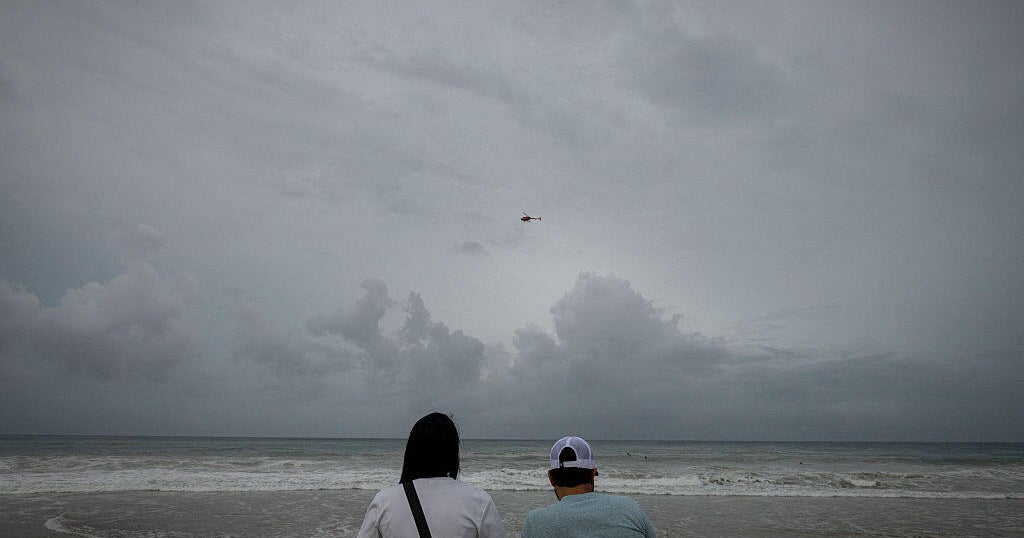
Hurricane Erin restrengthened back into a Category 4 storm Sunday night as it churned over the Atlantic Ocean north of the Caribbean.
Erin, the first Atlantic hurricane of 2025, exploded to Category 5 on Saturday before weakening to a Category 3 storm early Sunday morning and regaining strength later in the day. As of 11 p.m. ET, Erin had maximum sustained winds of 130 mph. The storm’s center was about 130 miles east-northeast of Grand Turk Island and about 965 miles south-southeast of Cape Hatteras, North Carolina. It was moving northwest at 12 mph.
Still a major storm, a Category 4 hurricane is defined as having maximum sustained winds from 130-156 mph.
Erin is expected to remain powerful for the next several days, forecasters said. Tropical storm warnings were in effect for Turks and Caicos and the southeast Bahamas, the National Hurricane Center said. The central Bahamas, the North Carolina Outer Banks and Bermuda should monitor the progress of Erin as the storm is likely to remain a dangerous major hurricane through the middle of this week, the center said Sunday night.
A tropical storm warning means tropical storm conditions are expected somewhere within the warning area. The NHC said Turks and Caicos would see tropical storm conditions overnight, while the southeast Bahamas would see tropical storm conditions overnight and into Monday.
“You’re dealing with a major hurricane. The intensity is fluctuating. It’s a dangerous hurricane in any event,” said Richard Pasch of the National Hurricane Center.
Earlier Sunday, while Erin’s maximum winds diminished, the storm’s overall size grew. Winds and heavy rains were whipping the Virgin Islands and Puerto Rico throughout the day.

A satellite image of Hurricane Erin as it churns in the Atlantic at 8:20 p.m. Eastern Time on Aug. 16, 2025.
NOAA
Heavy rain battered Puerto Rico on Sunday, and up to 2 inches of rainfall was still expected across the Virgin Islands and Puerto Rico as of Sunday night. Turks and Caicos and the eastern Bahamas, including San Salvador Island, could see up to 6 inches of rain through Tuesday, forecasters said. Flash flooding, landslides or mudslides are possible.
The storm wasn’t expected to directly impact the U.S. East Coast, but by doubling or tripling in size, it significantly increased the risk of life-threatening surf and rip currents all along the Southeast coast. Gusty winds and flooding tides could wash out parts of the highway that connects the North Carolina Outer Banks by midweek, the National Weather Service said.
What is an eyewall replacement cycle?
The hurricane center said Saturday night that Erin was undergoing an “eyewall replacement cycle,” which, according to CBS News meteorologist Nikki Nolan, is when the storm has become so significantly powerful that its eyewall, its strongest part, reaches maximum strength.

This shows the eyewall replacement cycle for Hurricane Erin.
CBS News
When this happens, Nolan said, the eyewall itself becomes so intense from intaking the available energy from its environment that a new eyewall will begin to build on the outside of the existing, inner eyewall. Once the new eyewall is created, it cuts off the fuel to the original eyewall.
Furthermore, as the new eyewall gains strength to keep up with the power of the storm, the radius of the eye itself will become much larger than it originally was, Nolan said.
This process may cause the storm to weaken temporarily, and its wind speeds may slow as it regains strength.
Erin’s restrengthening into a Category 4 storm came after an eyewall replacement cycle, the National Hurricane Center said.
Maps show Hurricane Erin’s forecast path
Erin’s path continued to curve northward, with the center of the hurricane passing just to the north of the northern Leeward Islands and Puerto Rico.
The northern Leewards stretch from the Virgin Islands to Guadeloupe and include St. Martin, St. Barts and other islands.

A map shows the projected path of Hurricane Erin as of 5 p.m. EST on Sunday, Aug. 17, 2025.
CBS News
A “spaghetti map” of the forecast models shows the storm skirting the Caribbean islands and remaining well offshore of the U.S. East Coast as it moves north.

A “spaghetti map” shows forecast models of the path of Hurricane Erin as of Aug. 17, 2025.
CBS News
A high-pressure system in the Atlantic was expected to steer Erin away from the Eastern Seaboard while a cold front was also forecast to push the hurricane offshore, CBS News Bay Area meteorologist Jessica Burch reported.
On the U.S. Virgin Islands, officials with the National Park Service announced that sites on the island of St. Croix would be closed starting late Friday afternoon until after the storm passes.
First hurricane of the Atlantic season
Erin formed as a tropical storm on Monday west of the island nation of Cabo Verde, a few hundred miles off Africa’s western coast. It is the fifth named storm of the 2025 Atlantic hurricane season, which started in June and runs through November.
So far this year, Tropical Storm Chantal is the only one to have made landfall in the U.S., bringing deadly flooding to North Carolina in early July. In June, Barry made landfall as a tropical depression on Mexico’s eastern coast.
Erin’s increased strength comes as the Atlantic hurricane season approaches its peak in September. According to the hurricane center, most of the season’s activity typically happens between mid-August and mid-October. In the eastern Pacific Ocean, hurricane season starts on May 15 with a peak in activity typically seen in late August.

These are the names for the Atlantic cyclone names for 2025.
CBS News
The U.S. National Oceanic and Atmospheric Administration, or NOAA, forecast an above-normal season for the Atlantic this year, expecting between 13 and 18 named storms.
Tropical storms have maximum sustained winds of at least 39 mph. Forecasters with NOAA anticipated that between five and nine of the storms this year could become hurricanes, which have sustained winds of at least 74 mph. Hurricanes are rated on a scale based on their wind speeds, ranging from Category 1, the weakest, to Category 5, the most severe rating.
NOAA forecasters predicted there could be between two and five major hurricanes in the Atlantic this season.
contributed to this report.
More from CBS News