
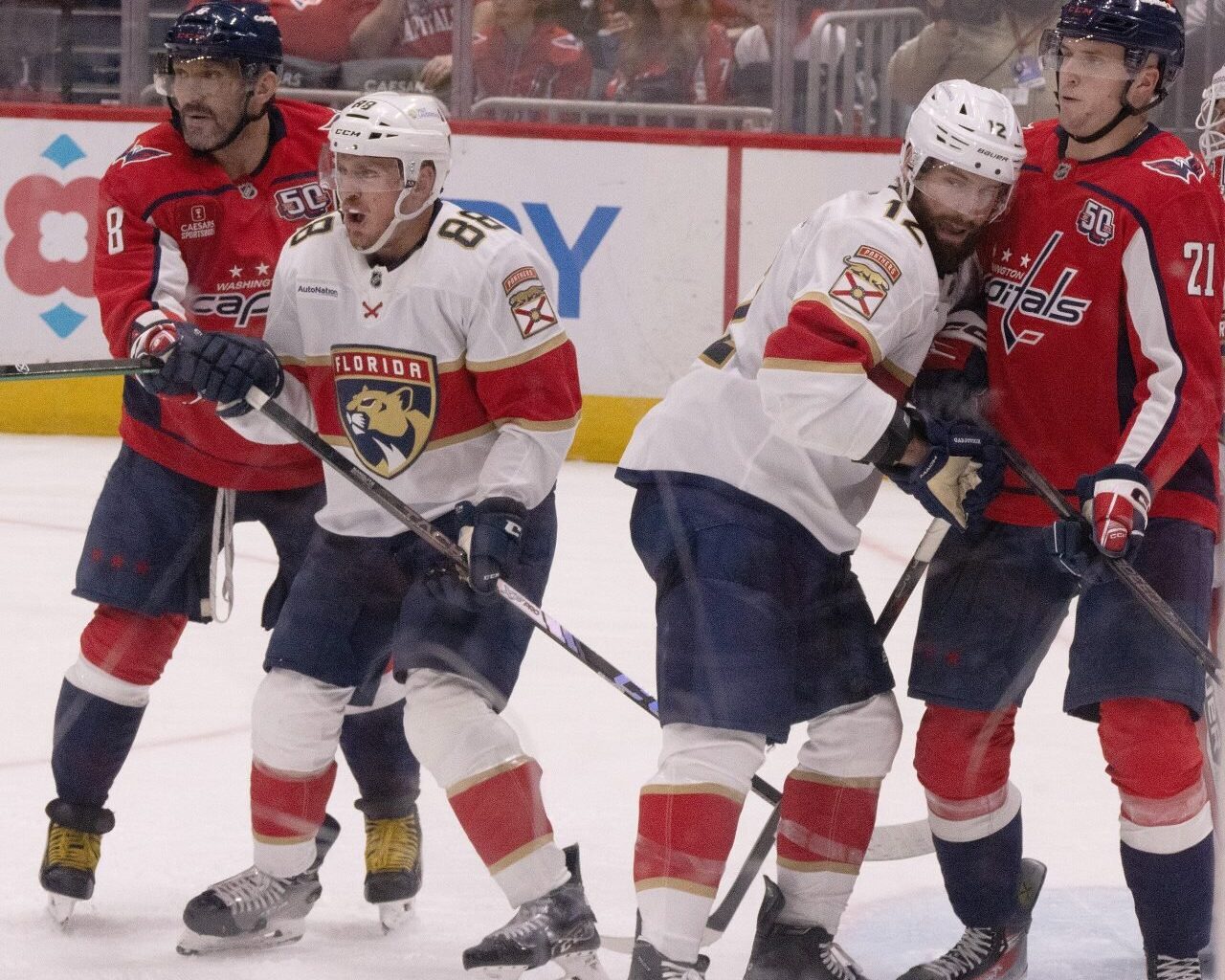
A self-congratulatory truism in the hockey world is that the Stanley Cup is the hardest major trophy to win. This is literally true, insofar as 82 to 110 games of full-contact skating cause untold amounts of immediate suffering, opioid addiction, and premature death. It is also true in the intended sense, as the insular character, relatively small markets, and tight salary cap of the NHL all maintain something much closer to league-wide parity than other, more popular North American sports can muster. Amidst this parity, a team has to be really, really good to win, even once. A team has to be phenomenal to win twice. The Florida Panthers, unfortunately, are that team.
Still, a casual fan would be forgiven for their surprise at seeing the Panthers and the Edmonton Oilers back in the Final (the first back-to-back since 2008–2009’s Red Wings-Penguins) had they only tuned in between October and April, a stretch in which both contenders alternatively phoned it in or wheezed through injuries for weeks at a time, each ultimately finishing third in their respective divisions. (Of course, the regular season–only fan doesn’t exist, and the casual observers who called a rematch would prove far wiser than the hockey heads.) What manifested as dull underperformance was really just the wisdom of teams experienced enough to know only to play hard when it counts. In the face of the slog, it made good sense to pay attention to more spectacular rises and falls. None of these stories was as exciting—for your author, at least—than the sudden revival of the Washington Capitals.
Since 2018, the Capitals have been a little lost. A nasty, unlucky seven-game series against Carolina pushed the reigning champs out of contention in the first round of the 2019 playoffs, and the team struggled through the Covid seasons and those that followed in a daze. One franchise player after another was claimed to long-term injury or the trade block, familiar and comforting names like Braden Holtby, TJ Oshie, Nicklas Backstrom, and Evgeny Kuznetsov disappearing from the lineup cards. Today only Alex Ovechkin, Tom Wilson, and an aging John Carlson remain. By 2023 the talking heads of the hockey world, who have always hated, denigrated, and failed to believe in the Capitals,1 were confidently declaring that Washington’s contention window was firmly and tightly shut. The Capitals’ 2024 playoff performance, when they squeaked in largely on the back of then-starting goalie Charlie Lindgren only to get swept by the Rangers in the first round, did little to quiet the doubters.
But in 2024–25, the Caps successfully pulled off the most difficult maneuver in pro sports: a genuine retool. A retool is a rebuild, but fast, with no mess, no painful contract dumping, no years of low-attendance humiliation, a U-turn out of the mushy middle without toe-dipping in rock bottom. While time will yet tell, coach Spencer Carberry’s greatest feat seems to be setting down the Ovechkin era with grace and dignity. The future looks bright in Washington, especially in the form of 6’6”, 250-pound Belarusian winger Aliaksei Protas.2
But the bigger story was Alex Ovechkin himself, who this season officially displaced Wayne Gretzky as the greatest NHL goal scorer of all time. Ovechkin is 39. He weighs 238 pounds, and while he is still strong, he is no longer fast, rocking an ever more protruding beer gut. (Ovechkin crushes Diet Cokes between shifts and never strays from his pregame meal of chicken parm from DC-area Italian fast-casual chain Mamma Lucia.) Ovechkin also scored 44 goals this year, the third most in the league, despite missing six weeks of the season with a broken leg. Is Alex Ovechkin “the greatest player” in hockey history? No, and I don’t care. Alex Ovechkin is a goof, a clown, a virtuoso, and a hero, the only one those of us unfortunate enough to be from our nation’s capital have, a player who’s given his all to a team that before him was little more than a sad joke.
A few other teams also improved. The Montreal Canadiens didn’t quite retool, but their short, irascible coach Martin St. Louis seems to have successfully accelerated the timeline of their long-awaited rebuild, which is also hard. The St. Louis Blues somehow dragged themselves into the postseason too, meandering through 2024 before stomping and smashing their way to April. The Toronto Maple Leafs clinched a division title for the first time since 2000 (excepting the scrambled divisions of 2020, a cursed win that resulted in little more than an epic meltdown against Montreal). Some teams got a bit better, but not enough, as the Columbus Blue Jackets and Calgary Flames both fell just short of the playoffs despite heroic late-season pushes.
More exciting, however, were the spectacular downfalls of the season, of which there were two for the ages. 2024’s regular season champions, the New York Rangers, seemed to just fucking explode. The Rangers entered the season as a lock for the playoffs, likely Cup contenders, and a reasonable bet to win it all. They had a few good weeks, and then the rails fell off. This once-dangerous team suddenly couldn’t defend, score, or even block shots, with marquee goalie Igor Shesterkin’s near-perfect numbers crumbling under a pile of high-danger chances. By November the team was 4-15-0 and had the distinction of losing to the lowest-standing team in the league twice in a week (first Chicago, then Nashville). This was a case of total system failure, as a bad coach, bad organization, and bad attitude in the locker room sent last year’s Conference Finalists into a tailspin.3 By the end of the season the Rangers had missed the playoffs, but the team hitting Cancun in May was unrecognizable anyway, scheming General Manager Chris Drury having taken a hatchet to the lineup. Captain Jacob Trouba was unceremoniously traded to Anaheim, followed by decade-plus team veteran Chris Kreider some months later; Drury also dumped former top prospects Kaapo Kaako, Filip Chytil, and K’Andre Miller. (A testament to abysmal player development: not a single Rangers first-round draft pick of the last decade remains on the team.)
One man linked the Rangers’ struggles to the season’s other epic meltdown. While it remains a bit of a mystery, something happened at training camp between then-Vancouver Canuck-now-Ranger J. T. Miller and still-Canuck Elias Pettersson. Miller, known for being a gigantic asshole, allegedly found Pettersson’s commitment to fitness (or perhaps toughness) insufficient and sought to motivate him with a barrage of homophobic slurs. Instead he detonated the team, and by February had been traded to New York, Canucks’ management having lost hope in any kind of reconciliation. The Canucks still missed the playoffs. Entitlement sucks, but mediocrity sucks more, and even if it’s peppered with a bit of schadenfreude, I admit that I’m a little disappointed to see once-competitive teams like New York and Vancouver wallow down below with the likes of Detroit, Anaheim, and Seattle.
J. T. Miller had one other shining moment. In an incredibly rare PR win, the NHL dispensed with the pointless and boring All-Star Game in 2024–25, replacing it with a short and unexpectedly politically charged international tournament. An Olympics teaser (2026 will be the first Olympics featuring NHL players since 2014), the ludicrously titled Four Nations Face-Off pitted the USA, Canada, Sweden, and Finland against one another in a round robin. (Russia is still banned, and the Czech Republic and Slovakia couldn’t field a team’s worth of active NHL players.) Scheduled during the All-Star break in mid-February, the best-on-best clash also coincided with the rollout of Trump’s tariffs and the disenchantment of lands south of the border for our northern neighbors. Cue the booing of anthems in the stands (the Swedes and Finns were mostly left alone in this regard) and the throwing of fists on the ice. The first nine seconds of USA versus Canada featured no less than three fights, as one by one Matthew Tkachuck squared up to Brandon Hagel, his ugly younger brother Brady dropped the gloves with Sam Bennett, and J. T. Miller made sure to pummel Colton Parayko too. As the brothers Tkachuck would later gleefully reveal, much to Miller’s consternation, the three meatheads plotted the fireworks in a group chat. Team USA won that game only to lose the final, as Team Canada’s (and St. Louis’s) villainous goalie Jordan Binnington stood on his head and carried the maple leaf to victory. Cue Mark Carney: “In trade as in hockey, Canada will win.”
The Four Nations Face-Off was great if slightly horrifying TV, but it’s an experiment unlikely to be successfully replicated. There’s a reason that international tournaments don’t usually play by NHL rules, and that’s because European players understandably don’t like getting the shit kicked out of them by Minnesotan or Manitoban goons. This was evident in the comparatively tame, skills-focused Sweden-Finland games, largely ignored by the world beyond the Scandinavian peninsula. (There will be no fighting in next year’s Olympics, or in 2028’s returning World Cup of Hockey, and even the hits will much more closely refereed than the bell-ringers handed on out a regular basis on this side of the Atlantic.) Still, it was reminder that the NHL can do nice things—the 2026 All-Star Game, set for Long Island, has been mercifully canceled, much to Kathy Hochul’s chagrin—and that the stakes of a game can be much higher than the vying dignities of Winnipeg and Dallas.
Every year the season churns on interminably, and then every year it abruptly comes to an end. After a short break, the completely different sport known as playoff hockey begins. The first round is often perversely the most fun. The heaviness of expectations and the levity of possibility warp spacetime, making every win feel both satisfying and insufficient, like candy, and every loss feel both nauseating and not quite dread-inducing, also like candy. There’s something particularly rewarding about the matchups that are simply too good for round one, a simultaneously unfortunate and thrilling aspect of the NHL’s despicable playoff format.4 So it was with the Dallas Stars and Colorado Avalanche, two of the 2020s’ perennial contenders with a newly personal rivalry. This spring, in a retrospectively world-historically stupid decision, the Avalanche surprise-traded Finnish superstar Mikko Rantanen to the Carolina Hurricanes, only for him to turn his nose up at the ever-unpopular Raleigh (more on that later) and get deadline-traded to Dallas. Though the Avalanche made acquisitions of their own, they would rue this day: in game seven Rantanen would erase a two-goal Colorado lead, score a hat trick, and push the Stars on to round two, ending his former teammates’ season in the process.
Due north, where the league-best Winnipeg Jets faced the wildcard St. Louis Blues, something stranger was going on. The Jets had soared through the season largely on the back of Connor Hellebuyck, nominally the best goalie in the world. But Hellebuyck is that rare, sad dove, like Aaron Judge or Bush-era A-Rod, whose regular season brilliance fades out like a busted lightbulb come playoff time. He gets nervy, and when he gets nervy the Jets get bad. Hellebuyck has been public about his mental health struggles, even penning an uncannily named children’s book, Bucky Beats the Blues, but the block is still there—he simply can’t win a playoff road game. The Jets-Blues series bounced back and forth across the border, each team demolishing the other on home ice only to get sledgehammered in turn. Lucky were the Jets to host game seven, but by the third period the situation looked dire: Hellebuyck had allowed three goals, and the coldhearted Binnington seemed unbreakable in the other net. What followed was quite possibly the most riveting hour of play I have ever seen, as the Jets battled to score twice in the final two minutes and again in double overtime, sending them on to round two.
And then some of these series just fizzle and thud. Innumerable Athletic staff writers picked the Tampa Bay Lightning, a team that has mortgaged its entire future in draft capital on winning now (an act of unconscionable greed considering their back-to-back Cups in 2020–21), to win it all, only for the defending champs to shellack them in five games. Sometimes the most dangerous opponents are your own demons, as the Maple Leafs very nearly fumbled a 3–0 series lead over the Ottawa Senators, only to right the ship before complete disaster and win in six games. Mostly it was somewhere in between: the Hurricanes abused a limping New Jersey Devils team, the Vegas Golden Knights topped a battling but overmatched Minnesota Wild, and the Capitals knocked around a Montreal team half their age and size. Up 2–0, the Los Angeles Kings looked like they had the Oilers on the ropes, only for Edmonton to drag them in four games straight.
Barring an exceptionally uneven matchup, the second round trends toward trench warfare, at least for the viewer. Most brutal of all was Caps-Canes, a pairing cooked up in hell. The Hurricanes play an analytics-first style of hockey politely described as unbearable, wearing the opposing team down with an aggressive forecheck and constant stream of low-quality shots. Unless you are for some reason a Canes fan and like to see them win, this makes for a watching experience that is simultaneously stressful and supremely boring. This system, and coach Rod Brind’Amour’s consequent hostility towards superstar showoffs and player creativity (often one and the same), has in concert with its universally despised facilities5 given Raleigh something of a reputation. The Canes’ higher-scoring but lower-speed division rivals in Washington went to pieces and had to be bailed out again and again by maverick goalie Logan Thompson, whose heroics weren’t enough to compensate for a paltry team effort in game one. Game two went a little bit better, a John Carlson power play goal sealing the deal for the Capitals—what year is it, asked your author?—but down south the wheels truly fell off. Game three quite literally made me vomit, and game four wasn’t much better. In game five, the Capitals rallied after going down a goal and seemed to have the game within reach following greasy goals from deadline acquisition Anthony Beauvilier and workaday forward Nic Dowd, only for Dowd’s goal to be called back after a hated offside review. A late winner from Andrei Svechnikov, the closest thing Carolina has to a “hockey star,” put it away. Well, shit. There’s always next year.
Out west, the Oilers rolled on, seemingly unstoppable in the wake of their comeback series victory over LA. Vegas, another sportswriter favorite, got flattened, only taking one of the five games thanks to a freak own goal by Edmonton’s other star winger, Leon Draisaitl. Jets–Stars was ripe for another Hellebuyck foot-shoot, Winnipeg losing the first at home and remaining unable to win on the road, despite posting two shutouts at home. In game six, on the brink of elimination, the Jets seemed poised to quiet the doubters once again: Hellebuyck was dialed in, allowing only one tough shot in three periods of play; Winnipeg forward Mark Schiefle, whose father died that morning, not only took the ice but scored his team’s only goal. Then, right in the final moments of the third, Schiefle took a tripping penalty, and within two minutes of overtime the Stars scored a power play goal. In truth, that should have been a penalty shot, a rare occurrence in playoff hockey, which would have offered Hellebuyck’s greatest opportunity yet to choke or self-redeem. As usual, we—the public—were robbed.
The best fight of round two, for those without dogs within, was unequivocally Florida–Toronto. The Maple Leafs are chokers. It’s who they have been, who they are, and who they will always be. And yet the thing about being a playoff choker is you’re always just that close to rewriting the narrative. This was Toronto’s best shot this side of 9/11, and they completely blew it.
Toronto came out the gate hard, edging out the Panthers 5–4 despite starting goalie Anthony Stolarz being taken out of the game by a stray elbow from notoriously dirty Florida center (and eventual playoff MVP) Sam Bennett. Same story in game two, minus Stolarz, now on concussion protocol. By game three the Panthers had regained some momentum, an overtime goal from former Bruins captain and trade-deadline-acquisition-of-all-trade-deadline-acquisitions Brad Marchand winning the night. Two nights later they shut Toronto out, goalie Sergei Bobrovsky looking more and more like the machine of the year prior. Game five, back in Toronto, was pure humiliation: by the end of a 6–1 loss, Leafs fans had escalated from booing their own stars to tossing their (very expensive) jerseys and beverages onto the ice. And yet the Leafs put up an improbable shutout of their own in game six, the till-then absentee Auston Matthews scoring his first goal of the series and forcing a game seven at home—maybe this was the worst option of all. Only a shift at the gumball factory poses a choke risk greater than game seven, and this iteration of the Leafs have lost every single game seven they’ve played. When the stakes are highest, cue “Yakety Sax.” The final score: 6–1, again.
In an act of silent protest, I refused to watch the Eastern Conference Final. I wished desperately for the Hurricanes to embarrass themselves again (in 2023 they got swept by the Panthers), as much to discourage their irritating style of play as out of loser’s resentment; still, I couldn’t in good conscience root for Florida either. The Panthers walloped them, handily winning every game but one, an obvious rest day, by several goals, and I can’t help but think that my Capitals would have had a better shot against the Floridian juggernaut (though they would have still lost). Where the Canes forecheck hard, the Panthers forecheck harder; faced with a team that plays their way, but harder, Brind’Amour’s system collapsed. So much the better, but at what cost?
The Western Conference was decided in five games too, but a world of difference separated this gentleman’s sweep from its eastern cousin. There’s something funny about the Oilers, and that’s their starting goalie, Stuart Skinner. An Edmonton native and the youngest of nine children, all of whose names begin with the letter S, Skinner is perhaps the most wildly inconsistent starter to ever take the ice for a Cup-contending team, entering the Conference Final with a game-by-game save percentage that was either well below 0.900 or simply 1.00—that is, a shutout. (Most elite goalies average out in the mid-low 0.900s.) Stranger still is that Skinner’s Jekyll-and-Hydeism seems to have no real basis in the game at hand; you either get the good Skinner or the bad Skinner, and in a tight goalie market the Oilers have no choice but to roll the dice. Game one was bad Skinner, compounded by stupid penalties, as the Stars put away three power play goals in just over five minutes. Then Skinner stopped every single shot he faced in game two and was more than good enough in games three through five, which were Oilers hockey at its best: big, showy blowouts equally full of mean, dirty play and dazzling feats of skill. Their earlier victories could offer little to the reeling Stars, their third Conference Final loss in a row (and the inexplicable decision to trash his goal to the postgame media) triggering coach Peter DeBoer’s firing within the week.
And so the stage was set for 2024 redux, a clash as inexorable as the fiery demise of the Molotov-Ribbentrop pact, an outcome so obvious that nobody predicted it. These were in large part the same teams as last year. Aside from a few bottom-six players poached on the open market the summer before, neither team had really lost anyone of great significance either. The Oilers’ roster might have been a tad shallower on paper, but it was the depth players, not the greatest-and-second-greatest-in-the-league duo of McDavid and Draisaitl, who really won the series against LA, Vegas, and Dallas. A two-goal game for Adam Henrique? Who?
By puck drop I had moved from acceptance to joy, this being the most exciting matchup possible after the travesties of the second round. Arriving at a real-deal Rangers bar and getting the worst service I’ve ever received there, probably because of my Capitals hat, I wasn’t to be disappointed. The mutual hatred was palpable from the anthems on, the Oilers glowering while the Panthers smirked—Marchand rakishly, Evan Rodrigues lewdly, with a disgustingly smug mastication of his mouthguard. I knew the Oilers’ controversial enforcer Evander Kane was itching to renew his yearslong battle with Florida’s even more detestable Matthew Tkachuck. The personalities are what really make the game sing, but on a structural level, these teams were destined for each other. Like the proverbial unstoppable force and immovable object, their well-balanced admixtures of skill, speed, and goonery—and polar-opposite systems emphasizing high-impact offense and shutdown defense, respectively—make this great, great hockey.
Game one was a barnburner. Draisaitl opened the scoring with an absolute beauty, goalie-killer Sam Bennett tied it up, Marchand extended the Florida lead, Bennett again, the Oilers crawled back, the Oilers tied it, and Draisaitl scored again in the last minute of overtime. Ditto for game two, the lead changing hands again and again, the aged Corey Perry tying the game up in the dying seconds of the third, and Marchand winning the day and tying the series in double overtime. Game three not so much, aside from an Evander Kane-led line brawl, as a classic Stuart Skinner flopjob handed the Panthers five goals towards a 6–1 win (in went ever-dependable backstop Calvin Pickard). I tuned into game four from enemy territory (North Carolina) with my Lightning-fan-turned-Oilers-bandwagoneer cousins. After the first period ended 3–0 Florida and Skinner was pulled once again, I gave up and walked down to the beach. When I got back, the score was 4–3 Oilers. By the time I sat down to watch the final minutes it was 4–4, Sam Reinhart having snuck one little goal past Pickard with twenty seconds to go. Draisaitl conjured the overtime winner again and tied the series once more.
Back home for game five in a tied series, you’d think the Oilers would be feeling their oats, as the saying goes. This time last year they certainly were—the Oilers lost the first three straight in 2024, only to bounce back from the brink with an 8–1 homicide in game four, a competent win in game five, and another blowout in game six. They very nearly became the first team since the 1942 Maple Leafs to force a game seven and win after going down 3–0, only to lose an incredibly tight elimination game 2–1. The defense-minded Panthers, to their credit, calmed themselves after three all-time routs and played their system perfectly. This year’s Oilers weren’t up against the wall in the same way, and maybe that was a weakness, not a strength, because game five sucked. Pickard started instead of Skinner and immediately threw his reputation in the trash, letting in three goals before Connor McDavid scored his first of the Finals. Still, number 97 couldn’t defibrillate his team singlehandedly and the Oilers failed to close the gap, the orange-and-blue faithful drunk-driving their GMC Sierras back to St. Albert, Sherwood Park, and Fort Saskatchewan in bitter disappointment.
Game six, back in Florida, facing elimination: time to lay it on the line. (Those in Canada, and those illegally streaming Sportsnet, were repeatedly assaulted this spring by an NHL commercial featuring forgettable Canadian ’70’s hard-rock band Triumph’s “Lay it on the Line” —the motor-oil riff remains wormed in my brain.) The Oilers seemed to miss this part, Panthers forward Sam Reinhart opening a personal four-goal night with a freakish mid-fall wrister. Skinner, back in to start, did his best to stabilize as the Oilers pushed back, but his vastly superior opponent in net, Bobrovsky, ensured this was nothing doing. The horrid Tkachuck tipped in a long shot from Anton Lundell just before the first period ended. Neither of these goals was Skinner’s fault; not so for the next, as he fumbled a rebound and served Reinhart his second on a silver platter. Skinner fought hard for a couple of big saves after that, but with just almost seven minutes to go the Oilers emptied their net in a desperate hope of crawling out of their three-goal hole. About thirty seconds later Reinhart completed his hat trick with an empty netter. Skinner stayed out, and after another minute and a half Reinhart scored on the empty net again. Skinner went back in, pointlessly, and Vasily Podkolzin chopped in one face-saving goal for the Oilers while the Panthers danced them across the ice for the final minutes. The celebrations started before the clock ran down, the dejected Oilers traipsing off the ice long before the Cup was wheeled out.
At first it was great, then it was terrible, and finally it was simply boring. I can acknowledge that the Panthers are one of the greatest hockey teams ever put together in the salary-cap era, but that doesn’t mean I like to see them winning, especially when they avariciously show no sign of letting up anytime soon. (Consider the recent signing of 37-year-old Marchand to a six-year deal.) The Oilers lost this series for themselves, but I’m not sure anyone else would have had a better chance. Call me a small-r republican—I don’t think dynasties are good for sports. Worst of all is that while this year’s playoffs were worse than last’s, if the metric is competitive series and not high ratings in Sunbelt growth markets, next year’s stand to be worse still. Several apparent contenders are sure to be weaker teams, most notably Toronto, Tampa, and Winnipeg, and the “winners” of offseason trades and signings are almost exclusively despicable franchises like Vegas and Carolina. Still, while the mantra that “there’s always next year” is hardly soothing, there is (probably) next decade, when Bobrovsky, Marchand, Tkachuck, McDavid, Draisaitl, and Skinner will all be retired or sundowning, barring new advances in sports medicine, and we can eagerly sit down to watch San Jose face Montreal in 2035.
If you like this article, please subscribe or leave a tax-deductible tip below to support n+1.