
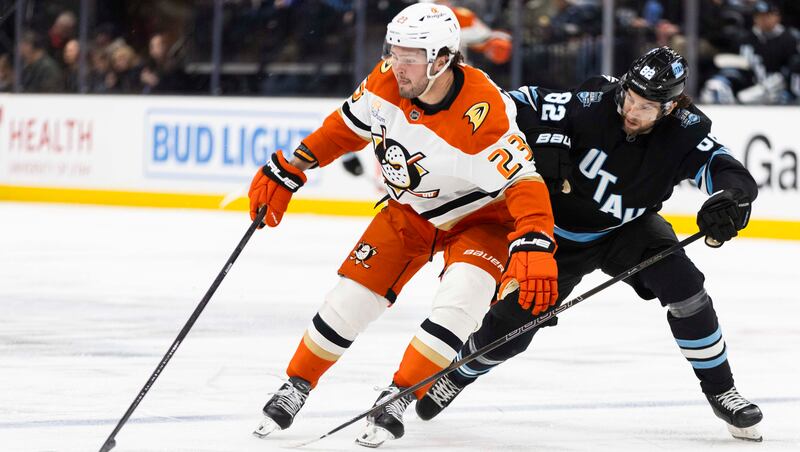
The biggest piece missing in the Utah Mammoth’s Stanley Cup contender puzzle is a No. 2 center. They have a few guys coming up through the ranks that could eventually fill the role, but it would be better to have someone in the same age group as their current core.
Enter Mason McTavish.
Advertisement
McTavish, the third-overall pick in the 2021 NHL draft, has been at the heart of plenty of trade rumors this summer after a stall in his contract negotiations with the Anaheim Ducks. Ducks GM Pat Verbeek has not been afraid to move on from his young stars in the past (Trevor Zegras, Jamie Drysdale) — and they say the surest predictor of the future is the past.
McTavish checks all of Utah’s boxes:
He can boost the power play.
He’s in the Dylan Guenther/Logan Cooley/JJ Peterka age bracket.
He’s won gold medals and championships at a number of levels.
The 22-year-old amassed 22 goals and 52 points in 76 games last season, and his production really ramped up in the back half of the season.
He’s perhaps best known for his goal-line save in overtime of the gold medal game at the 2022 World Juniors. His save kept the play alive, allowing his teammate to score the tournament winner a minute later.
Advertisement
Those types of storylines are typically reserved for movies, but this one happened in real life.
Where would Mason McTavish fit in Utah’s lineup?
As the Mammoth’s roster is currently constructed, the four centers, in order of the depth chart, are Logan Cooley, Barrett Hayton, Jack McBain and Kevin Stenlund. Adding McTavish would bump Hayton to the 3C position, which is likely where he’d fit best on a Stanley Cup-caliber team.
It would also give Utah the luxury of playing McBain as a winger. That’s significant because he’d essentially be a backup center, meaning he’d be available to take face-offs when the usual center is kicked out and he’d be able to slot back into the middle in the event of an injury.
Advertisement
In terms of McTavish’s playing style, he’d fit well between playmaking wingers such as Clayton Keller, Nick Schmaltz and JJ Peterka. He’s a great finisher with roughly 90th-percentile stats in most tracked shooting categories. He just needs someone to dish him the puck.
While McTavish does score on his fair share of one-timers and midrange wrist shots, many of his goals come from rebounds and deflections. He’s a bulky guy who’s hard to move from the front of the net, and he uses it to his advantage.
That would specifically help Utah’s power play because none of their high-end forwards are particularly big guys. It’s usually Hayton who plays that net-front spot on PP1, but McTavish might be better suited in that role.
Advertisement
Imagine a Mammoth forward group like this:
Keller — Cooley — Guenther
Schmaltz — McTavish — Peterka
Crouse — Hayton — McBain
Kerfoot — Stenlund — Tanev
What would it cost for Utah to get Mason McTavish?
There are two ways the Mammoth could get their hands on McTavish: trade or an offer sheet.
Utah GM Bill Armstrong has stated in the past that he’s not all too interested in offer sheets, considering how vulnerable his team could be to get revenge-offer-sheeted with six first-round draft picks currently pushing to make the NHL. Besides, the compensation he’d owe the Ducks might be more than he’d want to give up.
Coincidentally, the two most recent trades involving young, promising forwards have involved either the Mammoth or the Ducks. The Mammoth took Peterka off the Buffalo Sabres’ hands for a pair of roster players and the Ducks shipped Zegras to the Philadelphia Flyers for a roster player and two draft picks.
Advertisement
Other comparable players who have recently been traded include Dylan Cozens, Fabian Zetterlund and Kaapo Kakko.
In all five cases, the fanbase losing the best player has reacted in a “that’s it?” manner upon seeing the return.
Of course, supply and demand could drive up McTavish’s price. There are reportedly more than a few teams interested in him, so regardless of what’s happened in the past, it could simply come down to who wants him the most if the Ducks are indeed looking to move him.
Seeing as the Ducks’ stated goal is to make the playoffs this season, it’s likely that they’d prioritize players who can contribute now — similar to the Sabres in the Peterka deal — over draft picks and far-out prospects.
Advertisement
Mason McTavish’s Utah connections
As is usually the case when a player gets traded, McTavish would have a few familiar faces in the Mammoth locker room:
He played with McBain on Team Canada’s 2022 Olympic squad.
He played with Guenther at the U17s and the U18s.
He has also played with Oscar Plandowski, son of Utah’s director of amateur scouting, Darryl Plandowski, and he shares an agent with McBain, Hayton and Tucson Roadrunners forward Curtis Douglas.

Bill Armstrong, general manager of the Utah Hockey Club, speaks to the media at the Delta Center in Salt Lake City on Wednesday, Sept. 18, 2024. | Laura Seitz, Deseret News