
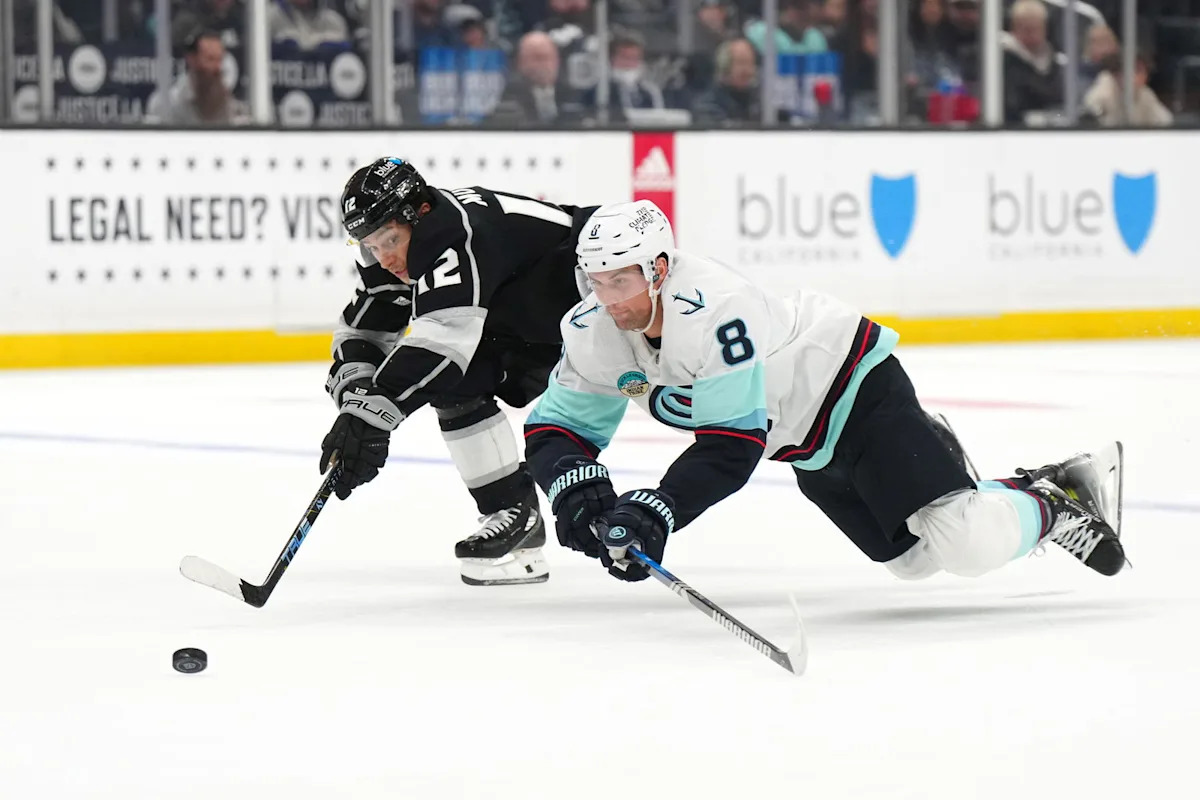
EL SEGUNDO — The Los Angeles Kings enter the 2025–26 season with a reinforced forward group but a potentially obscure back end. For years, the Kings’ blue line consistently stifled opposition, boasting a formidable top four that handled top competition with ease. Faces have come and gone, for better or for worse, as it looks to be that LA will have to rely on a pairing of Drew Doughty and Mikey Anderson, two players who have formed one of the NHL’s most reliable shutdown duos, to do some serious heavy lifting.
As the Western Conference remains stacked with high-octane offenses, the Kings face a defining question: Can their retooled defense handle the load, or will the burden again fall on an aging Doughty and emerging captain-worthy Anderson to carry more than their fair share?
Advertisement
The offseason saw two notable departures for the blueline. Jordan Spence was traded to Ottawa, a move that has recently resurfaced due to footage of Ken Holland on the phone with Spence discussing the trade. Many were surprised as he looked like a long-term fit on the backend, a survivor of the heap of prospects displaced and dispensed over the last half-decade.
In all due respect to Spence, the more significant loss was to Vladislav Gavrikov, who departed via free agency to the New York Rangers, leaving behind a substantial hole in the second pair as the bona fide number three over the last two-plus seasons. Gavrikov, with Doughty injured for the first half of last season, mainly played as the one, not the three. To fill the void, Los Angeles turned to veterans Cody Ceci and Brian Dumoulin, both of whom bring NHL experience but also come with significant question marks.
With these changes, the Kings must decide whether Ceci, Dumoulin, or Joel Edmundson can seize the number three defenseman role outright, platoon it, or if they’ll need to break up their long-standing top pair to better balance their blue line.
The Current Defensive Landscape
Doughty remains the heartbeat of the Kings’ defense, logging heavy minutes in his mid-thirties while still being able to drive play and flashing the ability to quarterback a power play. Anderson has continued to grow into a stabilizing force: a smart, positional defender who makes Doughty’s occasional aggressive style work. Together, they’ve been tasked with neutralizing top lines from across the league over the last four years.
The Kings also have retained personnel from last year’s blueline in the form of renaissance man, Edmundson, and the potential future of the blue line in Brandt Clarke. However, the defensive corps is still in limbo on paper until a single game is played or a practice is conducted.
Advertisement
With Gavrikov gone, the Kings lost a left-shot anchor who could consistently eat tough minutes. Spence’s departure strips the lineup of a right-shot possession driver who was trending toward a breakout role.
In their place, the Kings are looking to trust: Cody Ceci, a 31-year-old right-shot defender with over 700 NHL games of experience, bringing reach, penalty-kill utility, a willingness to block shots, but a legacy of struggles against mid-to-elite competition. Then there’s Brian Dumoulin, a Stanley Cup winner in Pittsburgh and more recently, a veteran presence in Seattle, Anaheim, and New Jersey. At 34, he remains steady, experienced, and positionally sound, but lacks the foot speed he once had.
On paper, Ceci and Dumoulin offer a size upgrade, experience, and defensive acumen, albeit at a higher price tag, in place of the substantial ask for Gavrikov to have stayed. Can either truly shoulder the burden of a second-pair shutdown role, the bona fide number three role, or are the Kings heading into a platoon situation where neither is fully trusted?
Why the Number Three Defenseman Matters More Than Ever
The modern NHL is unforgiving to teams without blueline depth. In the West, the Kings face gauntlets like Connor McDavid and Leon Draisaitl, Nathan MacKinnon and Martin Necas, Roope Hintz and Mikko Rantanen, and Jack Eichel, Mark Stone, and newly acquired Mitch Marner. Asking one pair, even Doughty and Anderson, to neutralize all of that is not realistic across an 82-game season and particularly into the postseason.
Advertisement
A trusted number three defender allows for balanced deployments, keeping Doughty fresh for critical situations. At his age and recent injury history, his ‘freshness’ will be needed more now than ever. A number three also gives greater flexibility in pairings, letting their true lone offensive-minded defender, Clarke, develop without exposure to top opposition every night.
Adaptability is critical in playoff series, where coaches relentlessly hunt mismatches. In the past, the Kings have had reliability in Gavrikov and Matt Roy. Two solid pairings could be utilized with ease, with a fifth defenseman able to still contribute. The error or failing state of the past was that the Kings’ forward group lacked the depth and firepower to contend with the top teams in the West, but now that has changed into what might be their best forward group in the Blake-Holland era.
However, it came at a sacrifice, as the Kings look exposed on the backend. The Kings will need a competent defensive core despite having four excellent lines. At a minimum, they will need a reliable three, and likely a four.
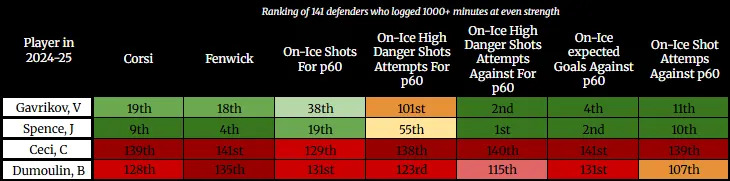
Player rankings in pool of the 141 defenseman who played 1000+ minutes of five-on-five last season, stats courtesy of Moneypuck.
Option One: Platooning Ceci, Dumoulin, and Edmundson
One solution is to accept that neither Ceci, Dumoulin, nor Edmundson will lock down the role completely and instead platoon based on matchups. Dumoulin has shown that he’s best deployed against heavier, slower forechecking teams where his positioning and experience shine. Ceci has barely tread water against mid-tier opposition but does boost shot blocking metrics (due to mostly getting caved in) and right-side stability if deployed on the third pair. He’s also had an uncanny ability to obtain higher-end minutes from past coaches despite the glaring on-ice results. Edmundson was excellent in a Kings uniform last year as the interchangeable four-five, thriving against lower-to-mid competition.
Advertisement
Despite the three options at the number three role being underwhelming, by alternating, the Kings could keep the three fresh, minimize their exposure, and lean on situational strengths. However, those strengths remain quite ambivalent when dealing with teams that have high-end, elite depth.
Option Two: Splitting Up Doughty and Anderson
The other option is more daring: break up the one pairing that has more minutes logged together than any other pairing possible for the Kings over the last half-decade. By separating Doughty and Anderson, LA could spread defensive responsibility more evenly. This could see the brushstroke of the future in real time: Anderson – Clarke, giving the young puck mover a steadying partner while easing his transition into tougher minutes. Then there could be a form of: Doughty – Dumoulin. This keeps Doughty in a leadership role but pairs him with a defensively inclined veteran who can cover when he activates.
Edmundson – Doughty, you may ask? Not likely. In 124:58 together last season, the pairing produced a 48.88% and 47.67% Corsi and Fenwick. They were outshot 54-64, even at goals scored, 4-4, but outchanced 57-76 (stats via NaturalStatTrick). Not horrific, but leaky in a smaller sample size.
Advertisement
This model of separation does, however, mirror what teams around the league have done, spreading their best defenders across multiple pairs rather than concentrating them. It also depends on late-game, critical situations where a team should load up. For the Kings, loading up might be the only solid pair on paper they have right now.
Special Teams Considerations
Ceci and Dumoulin will also impact the special teams dynamic, as both are no strangers to being a man down. Both veterans are natural fits, as their experience could ease Anderson, Edmundson, and Doughty’s burden on the PK. Despite some head-scratching results on the kill from both new arrivals, the Kings doubled their options on the PK from last season, as Spence was not the elite penalty-killing regular that Gavrikov was. In sum, the Kings received two questionable PK defenders at the cost of one excellent one.
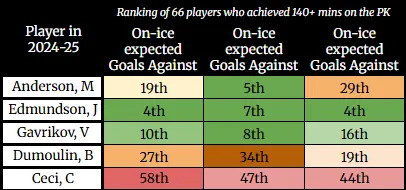
Player rankings in pool of 66 defenseman who played 140+ minutes of penalty kill last season, stats courtesy of Moneypuck
For the power play, it will be interesting to see if the team will continue to run the five-forward power play unit and see if Clarke and Doughty quarterback the second unit. A would-be mistake, if Clarke is not allowed to blossom in a role he saw positive results from while Doughty was out for the first half of last season.
Advertisement
Developmental Context
This season may be as much about Clarke’s growth as it is about Ceci or Dumoulin. The 22-year-old projects as a cornerstone, but whether he can step into consistent top-four minutes will shape the Kings’ entire defensive identity. Anderson is the natural partner to mentor him, but that also would require splitting up the top pair and having a reluctant franchise like the Kings to pass Doughty’s scepter, not baton.
Meanwhile, Ceci and Dumoulin represent degradable, short-term patches rather than long-term solutions. Their ability to provide eerily steady, if unspectacular, minutes may buy the franchise time and, more importantly, Clarke, to place pressure on the Kings’ coaching staff to embrace the future of the club.
My Take: Hybrid Strategy
While not the most appealing set of assets to work with, it does open up for a hybrid strategy. In divisional games against Edmonton or Vegas, Doughty and Anderson likely stay glued together to shoulder the toughest matchups. Against other clubs, splitting them to manage Clarke’s minutes and platooning the trio of Edmundson and Dumoulin at the three/four, while Ceci is given ‘pinch hitting situations’ and sheltered minutes as the five, could provide a better lineup balance.
Advertisement
The Kings’ success will hinge on whether Clarke accelerates into a top four role. If he does, Anderson-Clarke could emerge as a legitimate ‘pair of the future’ in its own right. If not, Los Angeles will remain overly reliant on a 35-year-old Doughty, and neither Ceci, Dumoulin, nor Edmundson is likely to fill that gap.
Conclusion: A Transitional Year on the Back End
The departures of Spence and Gavrikov stripped the Kings of stability and youth in the middle of their defense. The additions of Ceci and Dumoulin provide experience but also a dramatic flair of uncertainty. The team is attempting to replicate the supplemental renaissance that Edmundson enjoyed last season, but this time in a more exposed way. As a result, Los Angeles enters 2025–26 facing a central dilemma: either platoon the number three defenseman role between three veterans or split up Doughty and Anderson to better distribute minutes against elite competition.
Either path carries risks, but the outcome will likely define the Kings’ season. If Ceci or Dumoulin can deliver steady, mistake-free hockey, Edmundson can carry over his play from last season, and if Clarke makes the leap, the Kings’ defense could be deeper than expected. If not, the burden falls yet again on Doughty and Anderson, a dangerous gamble in a conference as deep and unforgiving as the West.