
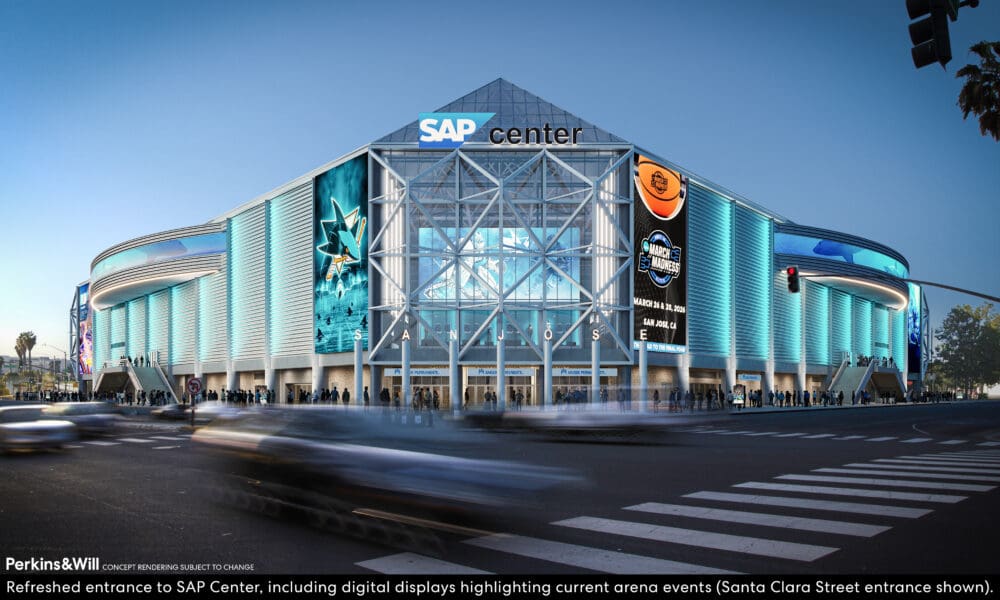
The San Jose City Council voted unanimously to keep the San Jose Sharks in San Jose through 2051 and approve funding for renovations of SAP Center.
They will also agree on a new arena site in 2027.
Following the vote, San Jose mayor Matt Mahan and Sharks Sports & Entertainment president Jonathan Becher spoke to media.
Here are the highlights from that availability and the day at City Hall.
“The Future Is San Jose”
The Future Is Teal has been the San Jose Sharks’ motto in their current era, with the excitement of Macklin Celebrini and their other prospects. At the City Council meeting, Becher introduced a new motto – “The Future Is San Jose.”
“You’ve likely heard us say over the last year, 18 months, that the Future Is Teal. That’s mostly a hockey saying, and that’s because we’re wildly, by pretty much any reporter, viewed as having the top prospect pool [in the NHL],” Becher said. “If this agreement gets approved, I think the same thing will be true of the arena and surrounding districts as well. We will pivot from saying the Future Is Teal to recognizing the Future Is San Jose.”
The Future is SAN JOSE!
🔗: https://t.co/E0z2OgXrH8 pic.twitter.com/5v8Tn6I4BJ
— SAP Center (@SAPCenter) August 27, 2025
SJ Sharkie was present at the vote and was shouted out in the audience by multiple councilmembers, as well as San Jose Mayor Matt Mahan, multiple times throughout the proceedings. Vice Mayor Pam Foley even joked, “You can’t say no to Sharkie.”
While the deal is between the Sharks and the City of San Jose, both Mahan and Becher emphasized the renovations are not just about hockey and hockey games. The goal is to attract more – and bigger ticket – events to SAP Center and the City of San Jose combined. The renovations will address issues like the layout of the ground floor of the stadium – which does not currently meet NHL standards – expanding the concourse area to prevent gridlock, adding a proper seating area for the visiting back-up goalie, and modernizing other elements of the Arena.
Jonathan Becher, on what the deal means to the organization:
“We don’t know exactly every renovation we’re going to do, but knowing that we got at least 25 more years in this building, knowing we have a chance to make it a world class facility again as it was when it first opened, it’s just feels like home. I think we’re still the only professional sports team born in San Jose, grew up in San Jose, and we’ve always wanted to stay in San Jose.”
Becher, on when he went from uncertainty about the deal to confidence it would happen:
“You asked me at the end of last the season, and I went from cautiously optimistic, where I’d been stuck for about a year to this will eventually get done. There wasn’t an exact date, but sometime in the January, February, March timeframe, there was a whole series of meetings where the big rocks mostly came together, and it was just small stuff. And there was a heck of a lot of small stuff. I mean, one thing the Mayor didn’t say on the stage is the collective agreements are somewhere between 350 and 400 pages, and so there isn’t one thing to trip you up. There’s just hundreds of clauses you have to read through that refer back to each other, et cetera. And we basically built a new agreement. And that’s just hard work, and it just doesn’t stop. And if you don’t get them all right, the rest of the thing doesn’t matter.”
Becher, on what one of the biggest issues with the deal was:
“From the city’s perspective, what came out later was their biggest issue was their budget over the next couple of years. And I get we didn’t know that until more recently and when that became ‘We can solve that problem for you.’ Our situation, where we have a very generous owner, so if that’s your fundamental issue, let’s make that go away. And once that went away, a lot of other things became easier.”
Matt Mahan, on incorporating and supporting the communities and area around SAP Center.
“What we’ve been calling Sharks way, … we’ve got to do the tactical things. Lighting, SJPD foot patrols, public art, murals and statutes and things like that. The way finding, the signage, knowing where you are and where other things are, how to get around.”
“Along a few blocks of Santa Clara, you’ll see better maintained streets, a number of new murals, improved lighting. A number of buildings will be engaged property owners to clean up their properties and created a beautiful, walkable environment. We want to do that between all of our major destinations in downtown.”
Becher, on what upgrades might come first:
“Part of what we’ve got to do over the next six months is build ourselves a structured plan, because there are lots of things of priority, but there’s only so many days that we can actually get them done. And as this team gets better, there’s less and less days to get them done.”
“Not having events during the summer, which we do have events, means we reduce the revenue there as well. So that’s a Jenga puzzle that I don’t have an answer. We have outside advisors that are helping us do this, that have done this for other buildings. There’s one camp of thought that says, do the simple things first that are out of everybody’s ways, because you can just get stuff done. There’s others that say, no, go to the heart of the problem and solve the most complicated things first and get that out of the way.”
Becher, to those who believe the city shouldn’t pay for the Arena renovations when the San Jose Sharks have a billionaire owner in Hasso Plattner:
“I would say to remind them this isn’t our arena. It’s the city owned arena, and the vast majority of investments have actually nothing to do with hockey.”
“The things that were more hockey oriented, Hasso is funding.”
Mahan added that the Sharks have already invested tens of millions of dollars into SAP Center over the years beyond their obligations.
The initial presentation to City Council included comparisons to other recent arena renovations, and what percentage of those the local municipalities paid for. PNC Arena, Spectrum Center, and Delta Center all recently underwent similar renovations in terms of price tag, with the municipalities fully funding those projects.
“In many, if not most, of these publicly owned arenas, 100% of the cost of upgrades to just keep the facility modern, to just keep a team, to continue to book large acts, to continue to have crowds come and spend money, is 100% born by the municipality,” Mahan said.
Becher on the statements from the public and the councilmembers in support of the San Jose Sharks organization.
“The fact that like 20 people, or something like that, from pretty much all walks of life. I don’t like to say it very often, but I came close to tearing up a couple of times because you’re close to it. You live it every day. Sometimes you forget how much impact we have on the community. We like to think we’re good community citizens, but to hear it come back just reminds me why we do what we do and how much we love it.”
“And then to see it from the council members as well. Because there aren’t many things that go through, forget San Jose, just in general, City Council’s rarely vote things that are unanimous. Typically, there’s one side, another side. You know how politics work in America these days, and just seeing them all line up behind this was nice to feel.”