

With no football to feed, Blake Lawrence thinks DU hockey should continue to feast at the Frozen Four.
RELATED: Where Rocky Mountain athletic programs stand as NCAA revenue sharing era begins
“I would expect the gap to widen between schools that have hockey and no football program versus schools that have hockey and a football program,” said Lawrence, co-founder of Opendorse, a company that facilitates Name, Image and Likeness (NIL) and marketing opportunities for student-athletes. “Because of how much of the revenue-share funding goes through the football program.”
The House settlement this summer flipped the chessboard and the landscape in college sports. Scholarship limits have been removed. Roster limits have been established. And, most notably, universities may now share athletic department revenue directly with student-athletes.
Those payouts are expected to be tiered by sport. Per CBSSports.com, most universities are likely to follow a formula similar to those of back payments in the House settlement: 75% of the revenues to football players, 15% to men’s basketball players, 5% to women’s basketball players and the remaining 5% to the rest of the sports offered.
So, where does the majority of that money go when you don’t play football?
At most private universities of DU’s size and profile, that answer is usually men’s basketball. Yet the Pios are part of a unique subset where ice hockey drives the train. DU has won a Division-I-best 10 national titles, sells out Magness Arena with regularity and has a reputation as a reliable talent incubator for the pros.
“We know, ‘Hey, this is priority A,’” Peter Mannino, the former Pios goaltender and DU’s new assistant athletic director for NIL, told The Post earlier this month. “We’ve got to go through these top tiers, set up this strategy, which we’ve talked about, and then from there it trickles down. It doesn’t take away from anybody, but you brought up hockey, that’s one of them. And that’s really important as we strategize and talk to attack it that way.”
The Pios derive the vast majority of their men’s sports revenues from the teams that don’t play hoops. According to the most recent Equity in Athletics Disclosure Act (EADA) report provided by DU to the Department of Education for the 2023-24 fiscal cycle, the school collected $2.88 million from men’s basketball and $14.48 million from non-basketball men’s sports. As a private school, DU isn’t subject to state open-records laws.
“We have a handful of partners that are Division I non-football (schools), and there’s really no limit in terms of their potential,” Lawrence said. “If (a school) is going to spend $5 million on their hockey team, it should. If the economic upside is there for the brand, for the university, for the market, for the state, then that investment is well worth it — because you will be able to out-allocate (schools) where they have 75% of their funding going to football.”
Opendorse works with about 30 Division I men’s hockey programs, Lawrence noted. Most schools who’ve worked with Opendorse that don’t play football expect to spend from $100,000-$900,000 in revenue sharing on a men’s hockey roster to remain nationally relevant. To that end, Lawrence would advise DU to spend at least 10% of its expected revenue on student-athlete payments.
In its EADA report 2023-24, DU listed revenues of $51.5 million for that fiscal year. (The CU Buffs reported $146.6 million in revenues for ’23-24; CSU reported $50.3 million; UNC reported $21.7 million; Mines reported $14.8 million.)
“Half a million dollars in rev share budget can build a team that can get to the Frozen Four,” Lawrence said. “If you’re spending six figures a year on your men’s hockey program for rev share payments or NIL deals … you’re outspending 80% of the market. At the end of the day, in our data set, there aren’t million-dollar men’s ice hockey budgets floating around the country. It’s few and far between.”
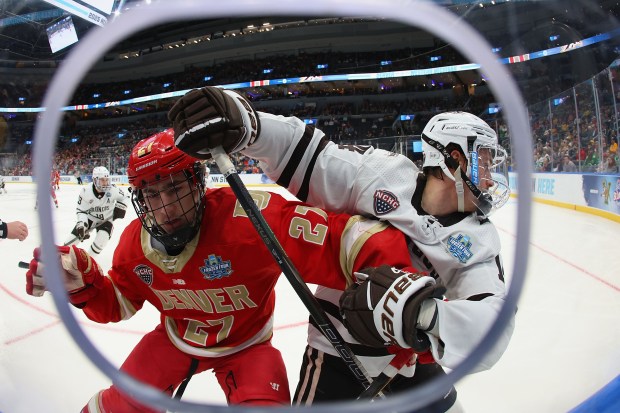 James Reeder (27) of the University of Denver Pioneers fights off Brian Kramer (14) of the Western Michigan University Broncos in the fist period of the Frozen Four semifinals at Enterprise Center on April 10, 2025, in St Louis. (Photo by Dilip Vishwanat/Getty Images)
‘We know what we stand for’
Josh Berlo has become something of a Pioneer in the collegiate revenue-sharing world as of late.
Earlier this month, the DU athletic director became the first at a full-time Summit League university to hire an administrator who’ll explicitly tackle NIL deals and revenue sharing.
“We know what we stand for,” Berlo told The Post recently. “And at a time where there’s a lot of chaos in college athletics and change — and much of it needed to happen, and much of it’s been very, very positive — knowing who you are, what you stand for, what your goals are, is a distinct advantage.
“We’ve also had the advantage because while we don’t have football revenues, we don’t have football expenses either … So we’ve been able to be thoughtful. And as we looked at that landscape, we are by no means intimidated by NIL. We are not intimidated by revenue sharing. We understand it’s going to be an element of our future success.”
Berlo said DU had discussed creating Mannino’s position for more than a year and a half prior to his hiring. The role for the ex-DU netminder will feature an educational component, working closely with DU’s Daniels College of Business and its Sturm College of Law, to promote entrepreneurship. Mannino will also work with Berlo on resource and revenue allocation for those NIL deals.
“(With) the contracts, all that type of stuff, (it’s) my job to educate them, be ahead of how we’re going to approach those things because there are a lot of questions out there right now with international (students), how you pay taxes, things like that,” Mannino explained.
“And absolutely, the coaches are going to be reaching out (to me). There’s going to be a ton of relationships there, where I’m in a complete collaboration with the entire athletic department.”
Athletic directors are charged with balancing the books, and bake sales won’t cover the tab. With revenue-sharing adding to their ledgers, universities have to try to lure more events to their respective venues as potential cash drivers. Berlo said the Pios want to “keep tickets affordable” while planning to be more aggressive — “entrepreneurial,” the AD called it — in lining up some splashy events going forward.
DU hockey will face Minnesota in the Hockey Hall of Fame game at Ball Arena in November, while Magness Arena will host a split-squad preseason game between the Avs and Utah Mammoth on the afternoon of Sept. 21.
“We’re leaning into those things,” Berlo said. “Again, doing it the ‘Denver Way,’ right? We’re not going to compromise what we seek to accomplish and our primary mission and goals, but (we’re) leaning into the entrepreneurial side of things while providing great value to the people who want to be a part of it and getting our donors to continue to support us. And we get tremendously supportive donors.”
 University of Denver Pioneers goalie Peter Mannino during a game against the Alaska Anchorage Seawolves at Magness Arena on Dec. 10, 2005. (Photo by Andy Cross/The Denver Post)
‘I don’t want to lose players because of money’
But the new normal isn’t cheap. While paying student-athletes was inevitable, doing so also opened Pandora’s box.
Top collegiate talent always had to be lured with perks. Only now said perks are above board, baked into the rulebook. Elite players, like elite coaches, are often swayed by the highest bidder.
Canadian winger Gavin McKenna, who’s expected to be the No. 1 pick in the 2026 NHL Draft, elected to play at Penn State for the 2025-26 season after an alleged tussle for his services. ESPN.com reported that the Nittany Lions arranged for a $700,000 NIL deal, while CollegeHockeyInsider.com reported that Michigan State was offering up to $300,000 for this season.
“You see rumblings, rumors of six figures for this player, that player. That’s not what we’re doing,” DU coach David Carle told The Post’s Corey Masisak. “There’s not any player on our team last year or this year that has been offered revenue share money, that has come here for revenue share. It’s not something that we are probably going to do this season.
“… I can’t say I want players to come to DU because of money. I don’t want to lose players because of money … it’s not like we just have $5 million sitting here to revenue share with student athletes.”
Fortunately for Carle, Lawrence doesn’t think DU will need quite that much to keep things rolling.
“If a men’s hockey forward in Division I is making $30,000 per year, they’re in the 95th percentile (of earners),” Lawrence said. “So if you want to have five forwards and you pay them like they’re among the top (earners) in the country, that’s $150,000, right?
“So then you do that across your defense, your goaltenders, and now you’re $450,000 in. I would hope that’s a winning formula.”
Want more sports news? Sign up for the Sports Omelette to get all our analysis on Denver’s teams.