
With the Calgary Flames in offseason mode and awaiting the NHL playoffs to come to a close, we thought it’d be a great time for another Offseason Mailbag to kick off the offseason. The Flames have a ton of cap space and a couple key players to sign this offseason, meaning there are plenty of big questions facing the team over the next few months. You asked, we answered below.
Is it time to reduce Mikael Backlund’s role?
Are we gonna talk about moving Backland to a fourth line role to develop younger players. Backs is a great player and aging. Move on from Rooney. Backs can still be up and downs the lines. Especially if we can find that young right shot centre.
Anderson is gonna get traded in…
— justistruth (@justistruth) April 28, 2025
At this point of his career, it absolutely makes sense for Mikael Backlund to line up on the fourth line of an NHL team. This past season was proof that Backlund’s days as a top-six centre are long gone. He can certainly stay afloat on a third line, but any contending roster very likely sees him lineup as their fourth centre in the rotation.
The problem is the Flames aren’t a contending roster, and they simply don’t have three centres better than Backlund. Nazem Kadri and Morgan Frost are the obvious top two options, but after that, you’ve got a duo of unproven AHLers in Rory Kerins and Sam Morton who certainly aren’t playing ahead of the captain.
The wild card is Connor Zary, and where the Flames decide to play him next season. Given his injury history, I think the team would rather ease him in on the wing over throw him to the wolves at centre. Unless the Flames move Zary to centre full-time or acquire a top-six centre this summer, don’t expect to see Backlund on the fourth line next year.
Looking at a Rasmus Andersson trade
I think there are two routes the Flames can take with a Rasmus Andersson trade return this summer. Option one would be to go all-in on future assets. The Flames should know well what that type of deal would look like. They made two such deals in the past decade, acquiring two top-four defencemen in Dougie Hamilton and Travis Hamonic for a first-rounder and two seconds. Any futures-laden deal for Andersson should be at minimum a similar value, whether that’s in the form of picks or prospects.
Option two is the blockbuster route. The Flames exceeded all expectations this past season, which has potentially bumped up their timeline. They also have a glaring need for high-end forward talent. Could they leverage Andersson plus some other future assets—like picks and prospects—to bring in a big-name forward who can help them right away? This would be the optimal route, but would of course be much harder to pull off.
Likelihood of the Flames trading into the top 10
First off, trading into the top 10 of the NHL draft is incredibly rare. Like, it pretty much never happens. In fact, the last time a top 10 pick was traded after it was confirmed to be a top 10 pick was 2013, when the New Jersey Devils traded their ninth overall pick to Vancouver for Cory Schneider. Since then, it hasn’t happened once, despite all the noise every year at draft time.
There’s also the fact that this year’s draft class is considered average at best. Outside of Matthew Schaefer and Michael Misa, there aren’t any can’t-miss prospects available. With that in mind, the only top 10 picks that I think are worth it are first and second overall. To get those picks would cost a small fortune. With that said, as long as the Islanders or Sharks aren’t asking for Zayne Parekh or Dustin Wolf, I’d make anyone else available for either first or second overall.
The odds of either of those teams wanting to trade out of the top two are slim to none, though, so I think it’s highly unlikely the Flames will be picking in the top 10 come June. If they can swing it, I’d be all in on a top two pick. Anything else probably isn’t worth it.
Does Dustin Wolf get extended this summer?

This is a great question. On one hand, Dustin Wolf was the team’s 2024–25 MVP, looks like a franchise goalie, and the cap is going to skyrocket soon. On the other hand, goalies are voodoo, and signing a young goaltender to a long-term deal after one good NHL season is a massive risk. Given Wolf’s track record, it seems likely that this past season wasn’t a fluke and he very much will continue to perform at a high level, but what if he doesn’t and he’s now locked down long-term and clogging up cap space?
The good news is the Flames don’t have to sign Wolf this summer, as he has another year before he hits RFA status in 2026. Signing him now would likely keep his AAV down by a considerable amount if he were to have another Vezina-level season, but it also comes with a lot of risk, as mentioned. I think it makes more sense to wait and see how Wolf does next season before handing him a big, long-term contract. It may end up costing the Flames a million or so a season, but it removes a lot of the risk of handing out a deal to a goalie with one NHL season under their belt.
What a Wolf extension might look like
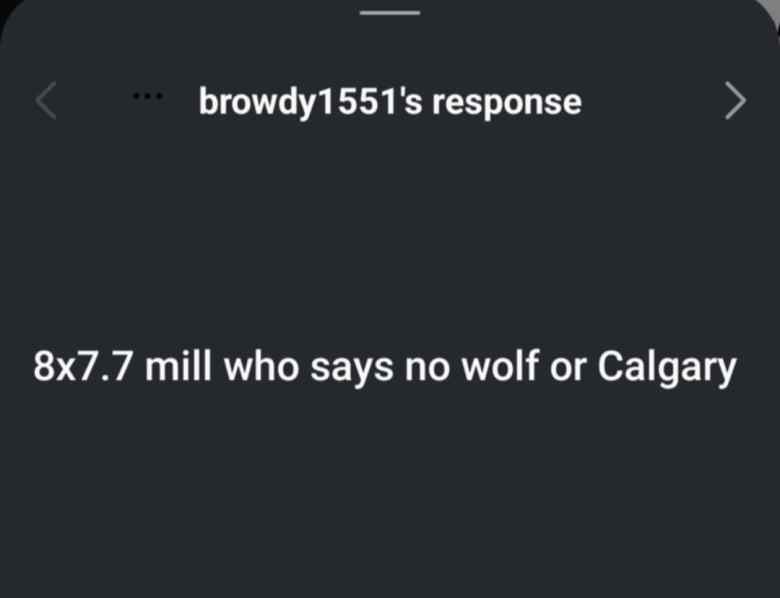
Continuing the Wolf discussion, if the Flames were to sign Wolf this summer, what would be a fair contract for the Calder finalist? I think the number you have here is quite rich, given Wolf has one year under his belt. I think the Flames would say no in this case, especially considering the sample size concern.
The closest recent comparable deals we can look to would be fellow 2019 draft pick Spencer Knight’s three-year deal that came with a $4.5M AAV signed in September, and Ukka-Pekka Luukkonen’s five-year deal carrying a $4.75M AAV that was signed in July of last year. Luukkonen, in particular, was coming off a 54-game, .910 save percentage season when he signed with Buffalo, which was extremely similar to Wolf’s output this year.
The problem with evaluating Wolf’s value is that there aren’t many other goalies like him. Rarely do we see a goalie his age accomplish this much already. I mean, he’s won WHL goaltender of the year, CHL goaltender of the year, AHL MVP, and is a Calder finalist before the age of 25. Luukkonen also signed at a time when the salary cap wasn’t projected to skyrocket over the next three years.
There are currently only five active goalies making over $7M, so it’s unlikely Wolf gets to that range after one season. I think if the Flames were looking to sign Wolf long-term this summer, we’d likely see a deal closer to the six to seven-year range, carrying an AAV right around $6 to $6.5M.
Related