

Explore the Vancouver Canucks’ challenges as Elias Pettersson seeks a comeback year under new head coach Adam Foote.
 Apr 6, 2025; Vancouver, British Columbia, CAN; Vancouver Canucks defenseman Elias Pettersson (25) handles the puck against the Vegas Golden Knights in the third period at Rogers Arena.
Photo Credit: Bob Frid-Imagn Images
Elias Pettersson enters year two of a massive eight-year contract worth $92.8 million. Rick Tocchet is out, and Adam Foote is in as head coach. It’s year one on the job.
The Vancouver Canucks missed the playoffs last season with a fifth-place finish in the Pacific Division. Now, Foote inherits a roster that isn’t much improved, and questions surround the production of his No. 1 center. Can Elias Pettersson revive his play? Is it enough to bring Vancouver back to the playoffs?
Can Elias Pettersson have a bounce-back year?
Elias Pettersson needs a comeback year. After two impressive seasons (102 points in 2022-23, 89 points in 2023-24), Pettersson scored an underwhelming 45 points in 64 games.
Pettersson’s numbers have been on a slow decline over the past three years, particularly his shot production. All Three Zones’ tracking data paints the picture. Despite being above average in shots per 60 in 2022-23 (0.92 z-score), he’s been below average the past two seasons (-0.40 and -0.34, respectively).
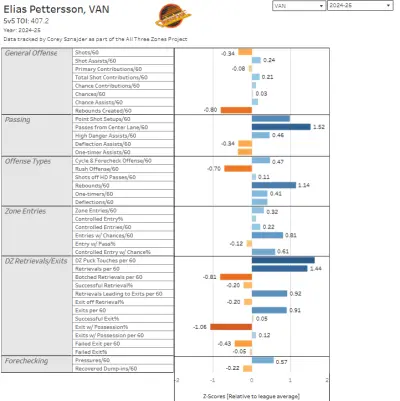 Elias Pettersson’s All Three Zones player card.
Why has Pettersson’s shot generation dwindled, and does it coincide with his point production?
One of Pettersson’s strengths is opening up space and creating plays. He’s also proficient at making plays around the net. Yet Pettersson struggles with carrying under pressure. Opponents can knock him off the puck with ease and beat him along the boards.
More Sports News
.wp-block-group__inner-container:has(> .embla),
.wp-block-group:where(.alignfull) > .wp-block-group__inner-container:has(> .embla) {
width: calc(100vw – (var(–side-spacing) * 2)) !important;
}
.embla {
position: relative;
overflow: hidden;
}
.embla__container {
display: flex;
flex-wrap: nowrap;
gap: 0 !important;
width: 75%;
}
.embla__slide {
margin-inline-end: var(–column-gap);
}
.embla__arrow,
.embla__arrow:active,
.embla__arrow:target,
.embla__arrow:hover,
.embla__arrow:focus-visible {
display: none;
position: absolute;
top: 50%;
transform: translateY(-50%);
width: 40px;
height: 40px;
margin: 0;
padding: 0;
line-height: 0;
background: rgba(255, 255, 255, 0.75);
color: var(–color-primary);
border-radius: 100vw;
svg {
width: 24px;
}
}
.embla__prev {
left: 0;
}
.embla__next {
right: 0;
}
]]>
Rick Tocchet was quoted as saying that he wanted to change the way Pettersson plays. Specifically, Tocchet wanted Pettersson to improve his offseason training as he believed that he needed to be explosive with the puck. Elias Pettersson likes to slow down the game, wait for the perfect play, and pass to his teammates.
It doesn’t help that Pettersson was also noticeably slower. Lack of speed hurt Pettersson’s effectiveness on the rush — he scored a -0.70 on rush offense/60 according to All Three Zones data.
But it wasn’t all on Pettersson — the Canucks tactics exposed Pettersson’s weaknesses.
Canucks Tactics
Last season, the Canucks played a 3-2 offensive zone pressure. Three forwards played low, and the defensemen played the points. If Quinn Hughes was on the ice, he was given freedom to pinch and create offense. Without Hughes, the Canucks had a 2.09 expected goals rate at 5v5 — with Hughes, they had a 2.52 xGF/60.
What impacted Pettersson’s production, from a tactical standpoint, was the system he was forced to play.
The Canucks relied on the forecheck to generate offense. They were the second-lowest team in the NHL in generating offense off the rush. Vancouver played a 1-2-2 forecheck, and F1 and F2 were encouraged to finish hits. They wanted to play a physical game, but Pettersson isn’t a physical player.
The Canucks were the second-worst team in the league with carries per 60, and Pettersson likes to enter the offensive zone with possession.
But even from a team-wide standpoint, the Canucks weren’t effective off the forecheck. They were slightly above average in recoveries/60 (8.86 with a league average of 8.46).
What Can Vancouver Do?
Foote will have to let Elias Pettersson play his game, which is dependent on how Pettersson improves his speed this offseason. Pettersson needs to create offense off the rush, and Foote needs to give him the freedom to do so.
However, the rest of the lineup doesn’t look promising. Evander Kane was acquired in a trade and missed the entire regular season with the Edmonton Oilers last season. He’s an excellent power forward, but at 34 and with recent surgeries, it’s questionable how effective he will be. Filip Chytil hasn’t played over 70 games since 2022-23, something he’s only done twice in his nine years. Chytil is slotted in as the 2C.
There are concerns across the lineup, but Pettersson has to return to form, and Adam Foote needs a strong first season if the Canucks hope to delay the inevitable rebuild.
Follow @OnTapSportsNet on social media!