
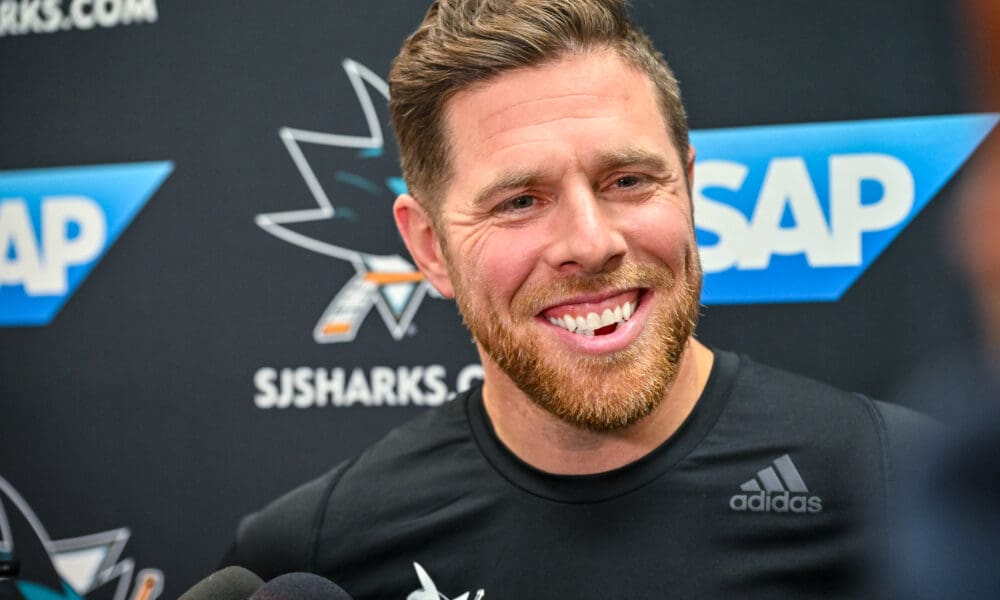
Joe Pavelski outperformed every expectation of him. Scott Gomez was a trailblazer.
Today, both ex-San Jose Sharks players were announced as 2025 inductees into the U.S. Hockey Hall of Fame along with photographer Bruce Bennett, women’s star Tara Mounsey, and Zach Parise.
Presenting the U.S. Hockey Hall of Fame Class of 2025! 🇺🇸
Congratulations to this year’s inductees!
— USA Hockey (@usahockey) September 3, 2025
The former San Jose Sharks captain was a diamond-in-the-rough. The 2003 seventh-rounder produced well with the USHL’s Waterloo Black Hawks before becoming a star with the University of Wisconsin Badgers and leading the team to a 2006 NCAA Championship. Between the Sharks and San Jose Stars, Pavelski totaled 1,332 games played, 476 goals and 1,076 points. Pavelski has the most playoff goals of any American player and captained Team USA at the 2016 World Cup.
“Very humbled,” Pavelski said at today’s virtual press conference. “Like everyone else that I’ve heard so far talk on this panel, very humbled to get this call and super excited to be going in with everyone that’s part of this class. I owe a lot to USA Hockey. They’re a big reason why we’re playing in this game, had the opportunities we did, and it was pretty special.”
Alaska-native Gomez was the first Latino NHL’er to win the Calder Trophy. Before his NHL career, which included two Stanley Cups with the New Jersey Devils, over 1,000 games and over 750 points Gomez was a star with East Anchorage High and the WHL’s Tri-City Americans. Now, he’s the head coach of the USHL’s Chicago Steel.
“It’s quite the honor,” Gomez, who suited up for the Sharks in 2012-13, said of his induction. “The other guys getting in, what a class.”
The two will be inducted into the U.S. Hockey Hall of Fame in a ceremony on Dec. 10 in St. Paul, Minnesota. Here are some great stories from both at today’s press conference.
Pavelski’s NHL Leaders
Pavelski credited his longevity to the NHL legends he learned from with the San Jose Sharks.
“You have to go right back to the start of the career, starting in San Jose and having leaders [that we] had around us. With Joe Thornton and Patrick Marleau, [Jeremy] Roenick and Rob Blake… I think people overlook how important that is when you come in as a young player, and to have that veteran leadership.”
In his final three NHL seasons, Pavelski never missed a regular season game. In those ensuing three postseasons, Pavelski had 13 goals and 24 assists across 40 games. That commitment was instilled by the NHL’ers who mentored him.
“There really wasn’t an option besides to play,” he shared. “They played through a lot of injuries, and they led by example. It didn’t really matter [what] they were going through to play that night. You have that standard. That’s what you hold yourself to… It’s a special game. You get 82 opportunities, and hopefully you get some more in the playoffs after that. Game day is always a special night, and I was obviously very proud and really enjoyed playing in all those games.
Pavelski’s Plover Beginnings
Pavelski was born in Plover, Wisconsin. His brother, Jerry, built an ice rink in the family’s backyard so the family would always have ice time available.
“To have a rink in your backyard is pretty special,” Pavelski recalled. “[I went] all the way through youth with my dad [as an] assistant coach on our team… You had two lines and a goalie, and we’d go to all the youth tournaments. It was fun. It was just a great childhood.”
Pavelski learned a lot at Stevens Point Area High, where he was coached by Jack Stoskopf.
“He was a hard coach,” Pavelski recalled. “One of the biggest things you learned from him was how to condition, how to skate sprints left and right. It was something that was a big part of the game. That was one area that I really took from [Stoskopf]: was [to] kind of enjoy conditioning. For me, not being the strongest of skaters throughout my career, conditioning was an important piece for me.”
Pavelski’s Coaching Prospects
With that in mind, does Pavelski see a future in coaching? The 18-year NHL veteran demonstrated strong leadership abilities throughout his career and was a captain for the San Jose Sharks and alternate for the Stars.
Pavelski was noncommittal in his answer. The 41-year-old shared that he helps when he can with the midget Madison Capitols and his alma mater, University of Wisconsin.
“I like the coaching side of it,” Pavelski said. “You really don’t take for granted how much effort goes into it at times. At [the midget] level, it’s just enough. It’s the right amount. The pro level, there’s a big-time commitment.
“I’m enjoying what I’m doing right now,” he continued. “Helping out, popping in with the Badgers when I get a little bit of free time. But we’re around the rink a lot, and it’s great to be around the game that way.”
USA Hockey Memories
Both Pavelski and Gomez admire the Team USA legends they watched and heard about. Among the most formative for them are the 1980 Olympic and 1996 World Cup of Hockey teams. Both won gold.
“The first time I was at one of the US camps, I got to go to [1980 Olympics site] Lake Placid,” Gomez recalled. “It was really neat. Seeing so much footage on it. But I think for our generation, the ’96 team took us all to another level … For the first time, we’re the best in the world. We have the guys.”
“They were our 1980 team,” Gomez continued. “Because they took us to another level. And when you get to meet those guys… what a special group. We owe a lot to those guys.”
While Pavelski also did not watch the “Miracle on Ice” team, he respects the Badgers who were on the team like Mark Johnson.
“The ’96 team was awesome. I remember Brett Hull’s tip goal there. He was one of my favorite players growing up. I have a faint memory of probably being in a bar somewhere, where the parents who took us after one of our games,” Pavelski, who was 12 in 1996, recalled. “Watching it, and it was pretty special to see them win.”
Pavelski’s Waterloo Memories
“When I played, I hung my hat kind on being smart and working hard… [with] P.K. O’Handley, that’s when things really started to sink in,” Pavelski said.
O’Handley was head coach of the USHL’s Waterloo Black Hawks for 20 seasons before becoming president of hockey operations. Pavelski credits the longtime head coach with teaching him the systems and mental aspect of hockey that propelled Pavelski’s long NHL career.
“P.K. was a coach, not much different from my high school coach, Jack Stoskopf,” Pavelski said. “You had to be committed if you were playing for him. He was a passionate coach. And I loved every minute. The team we had there, the character group that we had, we responded really well. He coached us hard. There [were] definitely some hard days, which this game will bring you. It’s what shapes you as a player and a person, and why this sport is so great. P.K. O’Handley was a huge part of my time at Waterloo.”
Pavelski’s Tipping Abilities
Pavelski is heralded as possibly the greatest player in NHL history at tipping in goals. The leader in NHL playoff goals scored by an American credits a story about Nicklas Lidstrom from Jay Woodcroft.
[Lidstrom used] some of his hand-eye [coordination,] the way he could bat a puck out of the air,” Pavelski said. “It went from an injury in 2010 to starting to work [on] this little drill. When I came back, all of a sudden, started knocking a few extra pucks out of the air.”
All Pavelski needed was a consistent blueliner to send pucks to the net.
“You could never get a guy to shoot you 200 pucks in a row [in practice], except Brent [Burns],” Pavelski said. And through all those reps, we created a pretty sweet little chemistry. Yes, I could tip a great puck, but I haven’t seen anyone that I’ve played with that can deliver a puck like [Burns] could. Whether you’re down on the ice with a little eye contact, whether it needed to be hard, soft, he delivered a puck that helped that part of the game grow a little bit. It gives you that confidence and just snowballs from there.”