
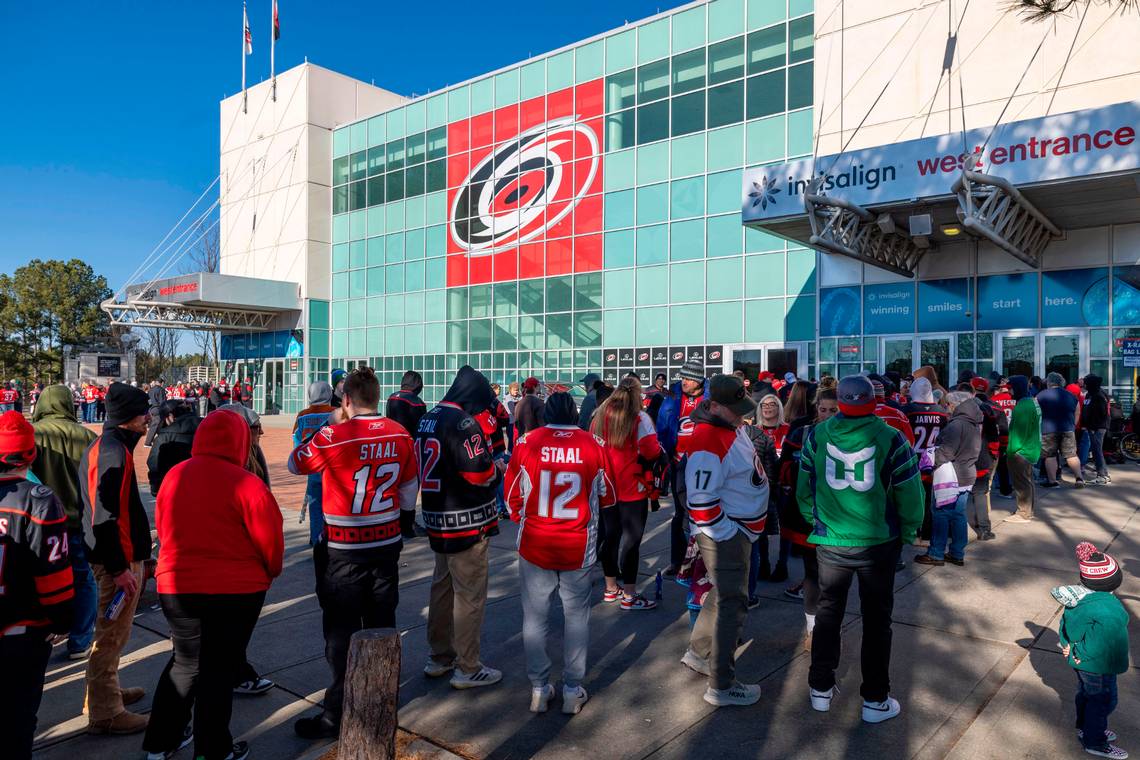
Raleigh has been cloaked in Hurricanes gear, flags with the signature “Take Warning” and “Raise Up” written across them are on street corners, and the giant Stanley Cup Playoffs banner across Edwards Mill Road make it clear — this isn’t an ordinary time of year.
The Carolina Hurricanes began the second round of the Stanley Cup playoffs Tuesday night, facing the Washington Capitals.
Advertisement
Welcome to the madness.
For fans just now tuning into the world of professional hockey, the NHL Playoffs are considered one of the best postseason tournaments in sports. With a bracket format and a seven-game series for each round, the two teams fighting to keep their dreams alive end up becoming close to bitter rivals before the traditional post-series handshake line forms at center ice.
And for this second-round matchup, the Canes and Caps are already rivals. This series could just add fuel to the fire.
Here’s the all-you-need-to-know guide to Carolina Hurricanes hockey before Round 2 begins.
How to watch the Canes on TV
When: Thursday, May 8 at 7 p.m. (Game 2)
Advertisement
Channel: ESPN
Streaming: ESPN App, Fubo, YouTube TV
Radio: Sirius XM 924
How do the NHL playoffs work?
The NHL playoffs are set up in four rounds, each a best-of seven series. The first team to four wins moves on to the next round, and the first team to win all four rounds hoists the Stanley Cup.
The magic number is 16 wins.
The first three rounds of the playoffs feature teams that are in the same conference — the Eastern Conference for the Hurricanes. The same thing is replicated for the Western Conference. The two remaining teams who win their respective conferences then face off in the Stanley Cup Final.
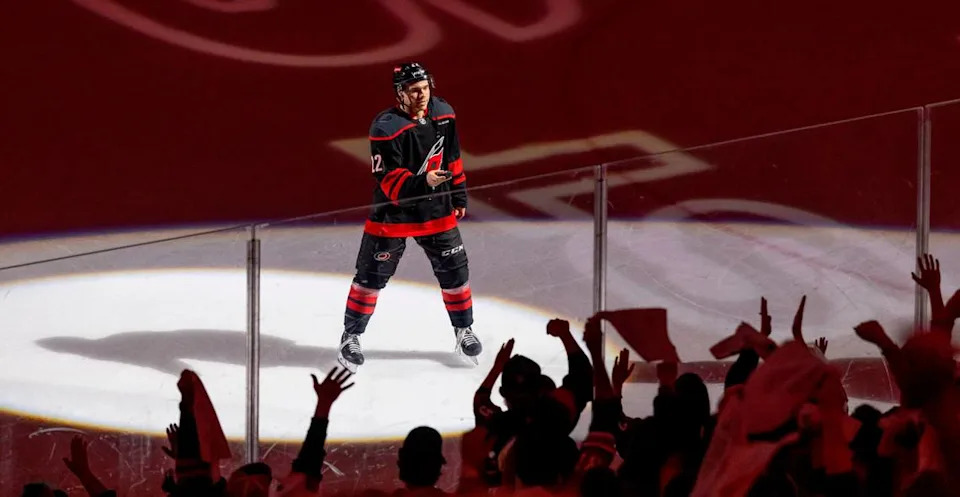
Carolina Hurricanes center Logan Stankoven (22) offers fans a puck as he is recognized for scoring two goals following the HurricanesÕ 4-1 victory over the New Jersey Devils on Sunday, April 20, 2025 at Lenovo Center in Raleigh, N.C.
The Canes and Caps are both in the Metropolitan Division, and played against each other four times during the regular season. It’s the first time since 2019 that these two face off in the playoffs, however.
Advertisement
Since the Capitals were the highest seed in the Metro Division, if the series goes all seven games, four of the seven will be in Washington D.C. The first two games will take place in the nation’s capital before heading to Raleigh for two. From there, it will flip-flop locations. Not every series plays all seven games, however — once a team wins four games, the series is over.
Canes chants and traditions to know
Each team has its own way of celebrating a playoff win.
In Raleigh, as fans head for the exits, the team places a red-and-black square along the wall of Lenovo Center’s main entrance, replicating the lifeguarding flag used to indicate a hurricane at the beach. There are 16 empty boxes, one for each win needed to bring the trophy back to Raleigh.
Advertisement
The team’s usual “Storm Surge” celebration, where players gather at center ice and do a Viking-esque “skol” chant, is only done during the regular season.
Washington fans gather at the steps to the Smithsonian National Portrait Gallery — a tradition that began during the team’s 2018 Stanley Cup Championship.
The Hurricanes haven’t won the Stanley Cup since 2006, but have reached the third round five times since the turn of the century — the most recent being the 2022-23 season.
Players to watch
This is the 20th time the Carolina Hurricanes have made the Stanley Cup Playoffs. Head coach Rod Brind’Amour, who won the Stanley Cup with the Canes as a player in 2006, became the first NHL head coach to win at least one playoff series in each of his first seven seasons behind the bench.
Advertisement
Brind’Amour was the center, and team captain, on the famed “BBC Line” with Bates Battaglia and Erik Cole during the 2006 championship run.
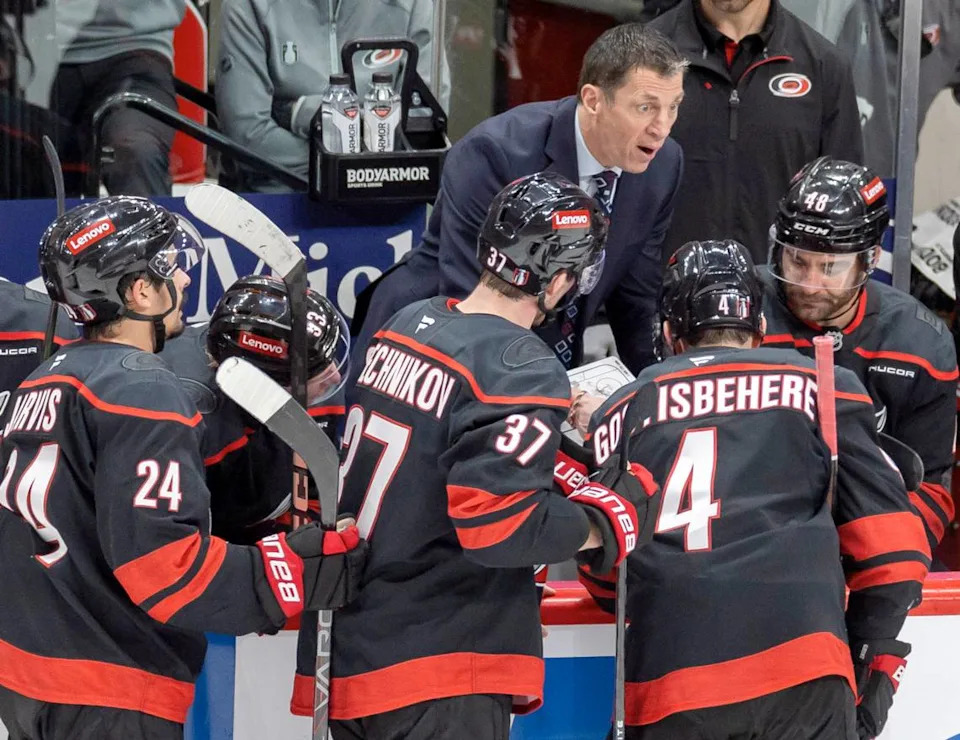
Carolina Hurricanes coach Rod Brind’Amour huddles with his players before a power play opportunity in the second period against the New Jersey Devils on Tuesday, April 29, 2025 at Lenovo Center in Raleigh, N.C.
Then, there are the key players that highlight this year’s squad. And the Canes have quite a few to load their lineup.
Andrei Svechnikov, Sebastian Aho and Seth Jarvis are three names fans will hear a lot on a broadcast. Jordan Staal is the Hurricanes’ team captain, and has been since the 2019-20 season.
Frederik Andersen is expected to be Carolina’s starting goaltender this series, returning from an injury after colliding with the New Jersey Devils’ Timo Meier in Game 4. Pyotr Kochetkov stepped into the goal crease and helped the Canes take down the Devils in five games.
Advertisement
Finally, the Hurricanes added Russian defender Alexander Nikishin to their playoff roster, but he’s been a healthy scratch throughout the first round. Brind’Amour said he wants to get Nikishin involved, but isn’t willing to “experiment” much during a playoff run.
NHL teams are allowed up to 24 players, 20 on the active roster and four on a reserve list.
Hockey terms and rules explained
The hockey lingo broadcasters say throughout the game can get confusing, particularly with the pace of the game. Here are a few definitions that can make it easier to follow along.
▪ Icing: When a team sends the puck out of its defensive zone, that team has to be the first to the puck beyond the far-side dots. If the opponent reaches the puck first, the whistle is blown and a faceoff is taken back in the original defensive zone. The catch: The team that ices the puck cannot change its players on the ice. This is particularly important in the final minutes of a close game, because it’s more likely the team on defense will be more tired.
Advertisement
▪ Offsides: The puck has to be the first thing that crosses the blue line when a team enters its offensive zone, otherwise officials will blow the whistle and the faceoff will come outside the zone. A player can have one foot or leg across the line, but not both legs.
▪ Power play: This is what happens when a team has an extra skater on the ice because the other team took a penalty. Usually, power plays last two minutes, when the team who committed the penalty has only four skaters on the ice, instead of five.
▪ Penalty kill: This is the term for the team that has to play defense during their opponent’s power play. It’s four skaters, all of whom specialize in clearing the puck out of the defensive zone. During a penalty kill icing doesn’t count, so a team can send the puck to the opposite board and successfully make a line change.
▪ 4-on-4: This occurs when both teams have penalties called against them, with each team landing a player in the penalty box.