

Zayne Parekh is only 19 years old, but there’s almost no chance he’ll be playing junior hockey this year.
Under the CHL–NHL transfer agreement, 19-year-olds aren’t eligible for the AHL unless they’ve completed four full junior seasons.
That means Parekh’s only options are Calgary or Saginaw.
Given his body of work, the Flames’ ninth-overall pick in 2024 is expected to push hard for an NHL job out of camp.
Make no mistake, that body of work is exceptional. Over the past two seasons in the CHL, Parekh became the first OHL defenceman in over a decade to crack 100 points, capping a 33-goal, 107-point year by leading Saginaw to a Memorial Cup.
Nevertheless, it’s incredibly rare for young defenders to step directly out of junior and make an impact in the NHL right away. So what should Flames fans expect to see in Parekh this year?
To set expectations, let’s compare Parekh’s pre-NHL profile against three groups:
The Flames’ own noteworthy CHL graduates.
High-end OHL defencemen from the past decade.
Recent 19–21-year-old NHL defenders who stepped directly into big roles.
Parekh vs Flames Junior Graduates
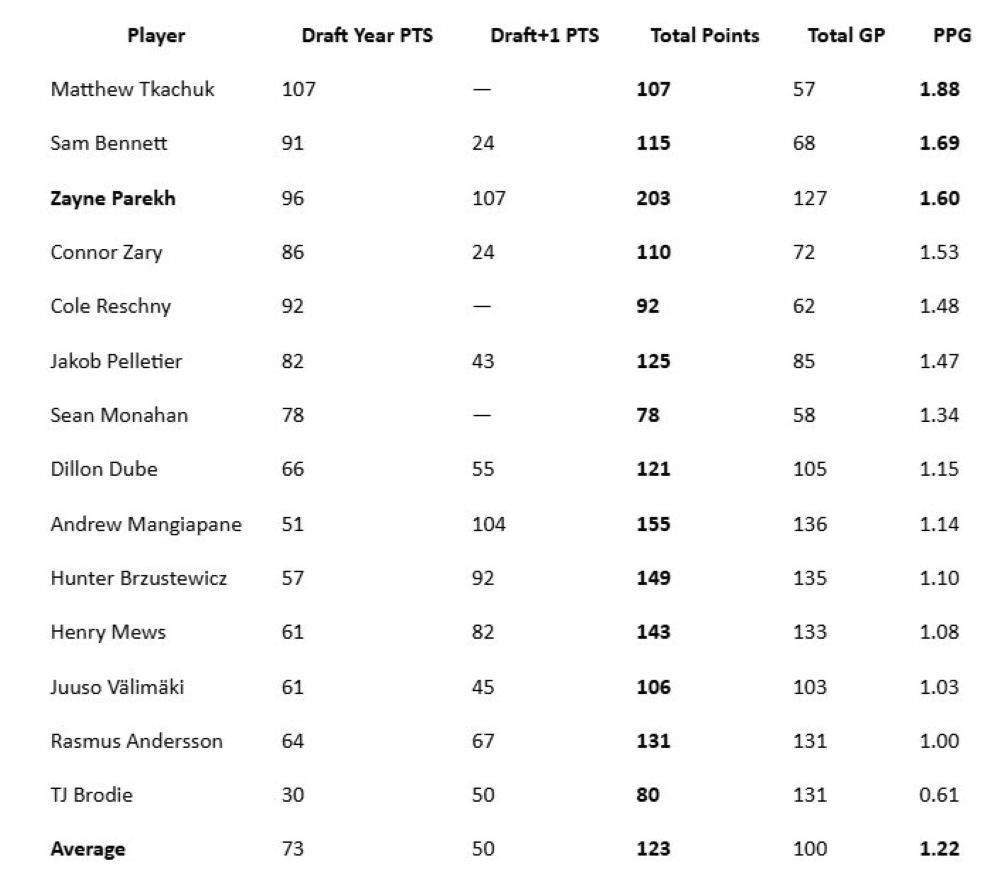
If you look at the Flames’ best CHL products of the last decade or so, the data underscores just how rare Parekh’s scoring profile is.
Recent high-quality prospects like Henry Mews, Hunter Brzustewicz and Cole Reschny were added for additional context:
Zayne Parekh chart
Parekh’s 1.60 points per game ranks third on this list, behind only Matthew Tkachuk and Sam Bennett, both top-10 drafted forwards who jumped directly into the NHL.
Among defencemen, there isn’t a close comparison. Rasmus Andersson (1.00 PPG), Juuso Välimäki (1.03) and TJ Brodie (0.61) don’t approach Parekh’s scoring output.
The average Flames CHL graduate posted about 1.22 points per game, with Parekh sitting roughly 30% above that baseline. That’s despite the fact that most of this list is made up of forwards, some of them top-6 contributors (or even stars) at the NHL level.
Calgary rarely has drafted players with this level of junior dominance. Historically, players in Parekh’s scoring range (whether forwards or defencemen) tend to profile as future stars.
How Parekh Stacks Up Historically
Zayne Parekh’s production over the past two seasons places him in rare company among OHL defencemen.
In 2023-24, he recorded 96 points in 66 games, followed by 107 points in 61 games in 24-25. No OHL defenceman has reached the 100-point mark since Ryan Ellis posted 100 points for Windsor in 2010-11.
Parekh is also the first OHL defenceman since Bobby Orr to score 30 or more goals in two consecutive seasons. In the modern era, no other OHL defenceman has matched that benchmark. Not Ryan Ellis, not Drew Doughty, not Dougie Hamilton, not Aaron Ekblad.
Among modern elite OHL defenders, only a handful have approached Parekh’s level of offensive impact:
Ryan Ellis (Windsor, 2010-11): 100 points in 58 games.
Pavel Mintyukov (Saginaw, 2022-23): 88 points in 69 games.
Brandt Clarke (Barrie, 2022-23): 61 points in 31 games, highest per-game output in that span.
Ryan Murphy (Kitchener, 2010-11): 79 points in 63 games.
Parekh’s output exceeds all of them in both total production and consistency. He’s one of the few defencemen in the past two decades to combine back-to-back 30-goal seasons with a 100-point campaign, making his offensive ceiling among the highest of any junior defenceman in recent memory.
Parekh vs. Other Young Stars
Young defenders rarely step right into the league, but that doesn’t mean it never happens.
Between Aaron Ekblad winning the Calder trophy in 2015 and Lane Hutson winning it in 2025, there has been a small cadre of elite youngsters who have leapt into the NHL relatively seamlessly.
Looking at recent examples like Cale Makar, Quinn Hughes, Luke Hughes, Moritz Seider, Rasmus Dahlin, Mikhail Sergachev, Simon Nemec, Ekblad, and Hutson, there are consistent trends in usage and production.
The group averaged just over 21 minutes of ice time per game in their first seasons, almost always starting in second-pair roles, typically skipping marginal, third-pairing responsibilities.
Offensively, this group averaged 45 total points with an average pace of about 0.61 points per game. Only a few — including Makar, Quinn Hughes, and Hutson — pushed above the 0.75 PPG mark as rookies.
Even the best young defenders often take time to reach their full impact. Dahlin, Seider and Ekblad, for example, each posted between 0.48 and 0.61 points per game in year one before growing into bigger roles.
The transition from junior to the NHL is demanding and Parekh will likely face the same adjustment period.
For Parekh, a realistic rookie projection falls somewhere in the range of 35 to 45 points (if he earns regular power-play usage), paired with an average workload of about 20 to 21 minutes per night.
If he pushes past 50 points, he would immediately place himself alongside Makar, Hutson, and Quinn Hughes as one of the most impactful young defencemen of the past decade.
While that seems like a tall order, consider the Flames’ depth chart: Last year, only MacKenzie Weegar (24:02), Andersson (23:59), and Kevn Bahl (21:23) averaged more than 21 minutes a night. Even with Andersson likely sticking around until the trade deadline now, there is room for the rookie in the club’s top four rotation.
Assuming he can handle himself defensively, of course.
While this is a reasonable expectation for Parekh, given his historic output in junior, it doesn’t mean he must absolutely hit these numbers in his 19/20 year-old season in order to be considered a cornerstone talent. Development rarely is a straight line and not every future star leaps fully formed into the show as a teenager.
Nevertheless, Parekh is a vanishingly rare offensive talent and arguably the most exciting Flames prospect since Matthew Tkachuk.
If he follows the path of other noteworthy, high-octane young blueliners, expect to see him land in Calgary’s top-4 depth chart sooner rather than later.