
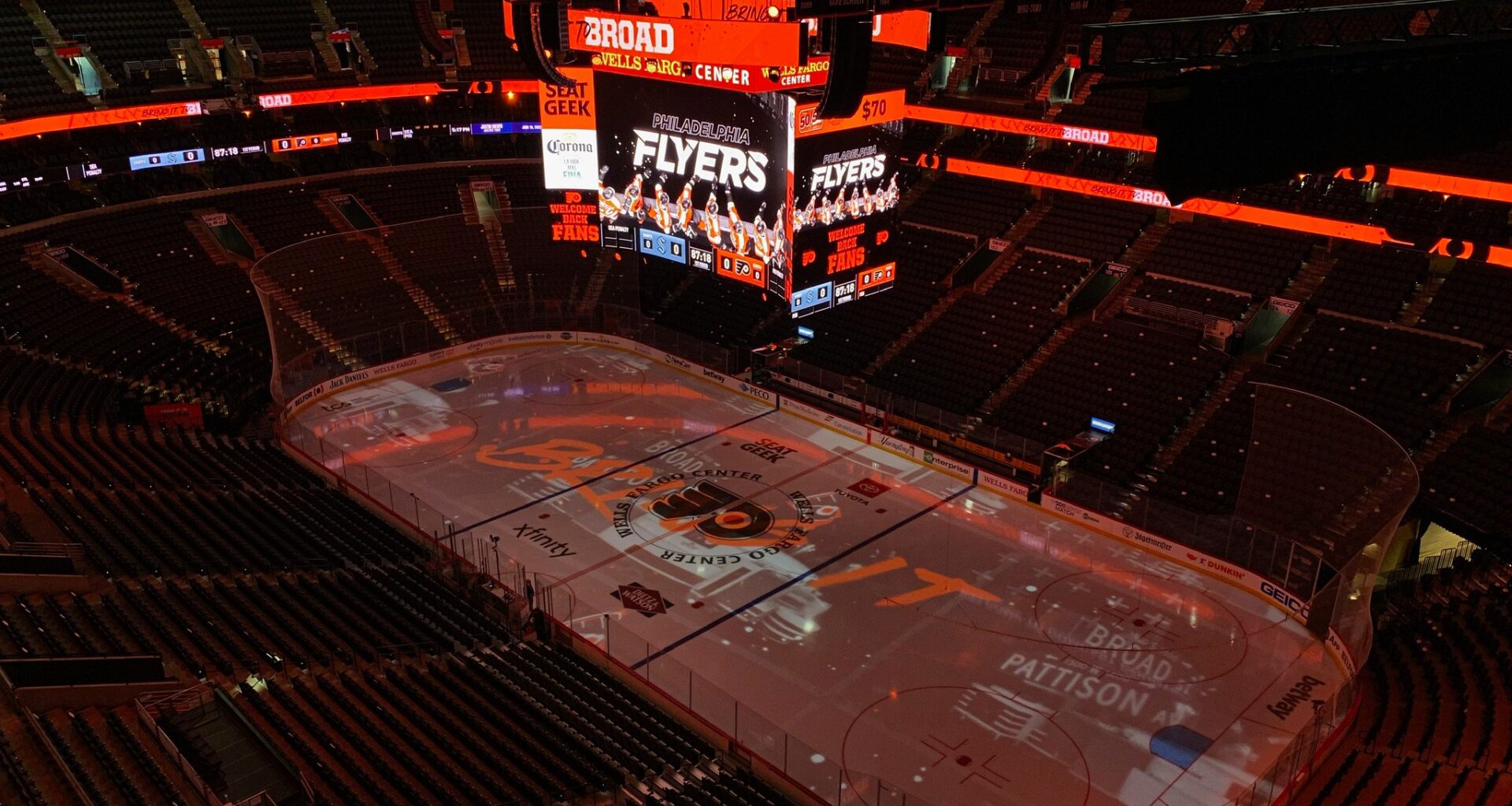
A New Era of Orange began in the 2023-24 season, which was the Philadelphia Flyers’ marketing slogan for their first season under the leadership of general manager Daniel Brière and president of hockey operations Keith Jones. However, a new era began off the ice last week when the team tore down a banner rather than raise one, specifically changing Wells Fargo Center to the newly named Xfinity Mobile Arena.
Corporate sponsors hold the naming rights for nearly every major sporting venue, with only a handful of outliers holding onto the past, like the Green Bay Packers’ Lambeau Field, or the New York Yankees’ Yankee Stadium. The Flyers have split their history almost evenly between two homes: The Spectrum (1967-1996) and their current, newly named venue.
While younger fans may have a tough time dropping Wells Fargo Center from their muscle memory, this isn’t the first rodeo for old-timers. In fact, the building has had four names in its history, each one home to different players, teams, and memories from the last 30 years of Flyers hockey. If you’ve ever wondered which era reigns supreme, however, you’re in the right place.
CoreStates Center (1996-1998)
Regular Season Record: 87-53-24 (.604 Points Percentage); Playoff Record: 13-11, 3-2 in Series
The throughline of names for the Flyers’ current arena is the financial industry. CoreStates purchased the naming rights for 21 years at $40 million, which would’ve carried it through 2017. Ultimately, several bank mergers led to the different names of the building, while the Philadelphia Eagles and the Phillies have maintained the same corporate sponsor since moving into their new locations from Veterans Stadium in the early 2000s.
It’s hard to ask for a better start to a new venue than this one. The building opened by hosting the 1996 World Cup of Hockey, with each of its two elimination games (a Canada-Sweden semi-final and Game 1 of the best-of-three Canada-United States Final) going past regulation. The US won the first-ever game in the building, a 5-3 round-robin victory over Canada. Despite losing that Final opener, the States went up to Montréal and won Games 2 and 3 to secure a landmark victory in best-on-best international play.
Meanwhile, the focal point of the arena has always been the Flyers, and they got off to a fantastic start in their inaugural season at CoreStates Center. Led by the Legion of Doom, the Flyers reached their first Stanley Cup Final in a decade. It also marked the second of three straight 50-goal seasons from John LeClair, the return of Ron Hextall, an all-rookie team appearance from Janne Niinima, and another dominant (but injury-plagued) season from Eric Lindros.
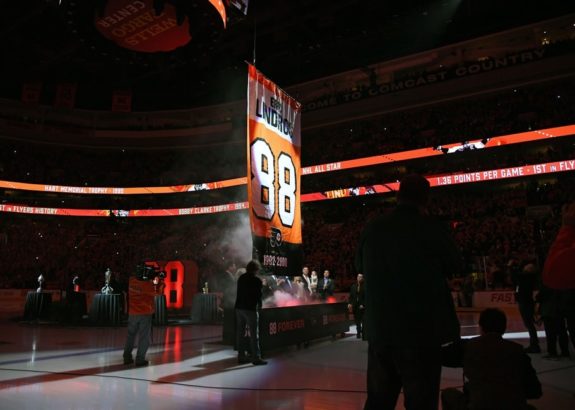 Flyers former player Eric Lindros (88) has his number retired (Eric Hartline-USA TODAY Sports)
Though they ended up on the wrong end of a sweep in the Final against the Detroit Red Wings, it’s hard to argue against a season that ended with the Prince of Wales Trophy. Despite that, the Flyers changed coaches after the season, and following a first-round exit in 1998, they changed arena names, too (and coaches in the middle of that season).
First Union Center (1998-2003)
Regular Season Record: 212-120-65-13 (.612 PTS%); Playoff Record: 22-26, 3-5 in Series
The second name lasted longer than the first (though it was still relatively short) and marked a period of transition for the organization. Probably the most significant on-ice moment during this time was the crushing Game 7 hit by New Jersey Devil Scott Stevens that ended Lindros’ Flyers career and helped the Devils erase a 3-1 deficit in the 2000 Eastern Conference Final.
Most of Mark Recchi’s second stint with the Flyers took place during this time, and that 1999-2000 team featured a pair of first-team all-rookies, including goaltender Brian Boucher and forward Simon Gagné, both of whom would play key roles in the next era.
Between Boucher’s rookie prowess and the emergence of Roman Čechmánek the next season (Vezina runner-up in 2001-02, co-William M. Jennings winner with Robert Esche in 2002-03), this may be the team’s best goaltending era in this building. Other key acquisitions in this half-decade included Jeremy Roenick and Keith Primeau.
Somehow, despite making the playoffs in all five seasons, the Flyers went through five coaches. Other than their run in 2000, the only season the Flyers won a playoff series was their last one (2003), which at least featured a much better Game 7 performance. Fun fact: that game doubles as the beginning of the illustrious deciding-game legacy of Justin Williams, who tallied the game-winning goal and a primary assist.
Wachovia Center (2003-2010)
Regular Season Record: 234-186-15-57 (.549 PTS%); Playoff Record: 38-32, 7-5 in Series
Year one at the Wachovia Center got off to an electric start. The Flyers immediately overcame the biggest stain on First Union Center by securing a 3-1 series lead against the Devils in their first playoff series in 2004, which ended at home in a thrilling Game 6 comeback and overtime victory against the Tampa Bay Lightning in the Eastern Conference Final. Their only regret is not keeping Ruslan Fedotenko in the First Union Center timeline and letting him leave for the Lightning and scoring in the decisive Game 7 in Tampa Bay.
The good news is that a championship was won at the Wachovia Center the very next season. Unfortunately, it was also the infamous 2004-05 lockout season that ultimately led to the salary cap. However, the American Hockey League was going strong, and the Philadelphia Phantoms were a dominant team full of future stars such as Mike Richards, Jeff Carter, and Patrick Sharp that swept the Chicago Wolves to win the Calder Cup, something that has happened just twice on that stage since (from ‘‘It was like a mini NHL’: Twenty years ago, a star-laden team won it all in the AHL’s greatest season,’ The Athletic, June 10, 2025).
Meanwhile, their parent club emerged from the stoppage with stalled momentum. The Flyers’ 2005-06 season ended with their worst playoff effort (they managed just two goals in a first-round exit, the fewest ever in a non-sweep), followed by their worst regular season effort in 2006-07, finishing 11 points behind the second-worst team and with a points percentage over 30 points worse than any other in club history.
Incredibly, they bounced back. Led by John Stevens, the coach of that championship Phantoms team, and a slew of offseason additions such as Scott Hartnell, Kimmo Timonen, and Brière, the Flyers reached the ECF in 2008 and hosted Stanley Cup Final games featuring Carter, Richards, and Sharp in 2010. By then, though, Sharp was on the visitor’s side and played a pivotal role in handing the Flyers a six-game defeat by the Chicago Blackhawks that ended on arguably the strangest Cup-winning goal of all-time.
Wells Fargo Center (2010-2025)
Regular Season Record: 544-455-158 (.538 PTS%); Playoff Record: 26-31, 3-6 in Series
The transition to the Wells Fargo Center was a mirror image of this most recent name shift. Rather than begin the on-ice change a year before officially re-naming the facility, it occurred a year after, when Richards and Carter were simultaneously jettisoned in separate blockbuster trades in 2011 – the most eye-popping development of the last 15 years, especially given that it led to the Ilya Bryzgalov megadeal.
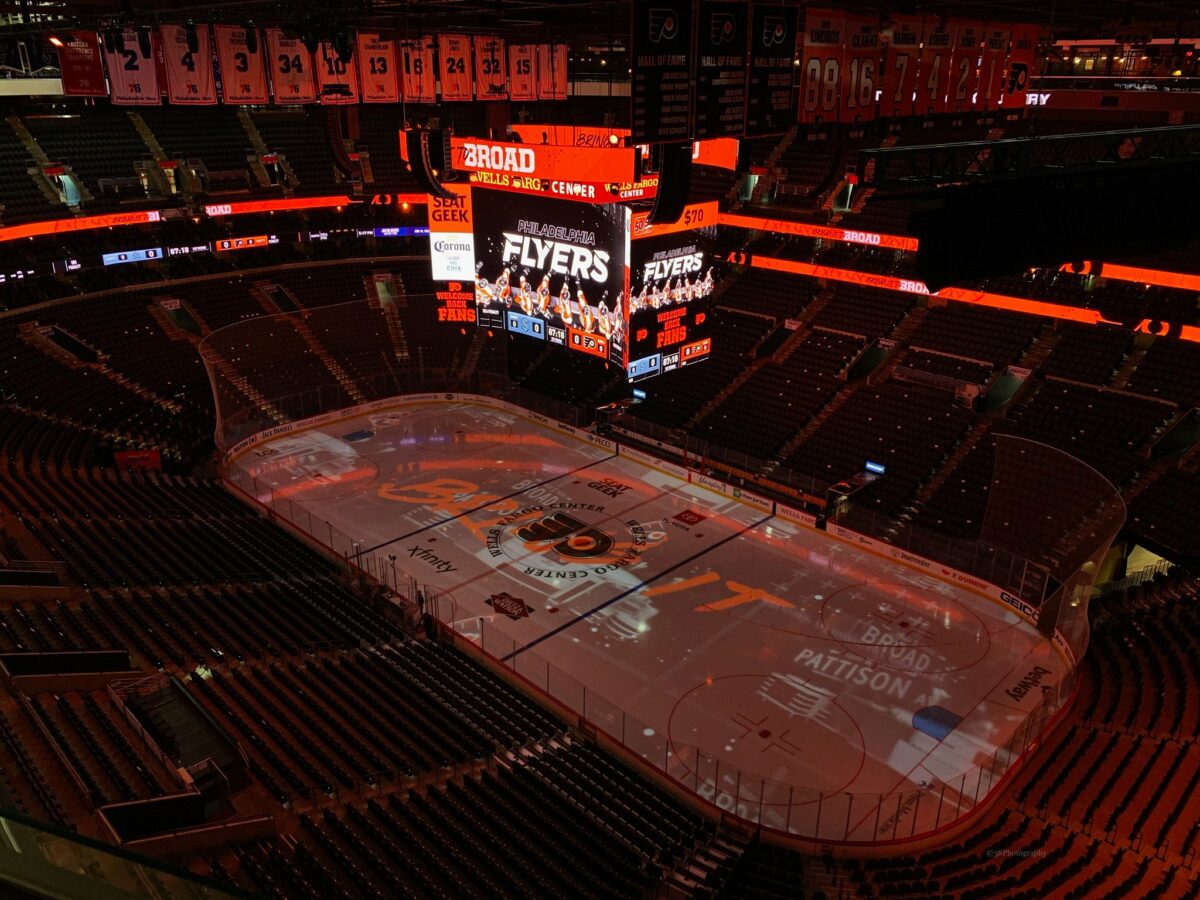 Wells Fargo Center, Philadelphia Flyers home arena (Amy Irvin / The Hockey Writers)
The Wells Fargo Center era would ultimately be defined by loss. Consecutive second-round exits seemed like a grim way to usher in the new name, but in reality, that was as good as it got. Next came a seven-year ping-ponging between first-round exits and playoff misses, which had happened only once in the building’s history before 2013.
The best chance of changing that was 2020, when the Flyers posted a league-leading 25 home wins during the regular season, but they were unable to play a single playoff game in Philadelphia due to the COVID-19 pandemic.
This era also featured star players in their prime. Claude Giroux scored 826 of his 900 Flyers points during this time and was captain for much of it, and current captain Sean Couturier, who captured the franchise’s first major individual award since Lindros’ 1995 Hart Trophy by winning the Selke Trophy in 2020.
It’s also the only time in the last 30 years the Flyers have played home games elsewhere, hosting the 2012 Winter Classic at the Phillies’ Citizens Bank Park and the 2019 Stadium Series at the Eagles’ Lincoln Financial Field. The building recouped some of that lost attendance by hosting the 2014 NHL Draft, a class that produced a top-four that has played in each of the last two Stanley Cup Finals (Aaron Ekblad, Sam Reinhart, Leon Draisaitl, Sam Bennett). The Flyers made the home fans happy by hitting on their first-round pick, drafting Travis Sanheim 17th overall.
The arena itself has seen significant upgrades in recent years, especially to the seating and club levels. But on-ice upgrades have been harder to come by, as the team’s current five-year playoff drought is tied for the longest in team history. The prior one concluded just two years before the place we know today as Xfinity Mobile Arena first opened its doors.
Good news, though – a member of the Flyers organization won a championship during this time, but it’s another Phantoms-like gotcha moment, as then-prospect Shayne Gostisbehere won not just the 2014 NCAA Frozen Four but the Most Outstanding Player award with a goal and two assists in the 7-4 title triumph for Union College.
The Definitive Flyers Arena Era Rankings
The Flyers could use new energy wherever they can get it. While their rebuild has shown promise, the last decade has been the team’s most underwhelming. Though home to some exciting regular-season games, the lack of a playoff victory since 2016 in the building makes the Wells Fargo Center an easy choice for the bottom.
First Union Center has the best regular-season points percentage and a ton of great names in a short stint. However, it’s the only one of the three names that wasn’t present for a Stanley Cup Final, and a lot of the great Flyers from those years are best known for their achievements before (such as Lindros) or after (such as Gagné) that five-year period. It places third.
Related: Flyers’ 7 Best Moments at the Wells Fargo Center
CoreStates gets bonus points as the inaugural branding, not to mention the significance of the United States World Cup-winning team. Plus, that group featured a pair of Flyers in LeClair and Joel Otto (who was even an alternate captain). But with only a round-robin victory in Philadelphia, it’s not enough to overcome the uphill battle with the Wachovia Center.
As for Xfinity Mobile Arena? It should approach the longevity of the Wachovia name, with plans for a new arena for the Flyers and the NBA’s 76ers in 2031. The question is whether the Flyers’ young pieces and assets can become the Cup-winning team this building’s name has yet to witness.
