
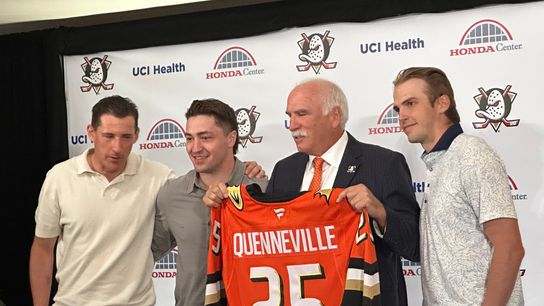
IRVINE, Calif. – What will the Joel Quenneville era look like for the Anaheim Ducks?
The first look at that–what many hope will be the first steps towards snapping a franchise-worst seven-season playoff drought–will take to the ice on Thursday at Great Park Ice, as Anaheim opens training camp for the 2025-26 season.
As the Ducks work towards their preseason opener on Sunday in Ontario against the Kings and their regular season opener on Oct. 9 in Seattle, new standards will be established, new pieces will slot into position and nip-and-tuck battles for the last slices of this NHL roster will commence.
Training camp gets underway with 54 players split into two groups for practice on Thursday starting at 10 a.m. and a pair of scrimmages on Friday and Saturday with practices at 10 a.m. and the intersquad games at noon.
Here are the top storylines to watch at Ducks training camp:
This is a section many hope to be deleted before this article is actually published.
When looking for Mason McTavish at training camp, will you actually see him?
The 22-year-old center is one of just five remaining unsigned restricted free agents in the NHL as league training camps open and certainly one of two headliners, along with New Jersey defenseman Luke Hughes.
Sportsnet insider Elliotte Friedman reported last week that Ducks general manager Pat Verbeek and McTavish’s agent Pat Morris were grinding out a long-term deal, and Friedman reiterated on his Monday 32 Thoughts podcast that it was still a battle.
This is not the first high-profile RFA negotiation for Verbeek’s Ducks to go down to the wire, and it wouldn’t be the first to go further. In the summer of 2023, Troy Terry agreed to a contract minutes before an arbitration hearing, and negotiations with Trevor Zegras and Jamie Drysdale both went deep into the preseason.
Zegras and Drysdale ended up having very slow starts and eventually went down with injuries to further exacerbate that. McTavish has been a notoriously slow starter in his short career with Anaheim.
Ultimately, any contract signed before the regular season begins is one both sides should take, but the longer this drags on, one wonders how beneficial this will be for either side to open this season.
Where Does Mikael Granlund Slot?
Of the Ducks’ two high-profile summer acquisitions, Mikael Granlund has the most versatility and could have the greatest domino effect on the roster around him.
The role for the other big new name, Chris Kreider–who will skate in his first non-New York Rangers training camp since being drafted in 2009–is pretty evident. He will be the second-line left winger, barring any unforeseen chemistry choices.
When Granlund signed as a free agent on July 1, Verbeek did not commit to a position lock for Granlund, who will either bring a deep balance to the lineup as a third-line center or push his skill as a scoring option on the second-line wing.
“That’s the beauty of this player,” Verbeek said in July. “It’s going to give us four balanced lines.”
Some of that will depend on McTavish’s status, as Granlund could have to be the second-line center if McTavish remains unsigned.
Assuming McTavish is on the roster, Granlund at third-line center would shift Ryan Strome to a wing, which would also likely coincide with pushing Troy Terry up the lineup and finding a spot for Alex Killorn.
Granlund on the second-line wing either keeps Strome in the middle or moves up Ryan Poehling to the third-line center and opens another slot on the fourth line behind.
Hours could be spent on combinations, but Granlund (and McTavish) will be lynchpins for that movement.
How Much Does Quenneville Break Up Established Combos?
Leading out of the last point, it will be interesting to see how much of some established chemistry that was built last season carries over under new management in Quenneville.
In the forwards, Leo Carlsson and Cutter Gauthier would seem to be a lock at sticking together after last season’s late surge, but does Quenneville see another way? Does Killorn stick to their wing?
Terry, Strome and Frank Vatrano were a nearly unbreakable and relied upon combo for Greg Cronin, but does Quenneville see more value in splitting those pieces? As mentioned, does Terry move up and does Strome move wide?
Again, where Granlund comes in could say a lot to how much of those combinations stick.
On defense, there was a pattern created down the pairings, with a left-handed young player and a stalwart veteran right-hander–Jackson LaCombe with Radko Gudas and Pavel Mintyukov or Olen Zellweger with Jacob Trouba.
Is Quenneville just as married to the lefty-righty ideology, or is there a vision for a more dynamic defensive makeup? Answering those questions might give more insight to what defenseman make the opening roster, as well.
Does Beckett Sennecke Show Enough to Crack the Opening Night Roster?
The biggest discussion coming out of last weekend’s Golden State Rookie Faceoff was that of Anaheim’s top offensive prospect, Beckett Sennecke.
The 2024 No. 3 overall pick performed as expected in his first post-draft year in OHL Oshawa with 36 goals and 86 points in 56 games and, maybe more importantly, 14 goals and 32 points in just 18 playoff games.
Those numbers left many thinking that Sennecke would not benefit from fourth year in junior hockey and might be ready to crack the Ducks’ NHL roster. Sennecke is not NCAA eligible due to signing his entry-level contract and is not AHL-eligible as a 19-year-old that has only played in three junior seasons.
Then came a lackluster performance at the rookie faceoff, where Sennecke collected just two secondary assists and drew criticisms for lack of engagement and getting muscled off the puck.
However, it was simply two games in a setting that Sennecke and Gulls coach Matt McIlvane said was more about knocking off summer rust and getting early installation of Quenneville’s systems ahead of main camp.
It is easy after a long summer to be hyperbolic over a pair of prospect games, but Sennecke’s true standing will be determined under Quenneville through training camp and preseason.
Everyone, Sennecke included, will want to see more in this next stretch to force a tough decision on Ducks management.
Bottom of the Lineup Battles
The most fierce battles of Ducks training camp will come for the final spots on the roster: the fourth line, the sixth/seventh defensemen and starting goalie for the San Diego Gulls.
Simply put, there are too many players for each of these roles, and many have reason to stake their claim.
Let’s start with the defensive corps, which could quickly run into the buzzword of last season: logjam.
Once again, there are far too many defensemen that could take one of those spots. Assuming veterans Radko Gudas and Jacob Trouba have their spots, and the same with Jackson LaCombe, Pavel Mintyukov and Olen Zellweger, there are two spots left in the defense.
Drew Helleson signed a two-year RFA deal in the summer after being a reliable right-hander. Tristan Luneau, who has stuck with Anaheim out of camp the last two seasons before being sent down, had a breakout season with bigger minutes in San Diego.
Ian Moore returns with enough promise after a late-season stint out of Harvard that he was held out of the Rookie Face
off games. Add in 2024 first-rounder Stian Solberg, who was a standout at rookie camp, and the battle goes one layer deeper.
Does Helleson earn the same trust from Quenneville that Cronin did? Does Ducks management feel Luneau would be better served with top AHL minutes instead of swapping in and out of the Anaheim press box? Is Moore a better candidate for the rotating spot, or should he also get San Diego minutes? Does Solberg continue to show out and crash the party?
Among the fourth-line forwards, beyond anyone in the top nine getting pushed out for Beckett Sennecke’s arrival, there will already be healthy competition from youth and veterans.
There are three spots in the line-up–five on the roster with the two healthy scratches–for six players.
There are three players that can line up at center: newly acquired Ryan Poehling (in the Zegras trade), veteran Jansen Harkins and Tim Washe, who played two games with the Ducks last season after winning the NCAA championship with Western Michigan.
There are young wingers in Sam Colangelo and Nikita Nesterenko, who both proved to be quite productive when slotted higher in the lineup, and there is another veteran in Ross Johnston, who was used more as a physical presence last season.
Based on offseason commitments, it would seemingly make sense for the opening night trio to be Colangelo, Poehling and Nesterenko, with Harkins and Johnston as the NHL extras. Washe could be best served as the top call-up from San Diego, but he showcased his usefulness with two goals and a netfront presence in the Rookie Faceoff.
In net, the Ducks’ duo is likely set with Lukáš Dostál under his new five-year contract and Petr Mrázek coming in from the John Gibson trade. Ville Husso was signed as a veteran No. 3 option, but that doesn’t guarantee a starting job in AHL San Diego.
Both Tomáš Suchánek and Calle Clang are coming off injury and are next in line for the Ducks goalie development pipeline. It’s hard to imagine either going down the ECHL Tulsa, but that may be the case. Vyacheslav Buteyets was strong in rookie camp, but with the amount of goaltenders, he may be slotted back to ECHL Tulsa as well.
After an offseason of change and many days of waiting, answers to these questions and more will begin to form as training camp opens on Thursday.