
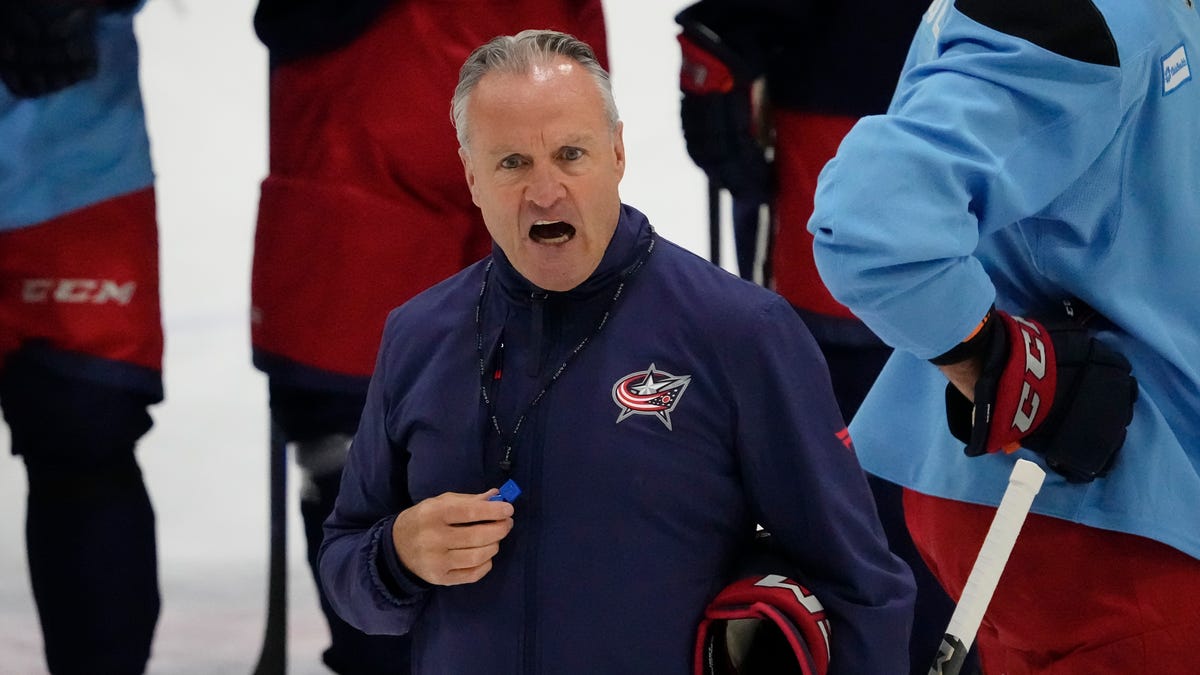
The upcoming season will be the 25th in the history of the Blue Jackets. It’s difficult to count exactly how many head coaches they’ve had in this span. There were two interim coaches, Gary Agnew and Claude Noel, who coached fewer than 25 games apiece. There was another, Mike Babcock, who was definitely not an interim and never coached a game. Such is Blue Jackets history. It’s confusing.
Enter Dean Evason. We’ll call him the 11th head coach, excluding the interims and including Babcock. He was hired by Jackets president of hockey operations/general manager Don Waddell just over 13 months ago. He took the helm of a team that was largely anonymous in the world of major professional sports, save for its association with losing.
Then, on Aug. 29, 2024, as Evason was looking ahead to his first training camp in Columbus, Blue Jackets star Johnny Gaudreau and his brother, Matthew, were killed by an accused drunk driver while riding their bicycles in South Jersey.
A year later, Evason looks back on the jobs he interviewed for and did not get and believes there were greater forces at work, pushing him to Columbus.
“I’ve thought about this, about faith and what have you, whatever you want to call it,” Evason said. “Things happen for a reason. I do think and believe that Don and I, and or staff, and so on, that this was the right place and time to be here.
Evason lives blocks away from Nationwide Arena and walks to work. He cooks, but he burns everything because he likes everything well-done. He has a bunch of tattoos, each of them imbued with personal meaning. He has been married twice and has three grown children, Bryce, Brianne and Brooke. The kids send him gift cards for restaurants to explore in Columbus. He has two grandsons, Connor and Hudson. He is a scratch golfer and a hot yoga enthusiast.
Evason has a reputation for being fiery in his modes of motivation and his approach to winning hockey games. His visage on the bench feeds into this perception, especially when his blue eyes flash like lasers. His vocabulary, which is not 100% of the Queen’s English, also abets the stereotype. Among his many tattoos is the Tasmanian Devil holding a hockey stick, which makes you go “Sure, I get that,” until he tells you the story about how all of his old buddies on a long-ago beer league team have the same tattoos. The devil is in the details.
“The way his eyes light isn’t the whole story,” Blue Jackets television analyst Jody Shelley said. “I watch him on the bench and, when you get past the eyes, you begin to see what he’s holding in. He’s pretty calculating. He’s holding back. And at the end of the game, he lets it all out.
“I think more than anything, what he loves is being a teammate. He loves it. Loves it.”
Evason can’t put it into words, but he had a sense of what the Blue Jackets needed after losing their ultimate teammate. This sense is the product of his 61 years on this earth, the experiences that he has had, the people he keeps close. That is why he is here.
Dean Evason and the prairies of Manitoba
Evason was born in the summer of 1964 in Flin Flon, Manitoba, by the Saskatchewan border. He spent his formative years in Thompson, a town of 15,000 located about five hours northeast of Flin Flon. It’s not like being in the Yukon, but it’s up there.
“There was no road north,” Evason said. “Just a road south.”
In Thompson, chances are you learn to skate before you walk. Evason was one of those kids born with blades on their feet. Everyone in his neighborhood had a backyard rink, and it was on those sheets that Evason and his brother, Dan, who was a year older, twirled away their pre-pubescence.
Evason’s father, Allan, worked for a company that rented, sold and serviced heavy machinery, and his job would take the family to Winnipeg and then to Brandon. With a population of 50,000-plus, Brandon, or “Wheat City,” is the second-largest city in the province (after Winnipeg) and an important railroad hub amid the vast Manitoba prairie. How flat is it? The locals say, “You could watch your dog run away for three days.”
Evason worked his first and last job as a “garage monkey” at a Ford dealership in Brandon. He did oil changes, took out the garbage, cleaned out cars and so forth. Since, all he has done is play and coach the game he loves, and these things he does not consider work.
“Early in my coaching career, I used to love skating the guys – because I would do it with them,” Evason said. “I loved the fact that you could get on the ice and grind and sweat and do all the skill stuff, or whatever, that we did when we played. Pretty cool.”
Evason went west as a teenager to chase his dream. He starred for a minor-junior team in British Columbia, was drafted to play for the Kamloops (B.C.) Junior Oilers of the major-junior Western Hockey League and never let up in his chase. He was part of a team that won Canada’s first gold medal at the World Junior Championships in 1982, during an era when the Soviet Union dominated the international stage. Evason half-jokes that the only reason he made the team was because Mario Lemieux got hurt. “I pretty much filled in for him,” Evason said with that look of his, the one with the blue-eyed twinkle and winsome smile.
He put up gaudy offensive numbers and won a WHL championship in Kamloops in 1984. A fifth-round draft pick of the Washington Capitals, he bounced between the AHL and the NHL for a year-plus before he was traded to the Hartford Whalers. In Hartford, he found himself among an extraordinary collection of young men.
“You go up and down that entire roster and people are still in the game. It’s extraordinary,” Evason said. “Everybody on that team gets asked, ‘Why?’ To this day, I don’t think anybody knows why.”
The top-line center, Ron Francis, was a Hall of Fame player who went on to become a general manager. Future coaches flecked the roster – Joel Quenneville, Dave Tippett, Kevin Dineen, Evason, just to name a few. Quenneville is second all-time, behind Scotty Bowman, in coaching victories. Tippett is 18th.
Goaltender Mike Liut became a powerful agent. Paul MacDermid turned into an Ontario Hockey League franchise owner. Ray Ferraro rose to the pinnacle of his future profession as a color analyst on television. It goes on and on and on.
For all of that, what the 1980s Whalers are best known for is their 1986 loss to the Montreal Canadiens in Game 7 of the Adams Division final in overtime, after which they were feted with a parade through the streets of downtown Hartford.
Those who were on that team attempt to find a balance between the joy of a captivated city and the joke of throwing a parade for a team that fell nine wins short of a championship. They remain haunted by the memory of Claude Lemieux, lifting a backhand and beating Liut for the series-winning goal. They still wonder what could have been.
Those Canadiens, led by rookie goaltender Patrick Roy, lost five games over four rounds en route to the Cup. Three of the losses were to the Whalers and the aggregate score for the series was 16-15. The winner had an easy path to ultimate victory. The loser …
“If we win that game …” Evason said.
The Whalers win the Cup, ownership stabilizes, Hartford turns into the Green Bay of the NHL and the team doesn’t move to Carolina 11 years later. There is an alternate history that boggles the mind.
“Shortly after that, stuff started happening, and then there was the trade.”
March 4, 1991: Francis, Ulf Samuelsson and Grant Jennings to the Pittsburgh Penguins for John Cullen, Jeff Parker and Zarley Zalapski. It was one of the most lopsided trades in NHL history. Francis and the Penguins won the Cup in 1991 and 1992. The Whalers veered off into irrelevance.
“If we win that game and at least advance, I think …,” Evason said.
Evason let that dangle. The “why” of Game 7 is a tough one. Or it’s as simple as Roy, who in 1986 became the first rookie goalie to win the Conn Smythe Trophy.
Dean Evason, Ray Ferraro: Brothers from another mother
Evason spent six-plus years in Hartford and is still remembered well in the abandoned city. “Ronnie Franchise” centered the Whalers’ first line and Ray Ferraro the second. Evason centered the line that was matched against the strongest opposing line. Evason was good for 30 to 40 points a year, but his greatest asset was his ability to read the game. He was a first-rate penalty killer.
“He was an undersized guy who could score goals, take faceoffs and check,” Dineen said. “Honest player. Character. Grit. Hard guy to play against.”
While Evason was (and remains) 5 feet 10 and 175 pounds, if/when the time was right to drop the gloves, he’d go with anyone.
“People think they understand animosity in today’s game,” Ferraro said. “Back then, we played the Quebec Nordiques (and other divisional opponents) eight times in a span of six months. Friction developed. One night in Quebec, Dean fought Dale Hunter three times in the first period.”
Hunter racked up 3,655 penalty minutes – second all-time in NHL history behind Tiger Williams – in 1,407 NHL games. Tough customer.
“For some reason, that night they’d just had enough of each other,” Ferraro said. “I remember thinking, ‘Oh my god, they’re going again.’ And they’d just gotten out of the penalty box.”
Ferraro and Evason are cosmically connected. They were born a day apart in August 1964. They were drafted back-to-back in the fifth round – Ferraro went No. 88 overall to the Whalers and Evason No. 89 to the Washington Capitals – in the 1982 NHL draft. When Ferraro was traded from the Portland Winter Hawks to the Brandon Wheat Kings in 1983, it was Evason’s brother, Dan, then an assistant coach with the Wheat Kings, who picked him up at the airport in Winnipeg for the two-hour drive to Brandon.
Ferraro scored a record 103 goals and was the WHL Player of the Year in 1984, when Evason’s Kamloops Junior Oilers won the league title and competed for the Memorial Cup, the championship of major-junior hockey. In the fall of ’84, they became roommates while playing for AHL Binghamton, a minor-league affiliate shared by the teams that drafted them.
When the Caps traded Evason to Hartford in 1985, he didn’t even have to change locker rooms. And when both Evason and Ferraro were called up to the big leagues, their last minor-league action was an attempted car theft.
They wondered what to do with all the cheap stuff that had piled up in their dumpy, $460/month (furnished!) apartment in Binghamton. Evason jammed all of their stuff in the trunk of a 1976 AMC Matador, which they’d bought for $600, and left the car in a parking lot with the keys in the ignition and the windows open.
“That car was a pile of junk and we wanted to get rid of it,” Ferraro said, “but nobody stole it.”
Both played for expansion teams, Evason with the San Jose Sharks in the early 1990s and Ferraro with the Atlanta Thrashers near the end of his 18-year career.
Ferraro went into broadcasting and is now the top color analyst for NHL games on ESPN/ABC.
Evason played 803 NHL games and had 139 goals, 372 points and 1,002 penalty minutes. He wrapped up his playing career in Europe and transitioned into coaching.
Dan Evason: Forged into a coach
Evason had a 20-year climb through the coaching ranks before he got a top job in the big leagues. He spent six years in the WHL, seven years as an assistant with the Capitals and seven years with the AHL’s Milwaukee Admirals. He was an assistant with the Minnesota Wild for two-plus years before he was given the team to run – first as an interim, and then officially.
Evason’s first model was Bill LaForge, a prolific winner at the junior level, including in 1982-84 with Kamloops, He flamed out when he got his NHL shot with the Vancouver Canucks, but LaForge was rugged. His teams took on his persona.
“I would’ve never played in the NHL without this man,” Evason said. “He taught me to play with bite, with heart, toughness. He hung a heavy bag in the locker room. Every day after practice, you had to grab the jersey on the heavy bag and, with the music cranking, you had to learn how to punch – 30 seconds with the left, 30 seconds with the right.
“He preached to us to play hard, but to play together, and for each other. We had some guys who weren’t that tough, but every guy knew we would stick up for the other guy. Every guy on that team. He taught us to be team-first and tough.”
If those Kamloops teams were Philadelphia Flyer-like, then Evason could be likened to another Flin-Flon-born captain, Bobby Clarke.
Daryl Reaugh, a former Whaler and longtime color analyst for the Dallas Stars, was the Kamloops goaltender back then.
“The coach would give us, say, a 10:30 curfew on Friday night,” Reaugh said. “It would get to 10:27, and Dean would phone the coach to ask for an extra half hour. Dean could talk to him. No other guy on the team could. LaForge would say, ‘OK, 11, but you better be home by then. I’ll be calling.’ ”
This was before cell phones. LaForge would be calling their billets, and he was a man of his word.
“At 10:57, Dean would call the coach and weasel out another half hour,” Reaugh said. “Then, as it got close to 11:30, Dean would call, the conversation would be brief, and he’d hang up and say, ‘Guys, we gotta go now.’ And the place would empty.”
Hall of Famer Bob Gainey, a mainstay for the dynastic Montreal Canadiens of the 1970s, coached Evason with the Dallas Stars in one of Evason’s final NHL stops. He’s another model.
Of Gainey, Evason said, “Be straight up, be honest and don’t mess around. … In your face. Honest. To this day, I don’t put scratches up on the board – I talk to the players I’m scratching, personally.”
Andy Murray, another Brandon native, came along late in Evason’s playing career, when Evason was weighing his chances of latching on with another NHL team against offers from minor-league and European teams. Murray, who was coaching the Canadian national team, had a different pitch – join Team Canada as a player/assistant coach.
If the WHL and World Junior titles in 1984 were one bookend to Evason’s playing career, this was the other. Evason captained Team Canada to a gold-medal victory in the 1997 World Championships. The team included Rob Blake, Sean Burke, Jarome Iginla, Keith Primeau, Sean Pronger, Mark Recchi and Geoff Sanderson.
“It was a little different then, winning the World Championships, because the Russians and Czechs were so dominant,” Burke said. “You never think about a guy coaching while he’s still playing, and I don’t really think of Dean as a coach on that team – he was the captain. He had that way about him as a leader and, when you think about it, a lot of guys who are wired that way go on to become coaches.”
Evason just couldn’t imagine stepping off the ice. He not only enjoyed designing drills, but he was also thrilled that he could participate and grind and sweat along with the players.
“It’s just such an incredible game,” Evason said. “It’s team. It’s skill. You have every element. Toughness. You can fight. It’s unbelievable. There’s that old saying about if you find a job you love, you’re never going to have to work a day in your life. It’s so true.”
Dean Evason’s brother died with his boots on
Danial Alan “Heavy” Evason, died suddenly on March 6, 2004. This is how his younger brother tells the story:
“I was coaching the Vancouver Giants (of the WHL) at the time,” Dean Evason said. “It was in the afternoon. We’d finished pregame skate and he called me. We talked for about 45 minutes. He’d played a hockey game in an old-timers tournament, with all my buddies back home. They’re called the Kinsmen. He called me.
“He goes, ‘We finished the first game. The guys were all going to the bar, having a few beers. I didn’t feel like going. I’m staying in the (locker) room, waiting for them to come back.’
“We all have tattoos. Seven of us do. It’s a Tasmanian Devil with a beer and a hockey stick. I put a team together when I was playing. We called ourselves the Old Guys. I started it to stay in shape because I’m playing in the NHL. I’d go back to Brandon, Manitoba, I’d get all my buddies, and then we’d get a couple of other guys, like, (former NHL forwards) Sheldon Kennedy and Jeff Odgers played for us. I had all of my friends together and we’d play against the Wheat Kings.
“We’d play for ice time, which was like $200 bucks for an hour. Losers had to buy the ice. I’m playing with my buddies. I’m playing with my brother, who’s 300 pounds and can still skate and play. I had to work so hard. It was the best training I could ever get because I had to work my a– off, just playing. Anyway …
“So, my brother is playing in this old-timers tournament with those guys. Plays a game. Sits in the room. Calls me. I found out later he called my mom. Just talking for 45 minutes, an hour. I knew afterward that he was probably feeling it was going to be his time. Then, he goes back, plays the second game, takes a shift, comes back to the bench and has a massive heart attack. He was (41 years old). Playing with all my buddies.
“Back in Vancouver, I’d just finished a meeting. My assistant coach comes into my office and says, ‘Dean, you’ve got to call your mom right now.’ I’m thinking, ‘My mom doesn’t call me before a game. She gets it. She knows what’s going on.’
“So, I call her. She says, ‘I know you’ve got a game tonight. You know how I do things. You know I don’t sugarcoat anything. Your brother is dead.’
“My assistant coach comes in and says, ‘What are you going to do?’ I said, ‘I’m going to do what I do. I’m going to coach the game.’ So, we played the game. We win in overtime. I held it all together. Then I walked off the bench, went straight to my car, drove home, my wife, my kids, all there. And the next day we flew to Brandon, Manitoba.”
For the funeral.
Among Evason’s many tattoos is one that says, “One day at a time,” and it is scripted in an imitation of his mother’s penmanship, across his heart. Evason says that’s where he gets his toughness, from Sheila, 87. As Evason describes it, “one day at a time” is Sheila’s way of absorbing life’s hardships and having the perseverance to move forward.
Another of Evason’s tattoos is a pair of skates, etched down one side of his torso. The skates are hanging on a peg. It’s a tribute to Dan “Heavy” Evason.
“He literally died with his boots on,” Evason said.
Heavy coached, scouted for and/or managed numerous Canadian junior teams in the Ontario and Western leagues. It’s not a stretch to say he was a legendary character in his corners of the world.
Here is one example:
Heavy coached a pro team, the Peterborough Pirates, in the United Kingdom’s Elite League in the early 1990s. The owner of the rink where they played, who had cashed in on the English hockey craze of the 1980s, came to a point where he wanted to break the Pirates’ lease. He wanted the team out so he could turn the place into a warehouse. To this purpose, the refrigeration units were removed, pipes in the floor beneath the ice surface were torn up and, in a wickedly Grinch-y move, the Zamboni entrance was torched.
The fans rose up with Heavy by their side. Heavy kept the team together and they played an entire schedule on the road. Back home, fans worked in volunteer shifts to rebuild the floor of the building. Every chance he got, Heavy was right there with them, wielding a pneumatic drill.
Evason and his brother Heavy and their father Al are in the Manitoba Hockey Hall of Fame. Their old man is also in the provincial baseball hall of fame. The boys got their athletic genes from the old man. The fire, Evason said, came from Sheila.
‘Johnny’s gone’
“I view Dean as straight-up, direct, tough, chin-up and walking into the wind,” Ray Ferraro said. “That’s why when Dean took the job in Columbus and faced the tragedy, I thought he was the right guy in the right place. Because he’s not the same man today that he was 10 years ago, or 20 years ago. He has seen enough in his life to shape him in a way where he was perfect for Columbus last year. I was really happy for the city that both he and Don Waddell were there, together.”
Ferraro played for the Atlanta Thrashers (now the Winnipeg Jets) in the early 2000s, at a time when Waddell was the team’s general manager. On Sept. 29, 2003, a Ferrari driven by Thrashers star Dany Heatley lost control on a winding, narrow road near Atlanta and crashed into a wrought-iron fence. Heatley was seriously injured. His passenger, teammate Dan Snyder, was killed. Waddell had to deal with the aftermath and, as he and others have said, there is no playbook.
Evason’s regular-season record of 147-77-27 over four-plus seasons with the Minnesota Wild was exemplary. But the Wild never got past the first round of the playoffs. A seven-game losing streak preceded his demise amid speculation that his teams lacked on-ice discipline. When Wild general manager Bill Guerin delivered his decision, both he and Evason cried. And they hugged.
Evason drew interest from a number of teams during his nine months in the wilderness. He thought he had a job with the Seattle Kraken, the team Ron Francis serves as president of hockey operations. He went through multiple rounds of interviews and was stunned when the Kraken demurred. Instead, AHL coach Dan Bylsma was promoted to the big-league bench. Bylsma was hired on April 21, 2023. He was fired on May 28, 2024.
The very day Bylsma was sacked in Seattle, Waddell was named president and general manager in Columbus. Waddell has had a long and varied career on both the hockey and business sides of NHL front offices. Likely, the Blue Jackets are his last stop before retirement, although he’s not the retiring type.
In the four seasons prior to Waddell’s arrival, the Blue Jackets had a record of 110-155-40 and didn’t get a whiff of the playoffs. In that span, the Jackets had four coaches, including Babcock, who was hired and fired before he got to his first training camp in Columbus.
Waddell hired Evason on July 22, 2024.
Thirty-eight days later, on Aug. 29, 2024, the Gaudreau brothers were killed. The Gaudreaus’ sister was to be married the next day. The tragedy sent shock waves through the hockey world. One family and a host of communities – Columbus, Calgary, Boston, South Jersey, USA Hockey and so on, and on – were shattered.
Evason and his daughter were in Denver to see country musician Dierks Bentley at the Red Rocks amphitheater when word reached him. Evason was in a hotel room. His phone rang.
“Johnny’s gone,” Waddell said.
“When I got hired, I said I’d heard everything about (captain) Boone Jenner and Goody (veteran defenseman Erik Gudbranson) and Z (longtime Jackets defenseman Zach Werenski) as our leaders,” Evason said. “But I thought it was important I show my face to Johnny Gaudreau. Sit down with him. I flew to Philadelphia. He was skating with his dad at 10 o’clock in the morning. I met him at noon. He picked the restaurant.
“We were talking for two and a half, three hours. Talking about hockey, his expectations, my expectations, the team, all that kind of stuff. So, I was just blown away that night when Don called. I was like, ‘It can’t be true. I just sat with him.’ ”
Waddell celebrated his 67th birthday on Aug. 19. Evason turned 61 three days later. These are men who have lived long enough to have absorbed many tough times. How do you go about healing a team, a community, a city in the wake of an unfathomable tragedy? They can’t say, not exactly. But they knew who they are, and that’s a start.
“You reach a certain age, you’ve seen some things,” Evason said. “Don Waddell had gone through it in Atlanta. He said, ‘I don’t know, really, what to do. We just support.’ There were no instructions. He was just calm.
“What we decided – not decided, because we really didn’t decide anything – is that we were going to be really transparent, completely open, allow everyone to just do what they need to do.”
The first time Evason met most of the players was when Jenner called the team together in the days after the tragedy. The first time Evason shook Gudbranson’s hand, the 6-foot-5, 250-pound defenseman burst into tears, and then Evason did the same, and they hugged it out. The first time Evason saw Sean Monahan in the Jackets’ locker room, he was standing in front of his late best friend’s stall, staring at the empty space.
“He just looked at me and I looked at him,” Evason said. “It was a moment after the candlelight vigil on the plaza (at Nationwide Arena). I gave him a big hug, and that was it. Never said a word. It was all surreal. Nobody could really say anything because there were no words that could …
“Basically, we just supported each other.”
Evason’s contemporaries, those who were contacted for this story, each sounded a similar note. They all echoed Ferraro.
“Last year, he looked like he was comfortable,” Reaugh said. “I was so happy for him. Sometimes he’s a little too raw for some people. But he’s so real. He has been through some things, you know? And at his core, I think, is ‘What’s the right thing to do here?’ ”
Reaugh recalled the passing of their Kamloops coach, LaForge, who died suddenly of an apparent heart attack in 2005. This was a year after Evason buried his brother.
“When coach died, we were sitting around and I said, ‘Dean, I don’t know if I can go to the funeral,’ ” Reaugh said.
There was a softer side of LaForge in a family setting, Reaugh said, but as a coach, LaForge was a hard man.
Reaugh: “Dean said, ‘There are some things in life that if you don’t do, you’ll regret it the rest of your life. You should go to the funeral.’ And he was right. It’s natural for him. He has got a natural ethic. Yes, he’s got fire. He can get fiery, man. He’s hyper competitive. He wants to win. But he always insists things be done the right way, and that he does right by people. I think that was the best thing for the group.”
Once again, an assistant coach came to Evason and said, ‘What do we do?’ And once again, the answer was the verb, “Coach.” Evason and his staff – it’s always a collective, with a lot of delegating – went to work.
The story of the 2024-25 Columbus Blue Jackets was among the most compelling in sports. As a group, and led by the players, the Jackets honored Gaudreau by embracing his soulfulness and his love for the game, on and off the ice. They didn’t shy away from talking about him. They weren’t afraid to appear vulnerable. They shared the journey with the Gaudreau family and, in a very real sense, kept the spirit of Johnny Hockey alive. It was beautiful.
On the ice, these Jackets became everyone’s favorite – or, at least, second-favorite – hockey team. The class and dignity they showed, combined with their unforeseen success, appealed to the hearts of human beings. These Jackets posted a 40-33-9 record, set franchise records for scoring and weren’t eliminated from playoff contention until the penultimate day of the season.
What do they do next?
“I think we just have to move forward,” Evason said. “I’m so excited about all these young guys whose careers have, basically, just started. We had to do a lot of teaching last year. I don’t have to teach these guys much anymore. They know.”
Back to work.