

Arizona State’s Latest Signing Played 40 Games in Minors Last Season
by Adam Wodon/Managing Editor (@chn-adam-wodon)

Related ArticlesArizona StateBemidji State
For as wild as things have gotten in college hockey in the past couple years — between NIL money, the eligibility of former Major Junior players, the transfer portal, and so on — another can be added to the list: the eligibility of former pro players.
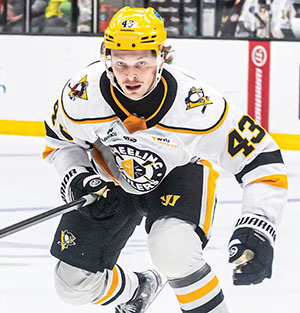
The latest team to add such a player is Arizona State, which this week brought in Jack Beck. Beck played four years in the OHL (Major Junior), then spent last season mainly at Wheeling of the minor pro ECHL, where he played 36 games. He also played 4 games at Wilkes-Barre of the AHL, the top feeder league to the NHL. Beck is the brother of Noah Beck, who spent four seasons at Clarkson, before playing at Arizona State last season in his grad year. They also have an older brother who played four years at D-III Cortland.
The existing connection to ASU was key, coach Greg Powers said.
“This was an incredibly unique cicurmstance,” Powers said. “If any random person came to us, the answer would’ve been no. But we’re close with the family, and (Noah) had a great year last year and a great experience. Education is important to the family. The kid missed the CHL rule change by a year. He saw (now) that he could go to college, and that’s what he wants to do.”
Arizona State had a late opening, because Cole Spicer — who spent two years at Minnesota Duluth and then last season back in the USHL before getting recruited by Arizona State — left the program before his career in Tempe began. He’s currently on Western Michigan’s roster and trying to earn his eligibility there.
“We just had space and room. It materialized and it happened,” Powers said.
Bemidji State got the ball rolling on this, at least within hockey. Thanks to the NCAA continuing to lose lawsuits left and right, players in other sports who have dabbled with pro signings have had their eligibility re-instated. Bemidji State coach Tom Serratore saw this happening, and decided to take a chance on adding Hudson Thornton (50 pro games last season) and Connor McClennon (9).
It worked. The NCAA Eligibility Center (formerly the NCAA Clearinghouse) approved their eligibility based upon the concept that those players’ pro earnings were still below the “full cost of attendance” plus the “necessary and actual expenses” of going to college.
A couple things to note:
For one, the rule change that opened the door to former Major Junior players, already OK’d players who participated in pro sports on tryout agreements. That is different from this new classification — players who actually signed contracts and got paid.
Also, these players are still subject to the 21-year old rule. In other words, your clock starts ticking when you enroll, or when you pass 21 years old, whichever comes first. So a player coming from USports (Canada’s college organization), CHL (Major Junior) or some form of pro hockey that are older than 21, have fewer years of eligibility remaining.
“This isn’t gonna be like a huge thing,” Powers said. “It’s probably a little more prevalent this year because of the (Major Junior) rule change, and kids that missed the rule by a year that really wanted to play college. But the 21-year old rule isn’t going anywhere. It’s not like we’re going to be in the (ECHL) recruiting.
“There’s no NIL, no revenue share money involved here. It’s not like we stole some pro player and outbid anyone. He’s on a scholarship, that’s it. Any other situation, any other name, any other persnon, we’d say no. He’s a good fit. No one is throwing money at these kids to get them to leave pro hockey.”
No matter their path, players all still need to go through the Eligibility Center. It’s just that those requirements are much more relaxed these days.
“They have to apply for amateurism through the clearinghouse like anyone else,” Powers said. “There’s no smoke and mirrors. Pre-enrollement professionalism is looked at differently now.”
A smattering of other teams have picked up players in this situation. Omaha, for example, brought in a bunch of USports players who had played in the CHL before. That has typically been the path for former Major Junior players who don’t sign pro deals — they go to Canadian colleges to continue playing. Those players were never eligible before, not because they played in USports, but because they had played in the CHL. Now they are, so Omaha went there to find some recruits. They have two “freshmen” who also played pro games — Aidan De La Gorgendiere (10 ECHL) and Marc Lajoie (1 AHL).
Right after the Beck news broke, Quinnipiac added Graham Sward, a 5th Round NHL Draft pick of Nashville in 2022. He played Major Junior, then played 47 ECHL games last season, plus 2 in the AHL.