

Training camp is barely underway, and already the Toronto Maple Leafs are giving fans plenty to chew on. New lines are being tested, familiar faces are getting pushed, and Craig Berube is starting to leave his stamp on this group. Camps always begin with optimism, but reality creeps in quickly—injuries, roster crunches, the hard truth of who might fit where, and the first round of cuts.
Related: Fans React as Berube Fires Back at Maple Leafs “Core Four” Label
This year, the Maple Leafs don’t just have to worry about what’s happening on the ice; they also need to navigate a tricky front office landscape. Without trade chips to fall back on, management will have to rely on its existing resources. And maybe that’s not the worst thing in the world. Let’s dig into three stories that are already shaping the conversation.
Item One: Maple Leafs Training Camp Injury Notes: Updates Trickling In
The Maple Leafs are only a few days into camp, and the injury notes are already starting to pile up. Three players were held out of Saturday’s practice: goaltender Joseph Woll (illness), defenceman Simon Benoit (upper body), and forward Nicolas Roy (lower body). None of the issues is expected to linger long-term, but their absences are a reminder of how fragile the early weeks of camp can be.
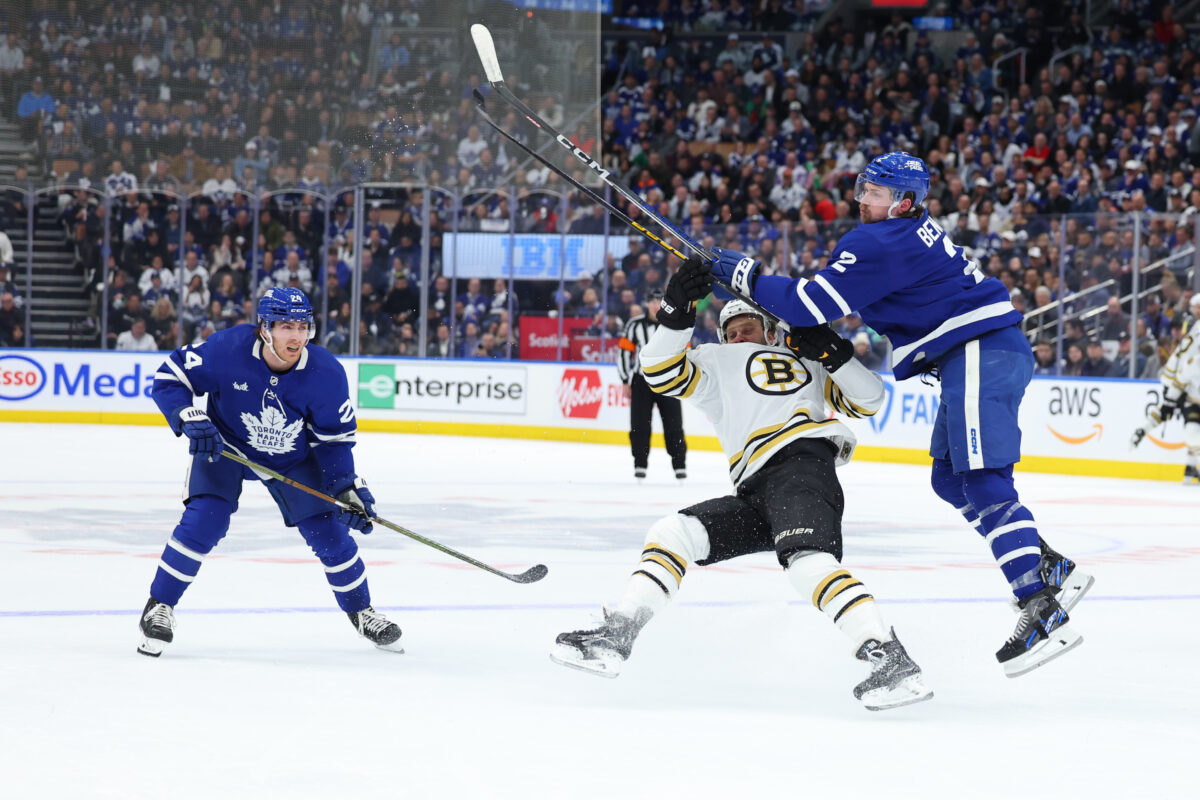 Simon Benoit lays a huge open ice hit during the first period of Game 3 of the Eastern Conference First Round playoffs between the Boston Bruins and the Toronto Maple Leafs.
(Photo by Gavin Napier/Icon Sportswire via Getty Images)
Woll, coming off a 27-win season, is expected to share the crease with Anthony Stolarz, so any time away from drills matters as he sharpens up for the season ahead. Benoit had been paired with Oliver Ekman-Larsson, the same partner he skated with during last spring’s playoff run, so his absence disrupts some early chemistry on the blue line. Roy, meanwhile, was centring a promising line with Dakota Joshua and Easton Cowan before being sidelined, making his situation worth watching given how much he could impact the team’s depth and versatility.
So far, nothing points to long-term setbacks, but the coaching staff is keeping a close eye on these bumps and tweaks. Depth players are getting longer looks in drills and scrimmages, which is giving the organization an early chance to evaluate who might be ready if a regular misses time. Fans might not love the phrase “day-to-day,” but at this point, that’s the best kind of news—no major headlines, just standard camp wear and tear.
Related: Maple Leafs News & Rumours: New Mood, Domi’s Injury & Rielly Rejuvenated
In the bigger picture, the Maple Leafs’ ability to navigate training camp with minimal injuries will set the tone for October. With such a competitive lineup, every absence—even a short one—opens the door for someone else to step up. That internal competition could make this camp more valuable than most, even if the injury reports remain a subplot for now.
Item Two: Maple Leafs Trade Assets: A Thin Cupboard for the Maple Leafs
One of the biggest challenges facing the Maple Leafs right now isn’t just what’s happening on the ice—it’s what they don’t have off it. Toronto is entering this season with a small collection of trade chips. Their first-round pick is gone until 2028, and next year’s second-rounder is already spoken for. That means when the trade deadline rolls around, the Maple Leafs will have little to dangle in front of selling teams.
 David Kampf, Toronto Maple Leafs (Photo by Kevin Sousa/NHLI via Getty Images)
Given that reality, the worst move they could make would be forcing a trade just for the sake of it. Shipping out Calle Järnkrok or David Kämpf won’t return anything meaningful, and moving prospects like Easton Cowan or Ben Danford would be reckless—mortgaging the future for short-term guesses. As I’ve noted, Järnkrok or Kämpf are valuable players, but they are replaceable. Given that injuries will always creep in, it makes more sense to place these two veterans on waivers and (if they are not picked up) accept the slight salary-cap loss, rather than handing away something with real value in a lopsided deal.
Related: 4 Maple Leafs to Keep an Eye on This Season
Given the number of replacements already on the team and the fact that there are simply no “gotta-get-this-player” guys out there, the Maple Leafs are better off standing pat than trading for nothing. Without premium draft picks or surplus prospects to deal, management will need to lean on internal growth and middle-six depth players for roster competition when there are injuries. Other contenders might bolster their lineups in March, but Toronto’s wisest play might be to keep what they have and ride it out.
Item Three: Tyler Hopkins Sent Back to Juniors After Strong Showing
It wasn’t a shock to see Tyler Hopkins reassigned to his junior club, but it still feels like he made an impression worth noting. The young forward came into camp without much expectation, yet his pace and willingness to compete against older players stood out. He didn’t look out of place, and that’s the best thing you can say about a teenager skating in a Maple Leafs camp.
 Tyler Hopkins, Kingston Frontenacs (Brandon Taylor/ OHL Images)
The decision to send him back has less to do with his performance and more to do with the organization’s long view. Hopkins will get far more ice time and responsibility playing a starring role in junior than sitting on the fringes of the Maple Leafs’ lineup. For a developing prospect, that’s where the real growth happens.
Related: Nicolas Roy Could Be the Maple Leafs’ Most Underrated Weapon
What matters is the second look he earned. The Maple Leafs now know they’ve got a prospect worth tracking closely, and Hopkins himself leaves camp with a taste of the pace, intensity, and preparation it takes to reach the NHL. That kind of experience can fuel a big season back in juniors—and possibly fast-track his path to Toronto in the years ahead.
What’s Next for the Maple Leafs?
The Maple Leafs’ immediate priority is getting through the rest of training camp without serious injuries. That’s always the unspoken goal—arrive at opening night as healthy as possible. The battles for spots in the bottom six and on defence will continue to heat up, and with Berube pushing for a tougher, more physical identity, the intensity isn’t going anywhere.
The bigger question is whether this team can live with its limitations off the ice. With no trade chips to burn, the Maple Leafs have to commit to developing what they already have. That’s not a failure—it might even be the kind of discipline the franchise has needed for a long time. October will give us the first look at how this group handles the grind, but the tone is already being set: what you see is what you get.
