
With Mitch Marner now in Vegas, the remaining Toronto Maple Leafs’ core is preparing to redistribute the offensive load.
Head coach Craig Berube is banking on a pair of key rebounds to keep the ship afloat — one from a fully healthy Auston Matthews, and the other from the blueline’s heartbeat in 31-year-old Morgan Rielly.
Toronto’s offensive output last season wasn’t anything to sneeze at (ranked eighth in 2024-25 both at even strength and on the power play), but compared to their own benchmarks, it relatively disappointed.
For context, last season’s even-strength scoring (2.6 goals per 60 minutes) marked a five-year low for the team. Whether it was Berube’s commitment to build in defensive integrity or the churn of injuries (not the least of which cost Matthews 15 games) that slowed the Maple Leafs down, Toronto’s brain trust knows their path to the playoffs necessitates high-end offensive production.
Perhaps that’s why Berube challenged Rielly entering the off-season. Berube was not pleased with his offensive output (41 points) last season, acknowledging some of it may have been borne from a much more conservative approach on the ice from Rielly, one that may have neutered his offensive capabilities.
And with new duties (including reassuming point responsibilities on the first power-play unit) coming in advance of the 2025-26 season, Toronto can ill afford another underwhelming campaign. Rielly’s skating and puck-moving ability from the back end can be lethal if used effectively, and greatly benefits even the best attackers in Toronto’s lineup – including Matthews.
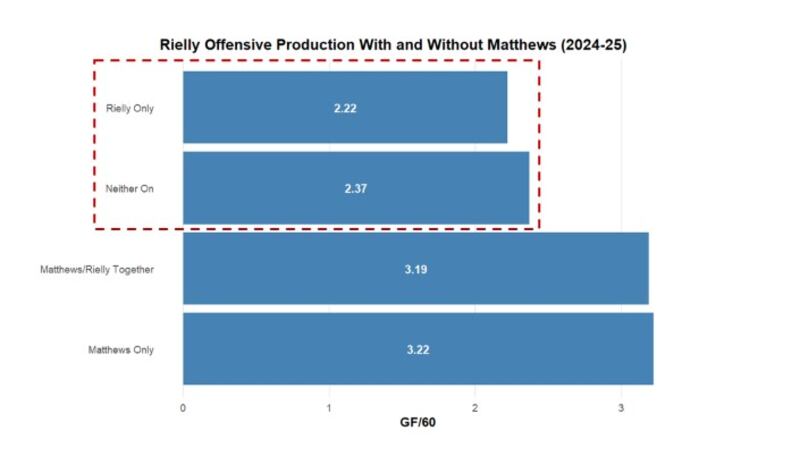
One data point that stands out from last season is that Toronto’s offence was woefully ineffective in Rielly’s minutes whenever he was playing with the non-Matthews lines. Great two-way defenders typically elevate the play of all their forward counterparts, and while Matthews and Rielly continued to make magic together, the opposite was true when split apart:
 Yost1
Yost1
It’s not about the Maple Leafs being less effective offensively with their first line on the bench; that’s a truism that spans all 32 teams. It’s the sheer size of the drawdown in performance, from a league-best attack to production levels you typically see from lottery teams. And while it may be harder to generate goals playing with Toronto’s bottom-nine forwards, it should not be lost on anyone that Toronto was more proficient offensively with both Matthews and Rielly sidelined, versus just Rielly. If Rielly serves as a major contributor for the attack, why was Toronto’s offence better without him?
It should be noted this is something of a multi-year trend. Look at the 2023-24 season, where Toronto finished with the league’s deadliest offence. Rielly’s numbers were directionally much better, but again, it appears entirely generated by Toronto’s top line rather than his own individual contributions:
 Yost2
Yost2
At this point in his career, Rielly isn’t going to distinguish himself as a premier – or even an above average – off-puck player. To the extent he’s valuable, it’s because he can ignite the offence from the back end and take much of the puck carrying and playmaking burden off the shoulders of Toronto’s forwards.
The hope is that the exit conversations between Berube and Rielly may have lit a fire under the alternate captain. He reportedly showed up to training camp lighter than usual and acknowledged the challenge from his head coach was in line with his own self-assessment of how last season went.
We won’t know if this is a truly inspired athlete or typical September training camp cliches until the regular season kicks off, but one thing is certain: Toronto needs the elite version of Rielly in their lineup if they are serious about contending this season.
Data via Natural Stat Trick, NHL.com, Evolving Hockey
Related Stories