
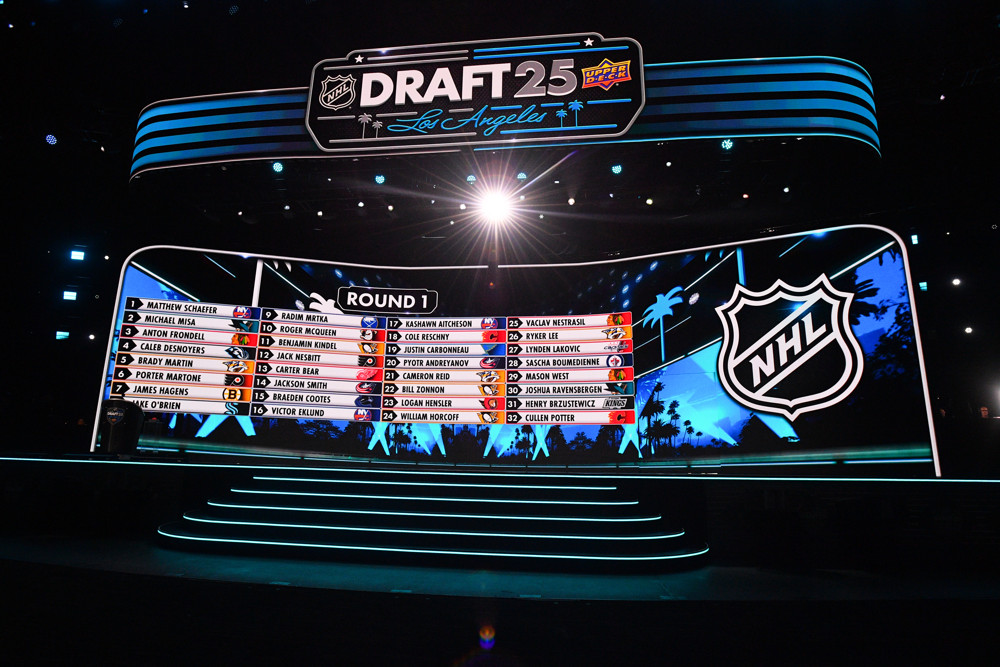
 LOS ANGELES, CA – JUNE 27: The compete picks of the first round of the 2025 Upper Deck NHL Draft at Peacock Theater on June 27, 2025 in Los Angeles, California. (Photo by Brian Rothmuller/Icon Sportswire)
The hockey scouting landscape is ever-changing. When you look at the recent decades, there have been ebbs and flows, as teams respond to the way the NHL game is evolving. At the very core, the NHL is a copy-cat league. As the Florida Panthers have dominated the playoffs in capturing two straight Stanley Cups, the focus at the draft has shifted to finding big, athletic, and physical players who can be difficult to play against. Teams are asking themselves, “is this a player who is going to step up or disappear in the postseason?” Look no further than the recent NHL draft where no defenders under six feet were selected.
While things like size, skating, and skill have always been valued, certain other traits or attributes have seen their merit fluctuate in my several decades of covering the game of hockey and the NHL Draft. Look no further than a few former articles that examine what scouts are looking for in players. Back in 2011, I put together this piece for my blog. Back in 2016, the great Gus Katsaros put together this piece for McKeen’s.
That begs the question, what are scouts looking for today? In an effort to build off those former pieces, we at McKeen’s Hockey have put together this piece to help our readers understand how we evaluate and what we value.
Forward
We polled our scouting team with the question, “what is the number one attribute that you look for in a forward?” The top answers by a great majority were “hockey sense” and “physicality/compete level.”
“Hockey sense is a term that’s difficult to define, but you know it when you see it. It touches so many areas of a prospect’s game. Being able to read and anticipate play or being in the right place at the right time. Recognizing your options as well as how much time and space you have to make a decision, both on and off the puck. Knowing your strengths and limitations and being able to leverage those to your advantage. To me, it’s always worth betting on smart players, even if they aren’t the flashiest. There are countless examples of players who don’t make it because they are all tools, no toolbox.” – Felix Robbins
“Hockey sense is one of the most subjective metrics used to analyze a player, and although many evaluate it differently, it is the most important attribute I look for in a forward. What separates the “elite” players at every level, regardless of physical skill, is how they think about the game and how quickly they can make their decisions. Even for players without top-end skill, a high hockey sense can put them in positions to complement their teammates that those without can’t really do. A high hockey sense gets you more opportunities with better linemates, gets you on special teams units and makes you a more versatile player compared to those who may have more refined skills but don’t think about the game as creatively.” – Aidan Carlson
“Hockey sense has a huge influence on a player’s pro projection. There are many forwards in the NHL who might not be the greatest skaters, shooters, puckhandlers, but if they can think the game at a high level, they can play anywhere in a lineup. The example that comes to mind for me is Ryan Strome. He is certainly not the fastest, nor the most physical. Some may view him as a disappointment as a 5th overall pick, but he’s on track to play 1,000 NHL games and has been a contributor everywhere he has gone. Whereas physical skills can be tangibly improved, it’s more difficult to get a player to be one step ahead, or consistently make the right read, or the best play. Of course, even hockey sense can be improved. And a lack of hockey sense can be mitigated by elite physical tools. But the guys who can think the game will always have the longest staying power in my book, so that’s what I target first. The guy who can make the clever connecting one-touch pass in the neutral zone because he scanned the ice before ever receiving the puck, or took a perfect angle to disrupt a play, that’s the guy that jumps out at me.” – Felix Sicard
“Prospects who understand where to go with and without the puck and can think the game are a step ahead of their peers. Game sense is crucial and one of the hardest things to teach.” – Adam Tate
“I don’t think you can win games at any level without players that compete. It doesn’t matter to me whether you are the smartest player on the ice, the fastest player, the player with the best shot… if you don’t compete hard, you will never be able to utilize those skills on the ice. Physicality is often intertwined with compete, and while they go hand-in-hand, players can compete without being overly physical. You don’t have to play like Brady Tkachuk or Jacob Trouba to successfully “compete”; you just have to prove to yourself and others that you want it more and will do whatever it takes to win. In my mind, that’s the most important skill any hockey player, regardless of position, needs to have to be successful.” – Michael Moroz
“In my view, compete level incorporates all the little details that a player is willing to do to help his team win. This includes how tenacious a player is in puck battles, how engaged he is on the forecheck, does he block shots or is he willing to take a hit to make a play, how engaged he is in the defensive zone, and does he go in the dirty areas in the offensive zone? It is the most important for me because I think competitiveness is a quality a player has or does not. And a player who competes will more likely find ways to go through the ups and downs of a season and a career. Also, I think it is a good sign that a player is willing to put in the effort to improve his game in the long run. I really think that for a player to have success and a long career in the NHL, the compete level is what makes the difference at the end of the day. Top players in the league have a high compete level. It doesn’t mean that they run everywhere wanting to hit everybody but they are engaged in doing the right things to win. When I watch players, I always keep playoff style hockey in mind and try to see if the player I am watching would be able to make an impact or be reliable in the playoffs.” – Jeremy Rivet
Secondary were attributes like “skating” and “puck skill/creativity.”
“The first thing I look at is Skating. It is the foundation and base of almost every prospects game for me. Want to get better at pretty much any other area of the game as a forward? Improve your skating. Skating gives you lanes to shoot, lanes to pass, gives you the ability to move the puck up ice, and recover for a back check. Skating is the first thing I talk about in every report I write and it is the defining thing I look at when I ask where a player needs to improve.” –
Linc Zdancewicz
“Skating – It’s the single greatest physical attribute that you can bring to the table that, if above average, can put you ahead of a number of your peers and, if below average, may doom you from advancing to higher levels.” – Chapin Landvogt
“Each year we hear from players and coaches that the game is getting faster. Players are skating at a faster pace, playing with more speed and skill compared to 10 to 15 years ago. With the speed of the game increasing, the decision making needs to be quicker. Players depend on their skating to get to the right areas on the ice. Players at the next level can have a career with average to below average skating but now, every organization has skating coaches to help improve and develop player’s skating. It is becoming more noticeable now than ever to identify players who have put in the work to improve their skating and which players have not.” – Liam Staples
“Forwards who compete hard but lack strong puck skills end up as bottom-sixers at best. On the other hand, when you combine a high-end competitor with at least above-average puck skills, you get a player with real upside. I always look at guys who made it despite some difficulties (usually being undersized) and that has shaped what I see as the ideal combo. A player who has the compete level to at least have a legitimate shot for an NHL career, but with individual skills that allow him to push for a bigger role, ideally in the top six.” – Matej Deraj
Of course, other attributes received recognition, most notably “personal character/leadership,” “strength on/off the puck,” “movement without the puck,” and “development opportunity/path.”
“Each player spends a very limited amount of time with the puck each game, so to me being able to play without is important in establishing an NHL projection. Movement without the puck is more than finding open pockets of space and creating scoring opportunities, it’s how they support the puck on breakouts and transitions, it’s how engaged they look when they’re defending the cycle (that includes scanning/ shoulder checking), and tying it back to “the compete level” attribute in my first selection, it’s how determined a player is to get the puck when they don’t have it (battling for loose pucks, applying pressure on the forecheck). For me, movement without the puck is tied closely with “Hockey Sense”, because it illustrates a player’s ability to read the play and then think/anticipate what they can do to create an advantageous situation for their team.” – Kyle Dalla Zanna
“Forwards are incredibly varied in how they can succeed in the National Hockey League and have many roles across the four lines that they can be deployed. However, the ability to win battles and tenacity speaks to me as being important secondarily to skating. Being aggressive with/without the puck says a lot about a players drive, compete, and mentality and it can overwrite some more glaring issues. The NHL is physical and heavy, finding ways to counter that is key. When forwards are aggressive and fight to get the puck on their stick, that is a great sign for me.” – Linc Zdancewicz
“I’m looking at a forward’s versatility. That’s a very attractive feature for me. I want someone who can have the ability to play up and down the lineup, or in any situation asked of him. Those are the true difference makers. If they need the puck on their stick to be effective, their path to the NHL is going to be more challenging. Macklin Celebrini. Brady Martin. Mike Richards. Jonathan Toews. Give me those types of forwards because I know that they can be difference makers in the playoffs and I know that they can be on the ice regardless of whether my team is down a goal or up one. You could certainly classify that as competitiveness. Or intensity. But I see it as versatility; forwards with a well-rounded skill set who can be workhorses, making those around them better and their team more successful” – Brock Otten
“The popular answer here might be two-way ability, offensive creativity, or work ethic, but I really think a player’s developmental opportunity really influences the type of career a player may have. If you don’t get an opportunity to play on a power play at a lower level, how can you be expected to be ready for such deployment at a higher level? Conversely, if you have been a “skill” player your whole life, how do you know whether you’ll have what it takes to carve out a bottom-six role in the pro game? In my mind, opportunity via development may dictate the type of skills a player adds to their repertoire, which in turn may determine how that player’s career ultimately materializes at the pro level.” – Michael Moroz
“For NHLers, playing hockey is more than just a game or a career: it’s an all-encompassing lifestyle. And because there are so few jobs in the NHL, there is tremendous competition among hockey players to reach and fulfil that lifestyle. It’s nearly impossible nowadays to make the NHL, and then stick around for a while, without character traits like competitiveness, perseverance, resilience, self-improvement, sacrifice and commitment. Other traits like skating or puck skill or decision-making can vary in successful players, although all of them can be improved over time and then maintained if a player’s character is high enough.” – Derek Neumeier
Defense
We asked the same question to our team about defenders, “what is the number one attribute that you look for in a defenseman?” Again, “hockey sense” was a top answer, but this time “skating” took on more weight
“Hockey sense is something that transcends position. You can have all the tools in the world, but you need to know how to put them together. For defencemen specifically, there’s so much to keep track of when defending and it only gets more difficult at higher levels. Being able to read puck carriers intentions, being aware of who’s on the ice (friend or foe), knowing how much time and space you have when retrieving pucks and knowing what to do with the puck before you’ve even touched it, to name a few things. Good habits like pre-scanning are important. Then there’s transition play and offensive instincts like knowing when to jump up on the rush or when to pinch. I don’t expect anyone to be an expert at 18, but I want to see some gears turning.” – Felix Robbins
“Decision-making is the most important aspect for a defenseman, mistakes from blueliners end up in the back of the net.” – Jamison Derksen
“As defensemen are tasked with many decisions per game on the breakout, effectively finding outlets and making smart decisions to exit the zone is an incredibly impactful trait. In the offensive zone, defensemen must read the play in order to pounce on opportunities to activate from the point or find cross seam passes.” – Kaeden Ireland
“While I do think hockey sense is an extremely vague term that can be dissected in hundreds of different ways, I think the defensive decision making on and off the puck falls into that category. I want my defencemen to know what to do without the puck (how to use and position their stick, when to pinch, to block shots or to block passing lanes, where everyone on the ice is, and how to be efficient to eliminate scoring threats) and with the puck (identifying the best breakout path, avoiding mistakes and traps).” – Jeremi Plourde
“Skating is most important, because four-way mobility is essential to being able to defend at higher level, lateral and backwards skating especially. Skating is critical when it comes to defending a rush or quick counterattack because if you’re unable to match an attacker’s footwork and use your feet to establish and control your gap on an attacker when they’re coming at you with speed, you’re going to get burned every time. Edgework is also important. Being able to make sharp pivots and quick turns to create space and escape pressure in tight areas are key to being a reliable defender that is capable of moving pucks.” – Kyle Dalla Zanna
“Skating is king. If a defenseman can’t pivot, accelerate, and keep a tight gap, they’re toast. Modern hockey is all about quick breakouts. A mobile D can escape forechecks, turn up ice, and get the puck moving. Poor skaters often panic and rim pucks away, leading to turnovers and extended defensive-zone shifts. Even the best-positioned defender will get beat sometimes. Skating lets them recover with backwards speed, crossovers, or quick pivots to kill chances.” – Marek Novotny
“Skating for a defenseman is so much more important than for a forward. While a forward can out-think and out-skill skating deficiencies, it is much more difficult for a defenseman to do so. There are more situations where a defenseman’s skating can make or break their ability to impact the play, whether it’s defending the rush, retrieving pucks below the goal line, or making well timed pinches at the offensive blueline. Skating is not the be all and end all, but it’s close to it for defensemen.” – Felix Sicard
Secondary were attributes like “physicality/compete,” “passing ability/vision,” “movement without the puck,” and “size.”
“Defending is a hard, grueling job. They need to be able to absorb offensive pressure and bend without breaking, while being hit by forecheckers, grinding along the boards, or battling (usually outnumbered) for control of the net-front area. A lot of defensive work is physical and unglamorous. At the same time, even smaller defensemen, who might lack physical advantages, can still be successful if their compete level is high enough, allowing them to consistently withstand or evade physical attacks against them.” – Derek Neumeier
“I think puck management is one of the top things I’m looking for from defenders. That vision/decision making element is incredibly important as they move up the ladder and time/space decreases. Regardless of whether you’re classified as an offensive defender or a stay-at-home type, you’re going to need to take care of the puck or you won’t play in the NHL. We’ve seen extremely creative and skilled defenders who can put up a ton of points struggle to make that transition to the NHL because their decision making with the puck lacks consistency. We’ve seen physical brutes, even athletic ones, struggle to stick in the NHL because they fold under the pressure of the forecheck. While this skill set can obviously be improved, defenders who struggle with their first pass, retrieval routes/habits, and overall puck management at the junior level are only going to struggle more at higher levels. So regardless of the future role I’m looking at a defender playing, I see this as one of the most critical things to scout in the position.” – Brock Otten
“The number one thing I look at for a defenseman is how well they position themselves and their stick. Do they know when to close the gap on an attacker, vs. shadow him? Are they aware of the lanes they can put their stick in to disrupt a play? Is their body open or closed to the defender at the right times? Just being in the right spot to either defend the puck or the pass goes a long way. It’s even better when a player is vocal and helps his teammates out with this, but that falls more under the category of leadership.” – Aidan Carlson
Other Factors
While grading certain characteristics and weighing them against each other is ultimately one of the main components of scouting, there are certain mitigating factors that also come into play. We’ll call them “green flags” and “red flags.” “Green flags are things that really make you interested in a player, perhaps more than one or two individual components of their game. It’s ultimately what makes that player a must draft for you. “Red flags” are the opposite; things that cause you to pause and reflect on whether said player is worthy of a draft selection. Again, we polled our scouts on their biggest “green” and “red” flags.
Green Flags
“I’m looking for progression. Year to year. Beginning of the season to end of the season. I’m looking for players who finish the year better than they start it. That tells me a variety of different things. For one, that they’re coachable and willing to put in the work to improve their games. For two, it tells me that they have another gear that they can reach and that their upside may be worth betting on. For three, it tells me that they are intelligent players themselves, who are able to adapt their games to find more success given their situations. Bottom line, I want players who are showing growth and not plateauing already. Year after year, the late season risers who rocket up draft boards closer to the draft tend to end up being great players.” – Brock Otten
“When a player has a standout trait. The majority of the prospects you scout usually are average in almost every category and that’s a talent in itself. But when you notice a player that can skate much faster than everyone, shoot harder, drive play more consistently, those are the players that have traits that are better than the average and will have the highest chance of making the NHL.” – Simon Johansson
“I would go with hockey sense. A player with elite hockey sense can often outlast or outplay someone who is bigger, faster, or stronger but doesn’t think the game. Smart players adapt faster and find ways to impact + good hockey IQ makes everyone around them more effective.” – Marek Novotny
“I always look for players who can maximize their individual situation and stand out as difference-makers, regardless of the circumstances. A good player should always be able to find a way to stand out and contribute something that tangibly elevates their team and leads to its success, even on dominant teams. At the same time, good players always find noticeable ways to stand out and make a positive difference even if they’re playing on the worst team in the league. The best is when you see examples of prospects succeeding in both the good times and the bad, because all NHL teams will go through both periods and all players will eventually be tested in both ways” – Derek Neumeier
“A willingness to work on and improve the areas of their game that aren’t as developed. You typically can’t be a one-dimensional player at the next level.” – Mika Burns
“Pace of play and consistent play. A player’s ability to keep that motor going every shift.” – Mark Dube
“Having a standout trait. What can this player use as their foundation as a pro?” – Jamison Derksen
“Forwards: Dynamism on the puck – being able to use sharp stick handling moves in tight and effectively get the puck through defenders is very helpful on the rush and in the cycle game to evade pressure. Defensemen: Use of body fakes to help in transition. This is extremely helpful for slower and smaller defenseman who can’t speed by/ muscle through.” – Kaeden Ireland
“I would say versatility, I think that the more boxes a player checks, the more chances he has to find a role in the NHL. On a game-to-game basis, the more versatile the player is, the more he can still be efficient when a part of his game doesn’t work as well that night, by relying on his versatility.” – Jeremi Plourde
“The biggest green flag for any prospect in any position would be their competitiveness or resilience. I love it when prospects show that they care, they want to battle and are never truly out of the fight. I find that I can notice the true leaders of the team by how a player communicates with their teammates when their team is down on the scoreboard. How are they motivating them to bring their team back into the game? Are they showing frustration, letting the game get away from them? Or are they staying calm and uplifting their teammates? I love to see that.” – Liam Staples
Red Flags
“It makes me really frustrated when players are scared of contact. Far too often I see a talented player get lined up along the boards and quickly throw the puck away to avoid the check and give up the puck. Even more often I see players stay away from board battles entirely. Both scenarios drop a player down my list. Hockey is a tough sport and if you are afraid to take a hit to make a play, you are not going to last long in the pros.” – Henry Lawrence
“Not having a physical game is one thing, but a lack of “compete” is what I consider to be the make-or-break factor for any prospect’s NHL projection. It could be physical resilience, a willingness to battle, or a high-end motor, for example. You just can’t teach that “win or die” mentality. Not everyone can be as intense as Steve Yzerman, for example, but there has to be something that makes me believe you’ll do anything to help your team win or I’ll lose interest.” – Felix Robbins
“I am of the personal belief that competitiveness is something that you’re born with; it’s innate. So, when I see a prospect struggling to find consistency who lacks that “dog” in him, it always concerns me. Sometimes you’ll see scouts/analysts say, “if they can find that next level and play with more conviction, it’ll drastically help their game.” I’d argue that it’s pretty unlikely those players do end up finding that. I’d rather let someone else draft those players.” – Brock Otten
“For me, the biggest red flag for a forward is when a player is playing too much on the outside and never attacks the middle of the ice for fear of getting hit. In the NHL, to produce offensively, players need to be willing to attack the middle. These kinds of players can find ways to produce in junior, but they will struggle to do so in the NHL. For a defenseman, it is the lack of defensive engagement or losing battles too easily in their zone. In the NHL, to win, you want defenseman that are hard to play against no matter what their size is.” – Jeremy Rivet
“If a smaller skill player is not a topflight – or at least clearly above-average – skater, then this drops him way down the totem pole right off the bat. He needs to have that second gear and he needs to be more agile and mobile than his larger peers. It feels like a number of smaller offensive players who were not exceptional skaters have been drafted over time, and you likely don’t need more than one hand to count how many of them have made it as a regular NHLer this century. You probably won’t even need all five fingers…” – Chapin Landvogt
“Character Issues – if the player is going to be a problem in the locker room and the community in general, regardless of skill level, it’s best to move on.” – Adam Tate
“An insufficient amount of natural or developable athleticism by the time a prospect is of draft age. Some progress can be made here with some players, but by and large, if you’re too far behind at 18 years old there are stiff limits for how far you can go from there. NHLers are professional athletes who now have to commit themselves to living that lifestyle year-round, and the league is composed of the best of the best of these athletes. While some players might be exceptional in some traits (like shooting or puck skill or hockey sense), they won’t be able to achieve sustained success in the NHL if they can’t handle the overall athletic demands, which can be seen in countless individual scouting case studies over the past few decades.” – Derek Neumeier