
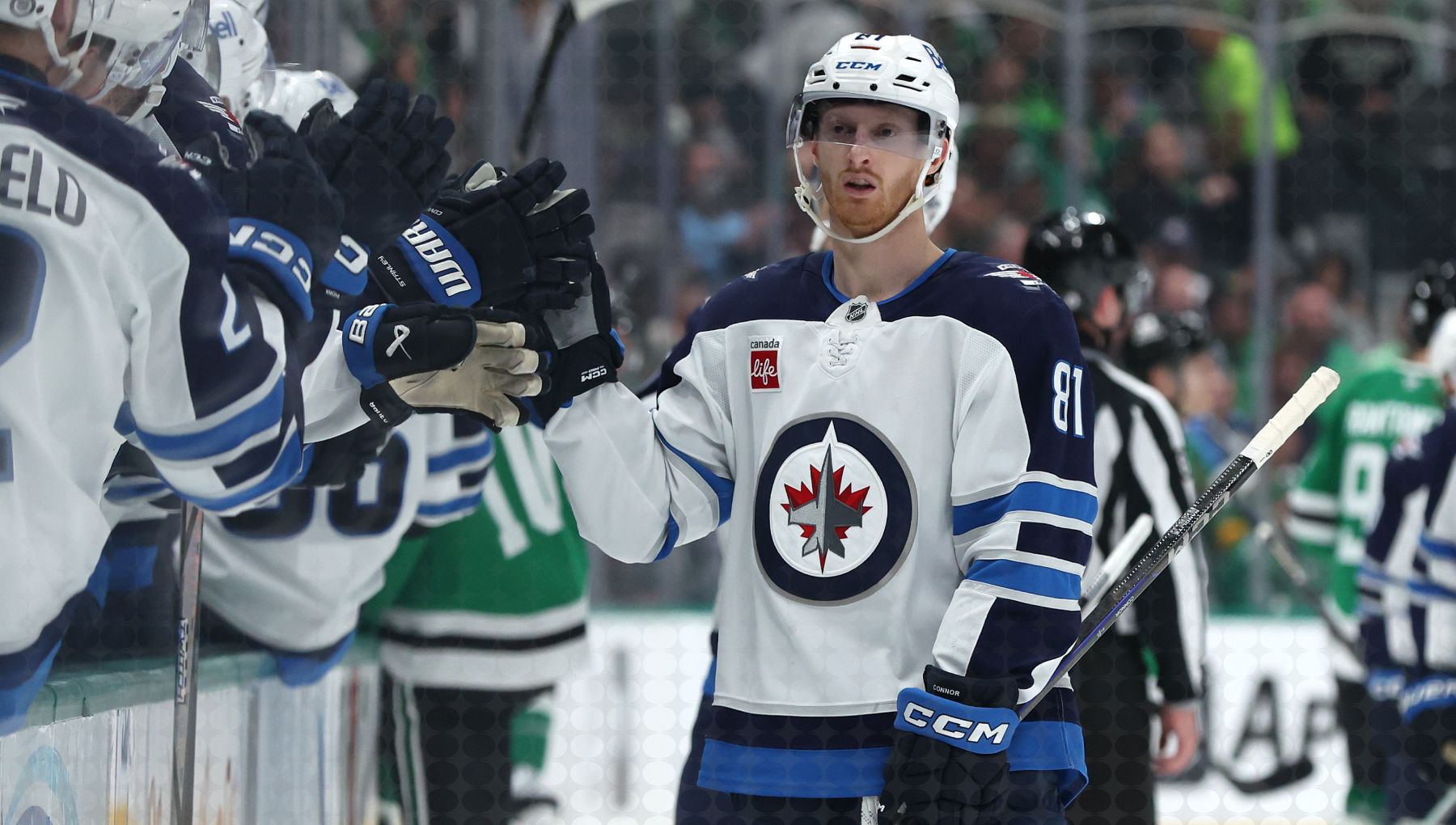
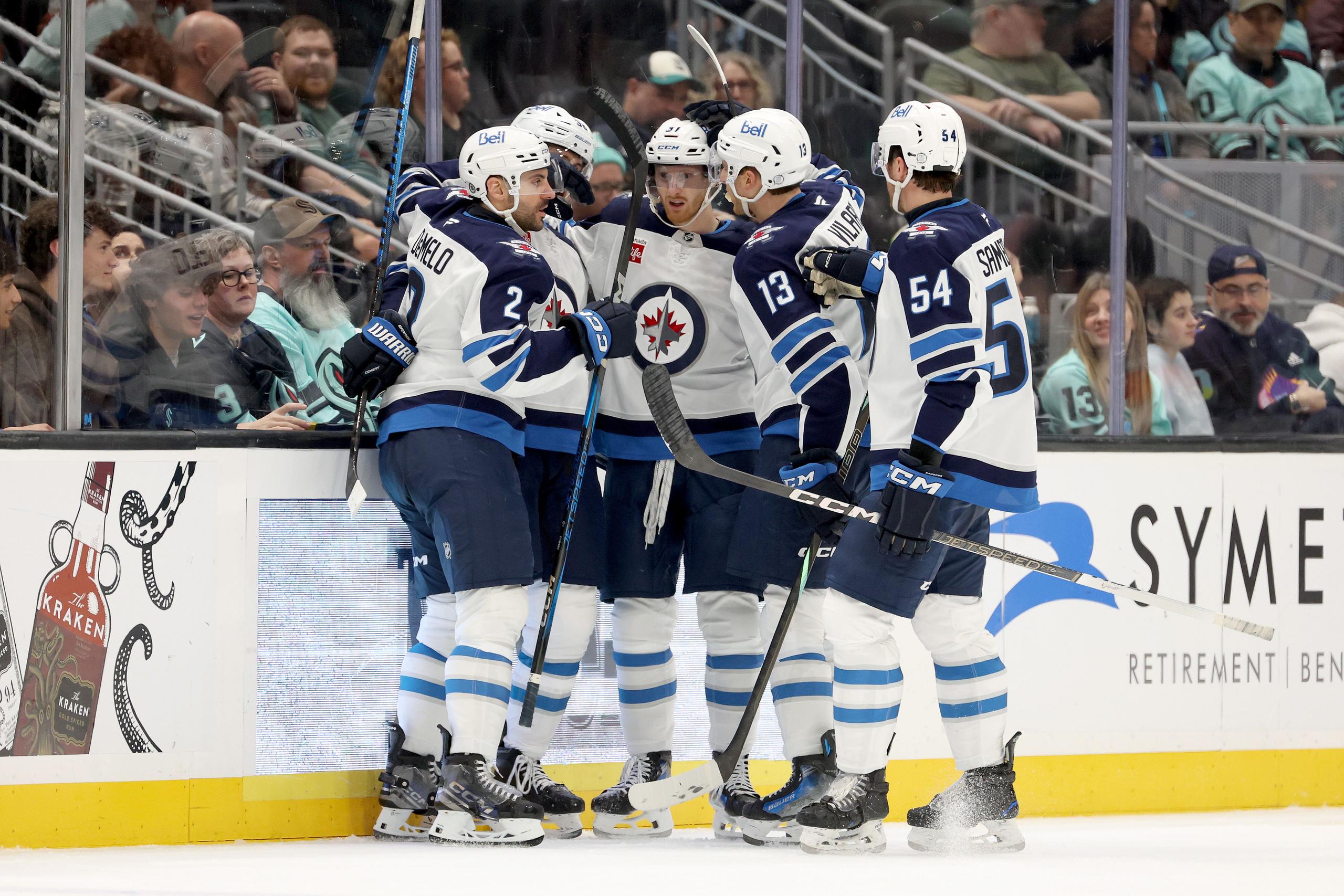
Winnipeg Jets celebrating a goal (Photo by Steph Chambers/Getty Images)
The Winnipeg Jets are entering an important season with big questions on the horizon. From Kyle Connor’s contract status to the challenges of competing as a small-market team, ownership has plenty to navigate.
With Jonathan Toews coming home to Winnipeg, the Jets also add a proven winner to their lineup. RG sat down with chairman Mark Chipman to discuss Connor’s future, the team’s outlook under a rising cap, and what Toews brings to the organization.
Interview With Mark Chipman
Is there any concern about Kyle Connor and where contract talks with him are headed?
“No, I think my sense, and I’m not involved in this directly, this is what Chevy’s [Jets General Manager Kevin Cheveldayoff] done so well for us and his group, so I don’t envision ‘K.C.’ going anywhere,” Chipman replied. “I think he’s part of that group that I’ve been talking about. He’s part of our core, and these guys are very, very close. I think it would be my expectation that we’ll get something done sooner rather than later. My instincts are telling me that this is likely going to get done.”
Ottawa Senators owner Michael Andlauer has been very honest with his fanbase that, as a small-market team, the Senators won’t always spend to the salary cap, even as it rises. Being in a similar situation, how have you and how will you approach that?
“Well, I think what you have to understand when you’re talking about small market teams is, I mean, we tend to get very focused on the cap because that’s what is forward-facing to the public,” Chipman pointed out.
“That’s what the fans are reading about and hearing about. But the CBA is a very comprehensive document that was engineered to create a sense of competitive balance in the league, and what I mean by that is, yeah, there’s a cap, and that helps create that balance. But, there’s also a revenue sharing model that, if you build your team the right way, and you run your team responsibly and you can generate the necessary revenues that you can get yourself to the cap. We don’t talk about that, and it’s a complicated formula that isn’t easily explained or understood.
I think what Michael’s well aware of, as are we, you can be a small market team and you can be a cap team. I mean, that’s what we’ve been, yeah, the cap’s going up, but there are mechanisms inside that adjust. You can’t just go to sleep, and it’s not a welfare state. You’ve got to do the work, and you got to run your team well, and Michael will. And if you do those things, you can get to the cap and be competitive.”
With that being said, will it be harder for teams that aren’t in a ‘hockey market’ like Winnipeg or Ottawa, where the community lives and breathes hockey, to maintain that competitive balance?
“I don’t think so. I mean, I look at some of those markets that everybody used to refer to as non-traditional, and they’re thriving,” Chipman pointed out.
“We go into Nashville, they’ve done a remarkable job there. And it’s not because they don’t have a state income tax. I mean, I know that can be helpful, but they’ve done a really good job of bringing the game to their fan base. And now that the fan base understands how good the game is.
I think that’s the responsibility of our league and every individual club is to grow the game and show people how good it is. And then, yeah, there’s obviously hotbeds of hockey where it’s better understood, let’s say, or there’s a longer history and heritage to it. But those non-traditional markets really don’t exist anymore. I mean, the Florida Panthers just won the last two Stanley Cups. The Dallas Stars are an absolute juggernaut. But I keep going back to Nashville. They’ve won a Presidents’ Trophy in Nashville, and they’ve gone to the Stanley Cup final in Nashville. I think as long as you’ve got the quality of ownership that our league now has, it doesn’t really matter where the market is because the game speaks for itself if you do it the right way.
I also believe that part of the magic of our game is the quality of the people who play it. So it’s going to continue to grow, and it should. So, I don’t look at it as we’re in non-traditional markets anymore. There’s no such thing. And I think that’s what the league’s done an exceptionally good job of is finding that. It took time. It wasn’t a linear path, but when you get good owners in good markets that are investing in the game and investing in taking care of players, it’s just naturally going to grow.”
What will the addition of Jonathan Toews bring to this team?
“I don’t think there’s been a better leader in the game in my time,” Chipman said of the 37-year-old and future Hall of Famer. “We came into the league in 2011, just as Jonathan was hitting his stride, right in that 10-year period where they won three cups. I don’t know. I mean, I think you talk about Jonathan and Sidney Crosby in the same sentence, right, in that 10-year block in terms of leadership. So, to have somebody with those intangibles, I think it’s just invaluable. I think we’ve got a very mature group. I’ve been saying these kids have grown up together. They’re men now. And I think it is a very natural fit. If he were with just a whole bunch, a brand new rebuild team or whatever, I don’t know that that works, but I think it does work with us because we’re a very mature group.”
How excited are you for the new season?
“This time of year always has some form of excitement,” Chipman replied.
“The team is a really good group, and they’ve won 154 games over the last three years, which is the most of any team in the league over that stretch. So there’s sort of a built-in excitement/expectation, and there has been over the past several years, to be honest with you. It’s a team that’s only missed the playoffs once in the last eight years. So there’s been this growing level of expectation that I think turns into excitement. So I would say that’s the trajectory we’re on. And yeah, there’s a palpable sense of anticipation in the group right now.”
As has been the case with so many Stanley Cup winners, there are moments and lessons learned from previous seasons that helped a team finally win it all. Do you feel like your team is building off moments and lessons like that?
“I would think so,” Chipman said. “I mean, look, there’ve been years where we got past the first round and past the second round and got into a conference finals. But every year and every series is different. And I think you take something from it all, and you learn something from every series; they’re always different.
Last year, two very different series. The first one was the most physical series I’ve ever observed in my time in the game. It was like St. Louis was the best team in the league from the trade deadline on. They were really playing well, and they’re a really good team, and they’re very physical. We matched their physicality. Sometimes it didn’t feel like that, but it felt like we were the only ones getting hit. But they hit, there were like 600 plus hits in that series, and it was pretty even. I think we actually had a few more, but I think we learned, I think our guys learned how to survive a really physical series that for sure, and that’s something they can put in their pocket.
In the Dallas series, I thought we played really well. I think the group was physically pretty tired going into it, but I liked the way we responded. I thought we played really well. And right up into game six, we had a lead in game six, and I think we felt like we were going to win that. And if we win Game 6, we’ve got a really good chance of winning Game 7 at home.
We had a heartbreaking development before game six, when Scheif’s [Mark Scheifele] father passed away, but that was really galvanizing for our group. And I don’t know that we could have got through that game the way we did if this group hadn’t grown up together and been through those other playoff series over the past eight years. We almost pulled it off with a really, really difficult tragedy that occurred. So I don’t know. I mean, I think you’ll learn with every series, and so hopefully we’ve got something to build on for this year.