
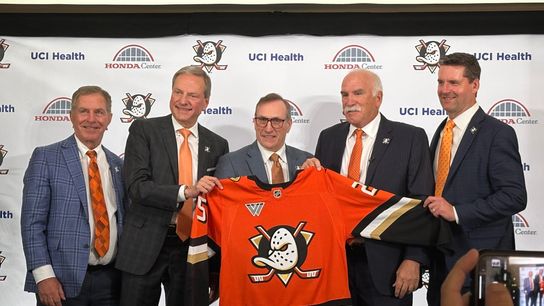
ANAHEIM, Calif. – Joel Quenneville was hired as the next coach of the Anaheim Ducks on Thursday, and with the baggage Quenneville brings, Ducks owner Henry Samueli understood the importance of speaking publicly on the team’s decision to hire the three-time Stanley Cup champion.
Quenneville has been out of hockey for nearly four years following an investigation into improper handling of alleged sexual assault within the 2010 Chicago Blackhawks organization. The 66-year-old was reinstated by NHL commissioner Gary Bettman last July, but any team that hired him knew there would be plenty of due diligence to clear his hiring internally and explain the work done to their respective fanbase.
The Ducks were the team to make the call, and for the first time in quite some time, Samueli addressed the media in a nearly 13-minute session to take on that explanation.
Samueli spoke on the concerns in hiring Quenneville, anticipating the reaction to hiring Quenneville and what made him comfortable in hiring Quenneville in the face of that.
The Ducks owner also noted what the team will do for the community of sexual abuse and assault survivors, the change of old-school hockey culture and finished with the outlook of opening the check book to make the Ducks a playoff team.
Here is a full transcript (edited for clarity) of Samueli’s media availability:
Joel Quenneville, obviously accomplished, but obviously extra that’s attached to him. What was your concern level when Pat Verbeek came to you with the possibility of hiring him, investigating him or looking at him?
Of course, it was a concern. First thing we talked about is what sort of due diligence have you done? Who have you spoken to? We spent hours literally going through all the details of his due diligence as we spoke to him and what they had to say. It was a very thorough process, starting with I spoke to Gary Bettman at the league, and as you heard earlier, they spoke to Kyle Beach.
So it was really important to Susan and I that we did a very thorough diligence on what happened, and we were very comfortable with the outcome of that. You have good people who make mistakes. You have bad people who make mistakes. So you want to make sure that you’re dealing with a good person who just happened to make a mistake. And I am absolutely convinced. Joel is a really good person.
He made a mistake. I make mistakes. Everybody makes mistakes. He paid the price, and spent three, four years out of the league, educating himself on what he should be doing better, what he could have done better, how to handle things. I feel very good that we’re in a good position.
And we’ve made it a top priority for Joel and Pat (Verbeek, Ducks general manager), this is going to be the safest team in the league when it comes to those types of issues. He’s going to be all over it, constantly talking to the players, to the other coaches, to the staff. So I feel very good about it. It was a process. It was.
You guys are obviously known and have done many endeavors that are very family friendly, community oriented, that you also kind of have to wonder, what would that reaction be like? In terms of the optics.
Absolutely correct. Correct. No, Susan and I have built a reputation in this community, hopefully a good one, and obviously preserving that is really important. We know that there will be negative comments on social media, but to us, it’s most important that we maintain our integrity.
Did we do a thorough investigation? Are we comfortable with Joel in his current state of health and being mental wellness? And we are comfortable, very comfortable, and we’re really not overly worried that it’s going to become a problem.
I mean, yes, we’ll hear negatives. Fine. We’ll deal with it, and I fully respect people who have negative opinions are going to have negative comments, a lot of people who are victims of abuse and I have nothing but the most respect for them, and we’ll listen and try to convince them that we really did go through a thorough process, and that Joel really is a good person who happened to make a mistake.
So I feel comfortable that we can deal with the situation.
You can be convinced that he’s a good person. He’s changed, but the fact remains there are a lot of other really good coaches out there who do not come on Joel Quenneville’s baggage. What was it about Joel specifically that changed that lever for you and Susan that made it more worth hiring him than another really good coach who doesn’t alienate a segment of the fanbase?
Correct. Well, first of all, as you heard a million times, you can’t argue with his record. A younger coach, there’s risk. They may have great experience, but do they really have that track record in the NHL? So going with somebody who’s been in the NHL, second winningest coach all time, he doesn’t have to prove his capabilities. We know his capabilities.
And then we look at his prior record of working with teams, as he mentioned on the stage, who are in a very similar situation as the Ducks A lot of young talent, ready to break out, and he’s done it twice. He did it in Chicago and in Florida, although he didn’t carry it all the way through in Florida, but we see how great of a team they’ve turned out to be. So, the fact that he has a historical record of greatness, but he’s also being put in a position where he’s been in twice before and succeeded twice before, lowered the risk for us, and that’s the reason he would go with him
How much did it contribute to your comfort level when you had a chance to talk to him and lay those things out on the table?
Oh, huge contribution to the decision. You can read all you want and read all the social media, read the press, read this, read that, but until you talked to the person, sat down with him and spoke to him, it made a big difference, big difference.
Did you feel that you or anyone else connected to you, needed to get the blessing of either the league, Kyle Beach himself, sexual abuse survivors? Did you feel like you needed to get the blessing from them?
Well, I wouldn’t call it a blessing. We needed to speak to them. And we did. We spoke to every one of them. Not me personally, for everybody. I spoke to Gary, obviously, but between Pat and Aaron (Teats) and others, literally spoke to all of the whole list of what Joel read on stage.
So we had to get a comfort level that these people were comfortable with Joel. They believe that Joel was remorseful. He has learned, and he is ready to come back and be a coach in the NHL. So we were very comfortable with that. Yes, we did speak to them all and got a level of comfort from all of them.
People have tried to describe what happened in Chicago was kind of a failure of hockey culture. It was a very old, traditional culture and it wasn’t equipped to handle a problem like that. You have a GM (Bob Murray) a few years ago that was also from the old school, very much a hockey culture guy and he lost a job because of that, probably. Did you feel any way that this is part of a change in hockey? Did you feel like Joel’s evolution and the things that he was doing are part of taking that next time and getting out of the dark ages hockey? You didn’t grow up in hockey. You didn’t grow up in the game, so how do you see that?
No, no, you’re absolutely right. There is an old time hockey culture, but I think the four years that Joel spent out of hockey has really given him an opportunity to learn a lot. I mean, from all the people he mentioned on the list he read on the stage. So in my mind, he will be a model coach for dealing with situations like this. I think he will be a mentor to other coaches in the league who can come to him and talk to him. How do you handle situations like that? What do you do? And they’ll trust him because he is old school, and he’s changed.
So you made a very good point. The fact that he comes from an old school hockey culture and lived in an old school hockey culture, and now has transitioned and learned what it means to operate in 2025, not 1980 or whatever. So I think that will make a very big difference in how he operates because he’s learned so much over the last four years.
Do you expect that there’s still going to be some blowback?
I hope not much, because again, we tackle the issue head on. It’s not like we’re trying to hide behind it. We came head on into the issue. We’re an open book. We told everybody what we did, how we did it. Conversations we had will remain private to respect people’s privacy.
But as transparent as we can be, we’re telling everybody what we did, and hopefully they’ll understand and they’ll read more about it, because if you just read social media headlines, you’re going to get the wrong message. So we’re encouraging people to, if they are interested to really learn what happened, read all the accounts of what happened. And I think hopefully they’ll feel better and it will minimize the blowback.
This team, yourself, your family, you’ve all been very community focused, philanthropic. What sort of the plans of this team has or the family has to reach out to that community of sexual abuse survivors and make them feel welcome in this organization, in this community?
For sure, as Pat mentioned on the stage. I mean, we’re already very deeply involved in the community. We work, Susan in fact, the foundation does work with sexual human trafficking and so many organizations that we’re working with in the abuse area.
The connections are already made. It would be very easy for us to introduce Joel to those folks. He can get more involved in the philanthropic side with our foundation. It will happen. I’m very confident Joel will be a star when it comes to working with those organizations. That’s a very good point.
To ask about the team. Seven years without the playoffs, been a difficult rebuild, difficult steps forward. Where do you see the Ducks are at in their evolution?
Absolutely, good question. It has been a long, painful process, but we felt that we’ve reached a point where the rebuild is coming to an end. It really is, and it’s time to take the step to becoming a perennial playoff contender and eventually Stanley Cup contender.
So we said, look, if we want to take that step, we really should bring in a coach who has been there and done that. And that was one of the main reasons for wanting to bring someone like Joel Quenneville in, because we felt comfortable that he could take us from the end of a rebuild to the beginning of a playoff era.
We were a perennial playoff team, five-time division champion. We’ve been through that. We know what it’s like, and I miss it personally going to playoff games. That’s one reason we were willing to write a much bigger check this time around. That’s because bringing in someone of Joel’s stature that’s going to cost more money, but we’re willing to make that investment into the team.
We’ve told the same thing to Pat. Going out looking for players, you will have the budget you need to make this a serious playoff team. You don’t have to pinch pennies anymore. Do what it takes to make us a contender.
It’s a rising cap. Does that mean spending to the cap?
Potentially, if necessary. He’s going to spend wisely. We’re not going to write stupid checks, but I told him, do what it takes to make this a really steady, perennial playoff contender and Stanley Cup contender down the road. And if that means signing big-name free agents, go for it.
We told him, going forward, you will not be constrained by the budget.
When Pat fired Greg Cronin, he said we expect to make the playoffs next year. First time he’s said that in two and a half years. Do you share that?
Oh, 100%. That is the pressure we’re putting on both Pat and Joel. They know that the fans and the ownership expect to make the playoffs this season. It’s a lot of pressure to put on a coach and GM, but you’ve got to do it.
Will you be delighted when this whole thing becomes a hockey conversation and that’s all?
Exactly. That’s why I’m standing here, willing to address all these issues. I have no problem with it. Because again, I feel good about the decision we made. But once they’re on the ice playing, hopefully winning, hopefully this all gets put to bed and people look at Joel as just a great coach.