
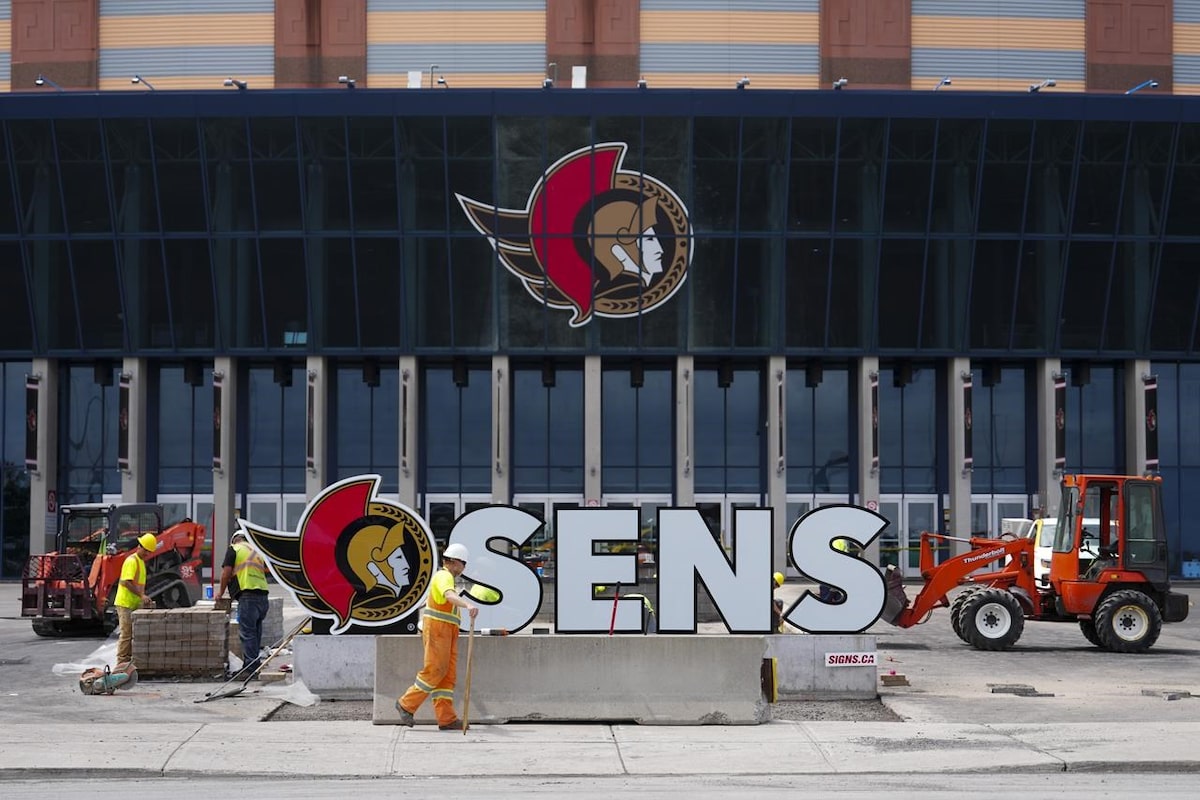
Landscapers work around Ottawa Senators NHL team signage at the Canadian Tire Centre, in June, 2023. The Senators announced last month a deal to purchase 11 acres near downtown Ottawa from the crown corporation that oversees public land in the capital region.The Canadian Press
When looking to build pro sports facilities, team owners often want public money to help get the ball over the line. Governments should not play along.
Unfortunately, this is a test that leaders keep failing.
In Edmonton, council recently agreed to a deal that would funnel city and provincial money into an “event park” associated with the newish Oilers arena, which was itself subsidized. And in Ottawa, the city is putting money into two sports facilities and will likely be asked to pay towards another, where the Senators will play.
This is not a problem with just professional sports. Toronto and Vancouver are scheduled to host 13 World Cup matches next year at a total cost of up to $1-billion.
The Senators announced last month a deal to purchase 11 acres near downtown Ottawa from the crown corporation that oversees public land in the capital region. Team owner Michael Andlauer has previously said that a new arena would require funding from all levels of government, according to the Ottawa Citizen.
So far Ottawa Mayor Mark Sutcliffe is saying the right thing about subsidizing a home for the Senators, telling CTV “I don’t think the public wants us to write a cheque.”
However, while his conclusion might be correct his logical process leaves something to be desired. The mayor cites as a higher priority a plan to refurbish the stadium where the Redblacks CFL team plays and build an arena for the the Charge, a women’s professional hockey team, and the 67s, a major junior team.
Arguing that the city shouldn’t pay for one pro sports facility because it’s already funding two others is a difficult case to make compelling. And the fact is that city may end up paying into the Senators’ facility anyway.
The chosen site for their new arena has contaminated soil; clean-up could be eligible for city funding under an Ottawa program for former industrial land. The city’s share was pegged at up to $150-million a decade ago, and the price tag is unlikely to have shrunk over that time.
Given that an arena couldn’t be built unless the soil issues are addressed, such an assist must be considered a subsidy.
In Edmonton, meanwhile, council voted at the end of last month to approve a $408-million master agreement between the province, city and the Oilers’ owner – nearly 80 per cent of it publicly funded.
More than half of the money will fund a new venue, operated by the Oilers’ owner, that will sit alongside the team’s current home and host sports, conventions and trade shows and community events. Some of the money will go towards demolishing the Oilers’ old home, the Coliseum, which the city took over after forgiving its debts. Another subsidy.
The only defensible part of the deal is a plan to build housing on what is now surface parking. There are many better uses for valuable urban land than car storage, which in any event is not in short supply in the city. A staff report two years ago identified 275 parking lots in downtown Edmonton.
Opinion: Public money should not fund Ottawa Senators’ fancy new stadium
However, some councillors criticized the wording of the agreement for not being strong enough. “The whole point of this was to build housing,” said Andrew Knack. “Now there’s no legal requirement to build housing.”
The master agreement compels the team owners only to “use commercially reasonable efforts to diligently advance” 354 units of housing by the second half of 2028 and, based on real estate demand, another 420 units within five years.
Turning down sports owners looking for a handout can be a difficult decision. Teams are often locally beloved and some are a rare bright spot in a depressed region.
And it’s true that sporting events can bring economic benefits. The shift towards putting sporting facilities downtown is good for cities.
However, it’s also true that sports is a mercenary business.
Players don’t hesitate to leave for other teams that offer more money and some owners are willing to pull up stakes and move their whole operation if their demands aren’t met. It can seem that the only people in the situation expected to have loyalty are the fans.
It’s understandable that political leaders worry about alienating these voters, many of whom willingly conflate their interests with the broader common good. But that doesn’t mean that governments should carry water for teams.
Sports franchises are not the soul of a city, they are a business. They should pay their own way.