
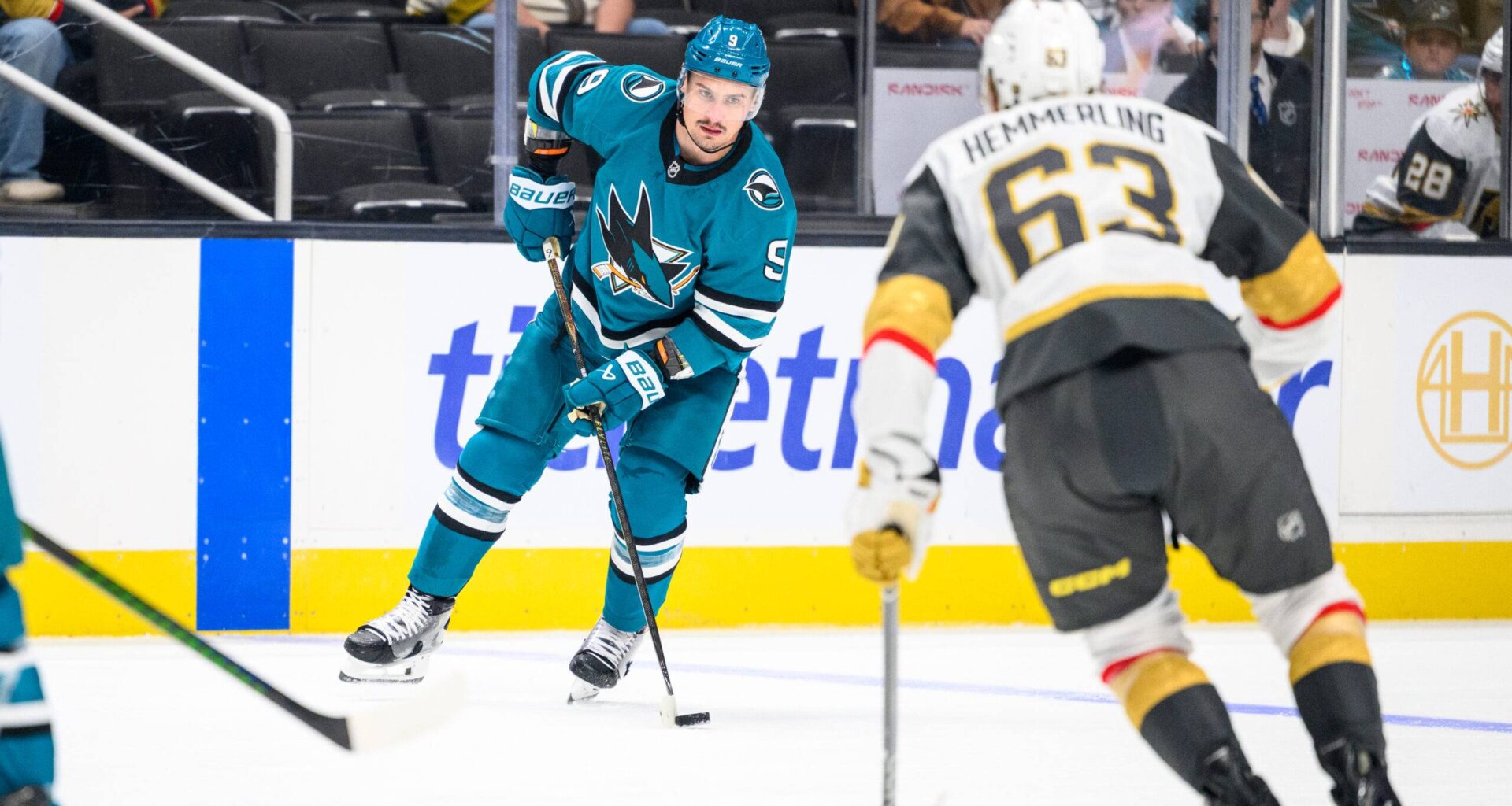
The San Jose Sharks brought in veteran defensemen Dmitry Orlov and John Klingberg to improve the back end.
While their experience is a welcome addition, they are no slouches on the ice. Klingberg scored a power-play goal in the first preseason game, and Orlov showcased his booming slap shot in the second.
In the 2024-25 season, the Sharks finished with an 18.6% power-play efficiency, ranking 26th in the NHL. A good power play is something head coach Ryan Warsofsky wants to see this season. Klingberg and Orlov’s shooting ability can do that.
Following the second preseason game, Orlov was asked if the coaching staff had given him the green light to shoot as much as he could.
Advertisement. Scroll to continue reading.
“It’s always nice to score. I have a hard shot, so I just need to use it more,” Orlov said. “In my career, a lot of coaches tell me that, but I like to give open passes to my teammates and try to find a better position. Sometimes you have to just play simple.”
After the departures of Erik Karlsson, Brent Burns, and Jake Walman, the San Jose Sharks haven’t had a heavy shooter on their blue line. Walman provided close to what Karlsson and Burns did from the point.
Before Walman was traded to the Edmonton Oilers, the Sharks had a power-play % of 19.9%. Although it doesn’t appear to be a significant increase in success rate, there was a noticeable drop-off in performance after the trade.
After the trade of Walman, the Sharks had a power play % of just 15.5% in 18 games.
Advertisement. Scroll to continue reading.
Walman played 65 games in the 24-25 season, finishing with 164 shots on goal, 125 coming with the Sharks. The next closest Sharks defenseman in 24-25 in shots for the entire season was Timothy Liljegren with just 102 in 68 games.
The Sharks don’t need Orlov and Klingberg to shoot the puck over 200 times in a season like Burns did regularly and Karlsson did during his 101-point season. They need a threat from the point, especially on the man advantage.
“Sometimes when you shoot, you create more offense. When you just get too many passes, especially [against] quadrant teams who play zone positioning. They’re always kind of back. It’s hard to make too many passes,” Orlov said. “Sometimes you have to make a couple shots, and then they’re going to worry about getting close to you. Then there’s going to be some things that open up.”
Orlov had 117 shots in 76 games in 24-25. In his last complete season, Klingberg had 139 shots in 74 games.
Advertisement. Scroll to continue reading.
Sam Dickinson needs to follow suit if he makes the Sharks
San Jose Sharks top defense prospect Sam Dickinson needs to follow the trend of defensemen shooting the puck. In 55 games for the London Knights in 24-25, Dickinson shot the puck 245 times.
That number led his team by a wide margin (245 to 188), ironically, to another defenseman, Oliver Bonk.
He led his junior team to points and was second in goals with 29. He scored 12 power-play goals, which led the Knights.
During the first part of training camp, Dickinson has manned the top unit in Klingberg’s absence due to injury. While it sounds like Klingberg will be returning to the team very soon, Dickinson will get his power play chances if he makes the opening night roster.
Advertisement. Scroll to continue reading.
The biggest offensive threat the Sharks have is Macklin Celebrini. Celebrini’s one-timer will be more effective on the power play as he gets stronger, but it won’t be open if the PPQB doesn’t pose a threat to shoot.
It doesn’t matter who does it, but Klingberg, Orlov, and Dickinson are the three most likely to provide that boost to an offensively challenged Sharks roster.
Read more news and stories about the San Jose Sharks on Sharks Hockey Digest! Bookmark the page and follow Sharks Hockey Digest on Twitter @SharksHKYDigest!
Advertisement. Scroll to continue reading.