
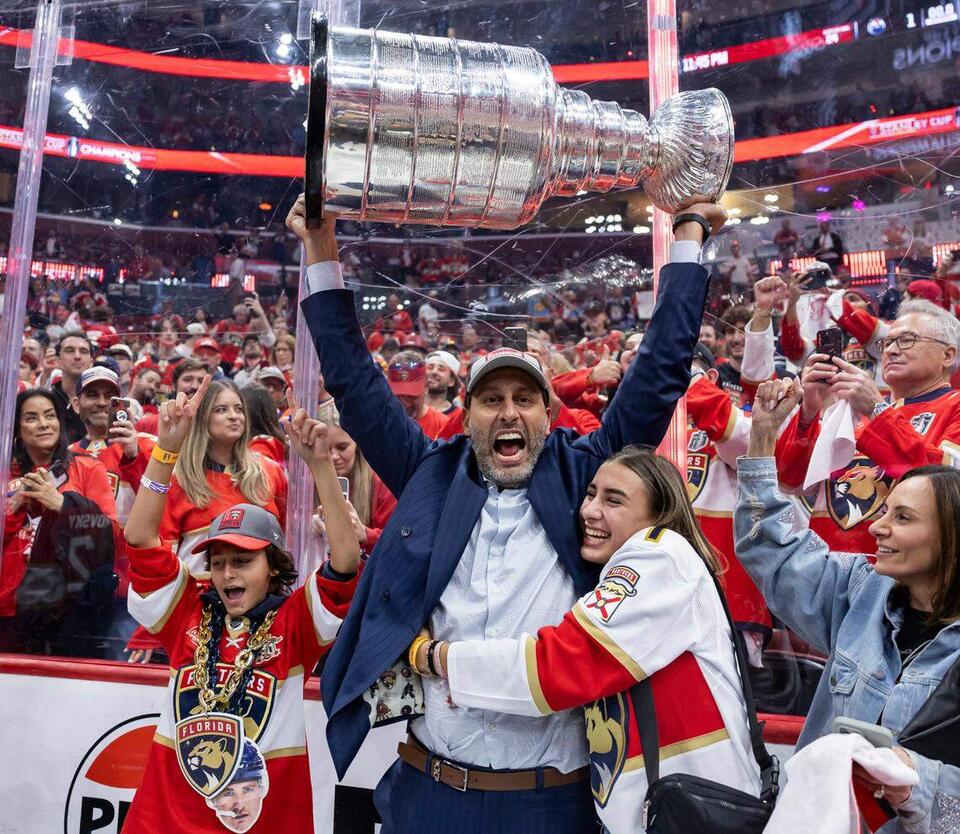
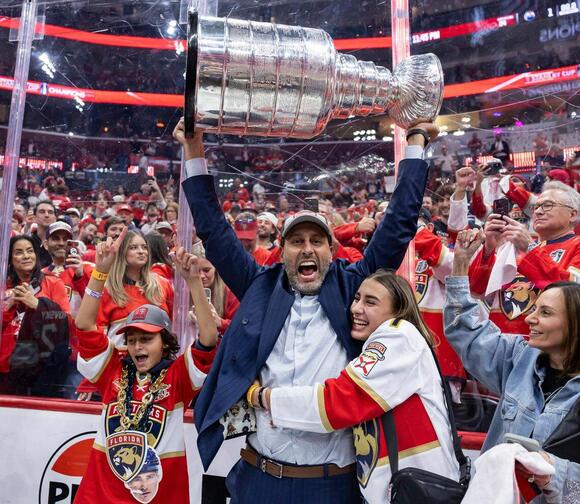
Roberto Luongo never felt the glory of hoisting the Stanley Cup during his playing days. Nearly two decades of dominance, of meticulous netminding, of setting records for a franchise years away from reaching its current peak, ended without one ultimate accomplishment.
The joy of being part of a championship team post-retirement is just as sweet. He has won twice as a member of the Florida Panthers’ front office, working behind the scenes for the team he played more than half of his career. He ate pasta out of the Cup following the first championship. He posted with viral Labubu dolls this year in an attempt at “aura farming,” as he posted on social media.
“The emotions were unbelievable,” Luongo told the Miami Herald. “They were just as fun as when I played. That’s the best part of it all.”
It has been nearly six-and-a-half years since Luongo hung up his skates to end his illustrious 19-year NHL career, 11 of which came with the Panthers. It has been five-and-a-half years since the Panthers retired his No. 1 jersey and sent his number up into the rafters of what was then called the BB&T Center. And it has been almost three years since he was inducted into the Hockey Hall of Fame.
But Luongo’s impact on hockey — and specifically his impact on the Panthers, the franchise for whom he still holds the records for career games played as a goaltender (572), wins (230) and shutouts (38) and is second in save percentage (.919) — hasn’t stopped. He was named a Panthers special advisor to the general manager in November 2019, seven months after he finished his playing career.
His real impact on the franchise, however, began in earnest one year later when the Panthers under new general manager Bill Zito created their Goaltending Excellence Department. Luongo is at the helm of what began as a four-person group also featuring renowned goaltending expert Francois Allaire, Panthers goaltending coach Robb Tallas and Charlotte Checkers goaltending coach Leo Luongo, Roberto’s brother. The group’s mission has been to create a “comprehensive, integrated experience and program for all goaltenders in the Panthers system.”
“I knew I wanted to stay in hockey,” Luongo said. “It’s been my life since I was a kid, and as soon as I retired, I jumped right into it, which was great for me because it didn’t give me time to sit at home and think about it.”
The group is entering its sixth season working together as a cohesive unit and has done its part to lay the foundation for the franchise’s long-term success at the goaltending position.
And it’s a decision Zito will look back on fondly.
“It’s a considerable tool, weapon, luxury that we enjoy,” Zito said. “We’re lucky — very lucky.”
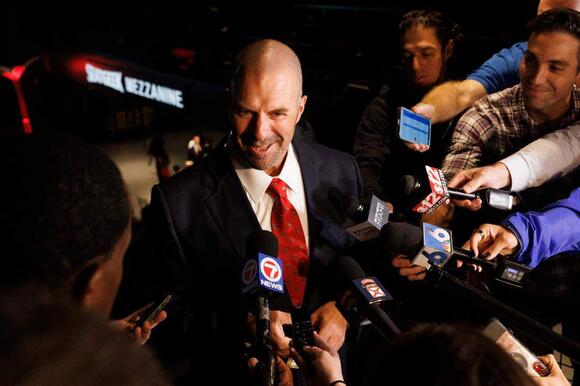
For Zito, the thought of creating an expanded goaltending department stems back to his days as an assistant general manager with the Columbus Blue Jackets. He noticed how Columbus’ goaltending coach did “just an ungodly amount of work on scouting goalies” in addition to his coaching duties for the Blue Jackets, which included developing an up-and-coming goaltender by the name of Sergei Bobrovsky, a soon-to-be two-time Vezina Trophy winner and now a two-time Stanley Cup champion with the Panthers.
“It was very clear that involving goaltending experts — because the craft is so unique — was paramount to having good, strong goaltending scouting,” Zito said.
Zito did that to a lesser extent in Columbus, playing a role in the Blue Jackets expanding their goaltending reach by hiring legendary goalie coach Jim Corsi as the organization’s goaltender development coach.
When he joined the Panthers, Zito wanted to do it on a larger scale. He already had the perfect candidate to run an expanded goaltending department in Luongo, who was a year into his time as a front-office member but did a little bit of everything while working with then-GM Dale Tallon.
And ironically enough, Luongo had already been thinking about a similar plan with Allaire, who was Luongo’s goaltending coach as a teenager in Montreal and has more than three decades of experience as a goaltending coach during which time he also developed the likes of Patrick Roy and Jean-Sebastien Giguere while winning three Stanley Cups (1986 and 1993 with Montreal and 2007 with Anaheim).
“We were just having early discussions, Francois and I,” Luongo said, “and then when Bill got hired, the first thing he asked me if it was something I would be interested in doing. So it kind of worked out perfectly that we already had the groundwork laid out for it. Once he asked me, I jumped in right away.”
Add in Tallas, who has been the Panthers’ goaltending coach since 2009, and Leo Luongo, who has been coaching since 2008 and part of the Panthers organization since 2016 (including most recently being promoted to head of goalie development and scouting), and the Panthers had their foundation. A fifth in new Charlotte goaltending coach Sylvain Rodrigue is now involved, too.
“The serendipity of that happening is remarkable,” Zito said. “It’s almost as if you didn’t know what hockey was and you say ‘Why don’t we find three forwards to start a team? We’ve got [Sam] Reinhart, [Aleksander] Barkov and [Carter] Verhaeghe. And then for two defensemen, we’ve got [Aaron] Ekblad and [Gustav] Forsling. Let’s have those guys play.’ Well, yeah. That’s a good idea.”
The idea is now reality.
Luongo leads anything and everything goaltending, with valuable input from everyone else in the group. This includes all three levels of the organization — from the NHL to the Checkers in the AHL to the Savannah Ghost Pirates of the ECHL. This includes pro scouting and identifying targets in free agency and trades. And this includes amateur scouting and the draft, where the department generally gets one selection a year.
“It’s important,” Tallas said, “because in a lot of organizations, you don’t have that. You have scouts that are just looking at goalies and this and that, and you’re kind of almost trying to get lucky sometimes. I think the department does a great job of scouting and looking at our younger guys, and like setting up our future. It’s good. They’re the key to what what’s to come.”
When identifying players who might be successful goalies long-term, Luongo tends to look beyond the stats. They don’t always tell the full story, especially with goaltenders.
“We like a goalie that’s got some size,” Luongo said. “That’s not to say we won’t draft a guy on the smaller side, but if we do, he’s got to be elite at what he does. But there’s a certain type of mold that we like to look at. Obviously, he’s got to be able to stop the puck. We look at traits that are natural. If they’re not so good at the technical stuff, those are things that we can teach and help them get better as a goalie if we can identify their strong points.”
And they’ve had a pretty good success rate with their acquisitions.
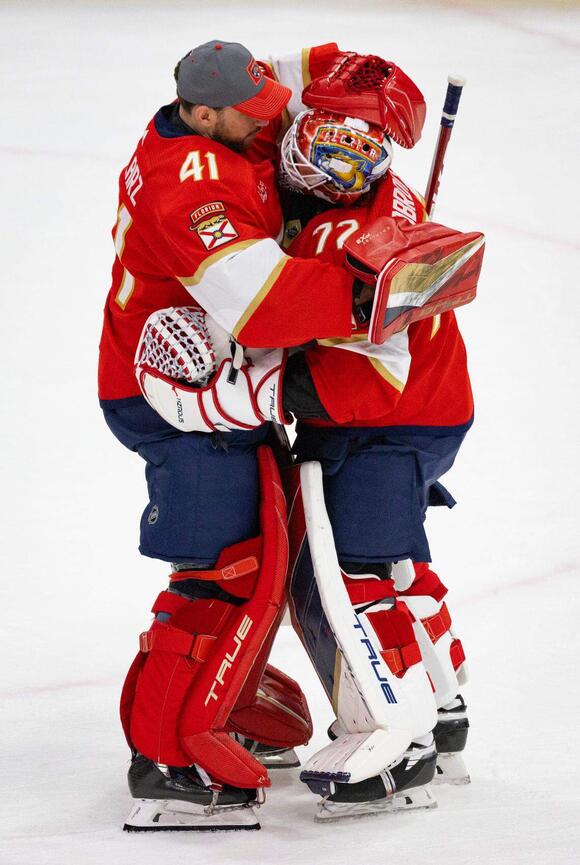
While so much focus with Florida goaltending over recent years is (understandably so) on Bobrovsky’s resurgence over the past three years, look at the players the Panthers have brought into the organization over the past few years.
There was Chris Driedger, who turned two years as a backup in Florida into a starting gig with the Seattle Kraken before injuries took their toll and limited his playing time.
There are Alex Lyon and Anthony Stolarz, who went from players with minimal track records to serving as steady backups to Bobrovsky during the 2022-23 and 2023-24 seasons, respectively. It was Lyon who backstopped the Panthers to six consecutive wins late in the 2022-23 season to help them sneak into the playoffs before Bobrovsky took back over in the postseason for their first of three runs to the Stanley Cup Final. One year later, Bobrovsky and Stolarz formed one of the top goalie tandems in the league on their way to the franchise’s first Stanley Cup. Lyon and Stolarz parlayed their one-year success at Florida into starting gigs elsewhere (Lyon in Detroit, Stolarz in Toronto).
Florida also helped develop Spencer Knight, their first round pick in 2019, into an NHL starter. They traded him to the Chicago Blackhawks last March for defenseman Seth Jones.
There is optimism that Daniil Tarasov, acquired from the Blue Jackets this offseason to be Bobrovsky’s backup this season, will thrive in Florida’s system, too.

But most of the player development aspects of the team have gone on at the lower levels.
They saw success with Kappo Kahkonen in Charlotte after picking him up the trade deadline last season. He backstopped the Checkers to the Calder Cup Final and turned that into an NHL deal with the Montreal Canadiens.
There’s the emergence of 6-8 goaltender Cooper Black, who the Panthers signed as an undrafted free agent and had a strong first pro season with the Checkers last year (1.98 goals against average, .910 save percentage, three shutouts in 17 games).
They also see promise in Kirill Gerasimyuk, the Panthers’ fifth-round pick in 2021 and the first goaltender Florida drafted under Luongo’s supervision. The 22-year-old Russian is set to make his pro debut this season after a dominant showing last year in Russia’s minor league with a .930 save percentage and 1.93 goals against average.
“The funny part is that most of the stuff that we’ve been working on is the guys that we’ve been drafting that are still not here yet and are about to arrive,” Luongo said. “That’s the exciting part for us. Those are guys that we’ve identified through the draft, and those are the guys that will be coming in and then over the next few years, hopefully we can do something with those guys.”

And those goaltenders understand exactly what is expected of them, regardless of which level they are playing.
The Luongos, Tallas and Allaire make it a point of emphasis to streamline communication between the affiliates so that messaging is seamless.
For players who have spent time at different levels, it’s noticeable.
“It really helps as a goalie when everything from the top down is the same,” said Black, who played at both the AHL and ECHL levels last season and is in his second training camp with the Panthers. “When you have one guy saying one thing, the next guy saying another, you’re like, ‘OK, like, who am I supposed to be listening to here?’ The whole department does a fantastic job just working together and making sure that their messaging is identical and they have a goal in mind for for each goalie in the system.”
Added Evan Cormier, who has spent the past two seasons with Florida’s ECHL affiliate but was with the Panthers for all of last season’s Stanley Cup run as their No. 3 goaltender while Charlotte went on its own playoff run: “One thing they want us to do is just play our game and we’ll adapt to certain things along the way. It’s just keeping it simple and and sticking to what got us here.”
Luongo can reflect on the past five years with a smile. The department he oversees has, for all intents and purposes, been a success thus far.
But this is just the start.
“We’ve evolved every year,” Luongo said. “At the beginning, we were kind of a little bit riding by the seat of our pants just with our experience with goaltending, but now that we’ve been through multiple seasons together, we’ve got a game plan of how we want the season structured for our evaluations, development and all that kind of stuff. It’s getting to be a little bit easier. We try to bring more things in and try to get better every year.”