
Several goaltending deployment strategies have stood the test of time.
There’s going with your top guy as long as possible, gut feeling of who should play on a given night, and playing who has measured up best against a particular opponent.
Former Vancouver Canucks head coach Alain Vigneault turned trade acquisition Roberto Luongo loose like a thoroughbred in his first two NHL seasons as the starter. Ride him hard was the rationale.
Luongo logged 76 in his first season and 72 games in his second and a lot had to do with his emergence as an elite goalie forcing backups reduced to minor support roles in Dany Sabourin, Curtis Sanford and Drew MacIntyre, who combined for just 27 games those two seasons.
Luongo’s numbers in the campaigns were superlative — 47-22-6, 2.28 goals-against average, .921 save percentage and five shutouts in 2006-07, followed by 35-29-5, 2.38 GAA, .917 percentage and six shutouts — and it was recognized. Luongo placed second in Hart Trophy and Lester B. Pearson voting behind Sidney Crosby, and second for the Vezina Trophy to Martin Brodeur.

Alex Burrows celebrates with Roberto Luongo after Canucks claimed the Western Conference crown in 2011.
Vigneault’s deployment was understandable because Luongo brought stability and superiority to the ‘goalie graveyard’ where 18 netminders were used and discarded over 18 years. In his 2007 playoff debut, Luongo made 72 saves in a stunning four-overtime win over the Dallas Stars at GM Place in Vancouver. He added a 56-save outing in the second round against the Anaheim Ducks and holds eight franchise records.
And yet, that slippery slope to invite indifferent play and injury because of the immense workload was always looming. Luongo had groin, rib and upper-body ailments. His workload dropped and the arrival of the capable Cory Schneider gave the Canucks an enviable tandem and balance.
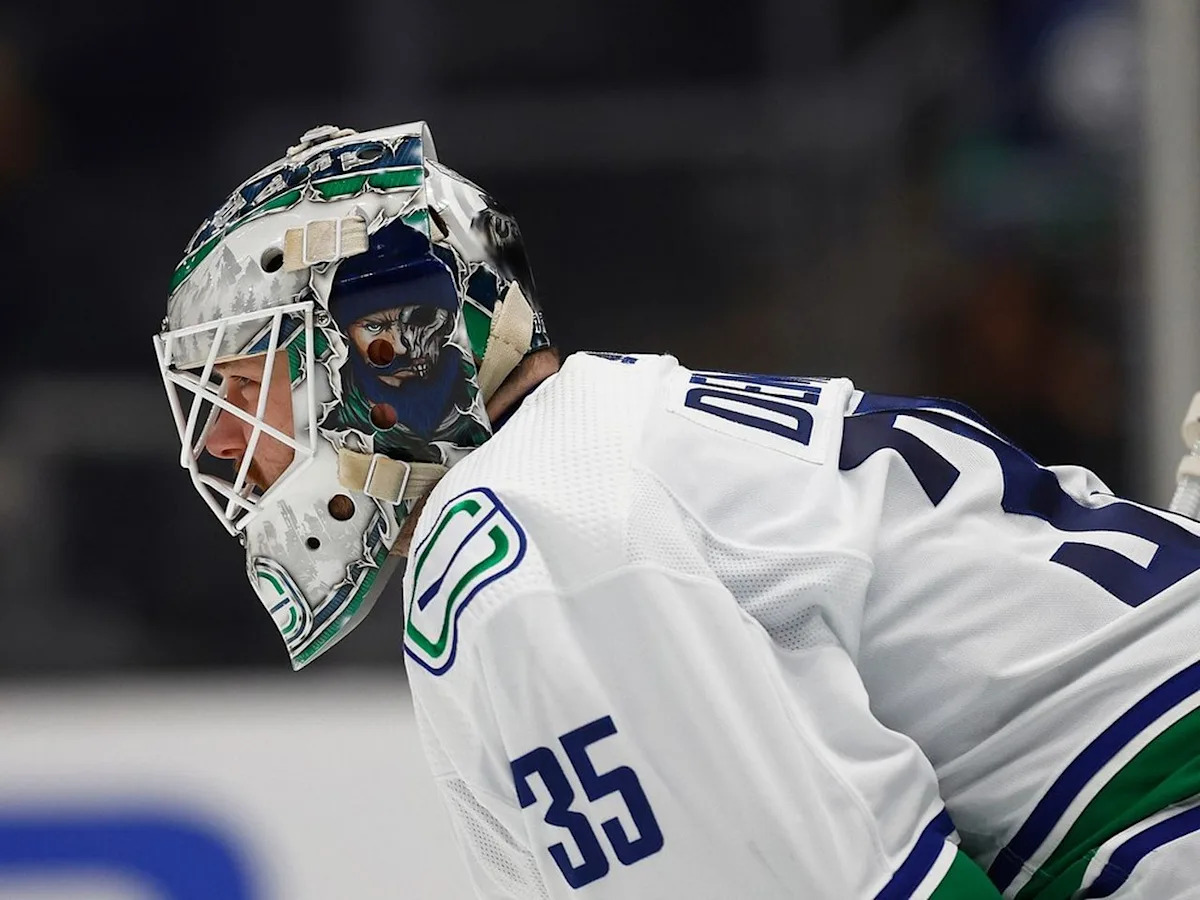
Fast forward and it’s playing out again with Thatcher Demko, 29, and Kevin Lankinen, 30, poised to backstop their club back to the post-season.
And that’s where it gets interesting, because this campaign is unlike others. The 2026 Winter Olympics have compressed the regular-season slate, so rest and recovery are as vital as performance.
The Canucks have five road games in eight days next month, another five in a nine-day slog in December, and six games in 10 days in January to determine whether a return to the playoffs is possible. A pair of eight-game home stands in January and March jammed into 15 days and 18 days will do the same because the Canucks were a paltry 17-16-8 at home last season.
We know of Demko’s hip, groin and knee injury history and finishing second in 2023-2024 Vezina Trophy voting, despite being reduced to 51 games because of a freak popliteus knee-muscle strain. He posted a career-best 2.45 GAA, .918 save percentage and five shutouts.
Demko has looked good in this pre-season and obviously wants the net. He’s also buoyed by a full off-season of training.
“It (popliteus) is such a rare injury, but could occur again if he were to have a movement or contact that causes the injury,” physician Harjas Grewal told Postmedia. “Some of the ways it could happen are direct contact to the outer knee, or even just rotation of his knee while it’s flexed.
“The popliteus is unique and important in starting flexion of the knee. To get into a butterfly, or any other position, the initial bending of the knee is initiated by the popliteus. These types of plays happen a lot, and this injury is so rare that it would shock me to happen again.
“Managing his workload helps to reduce risk, but that’s true for essentially all muscular injuries.”
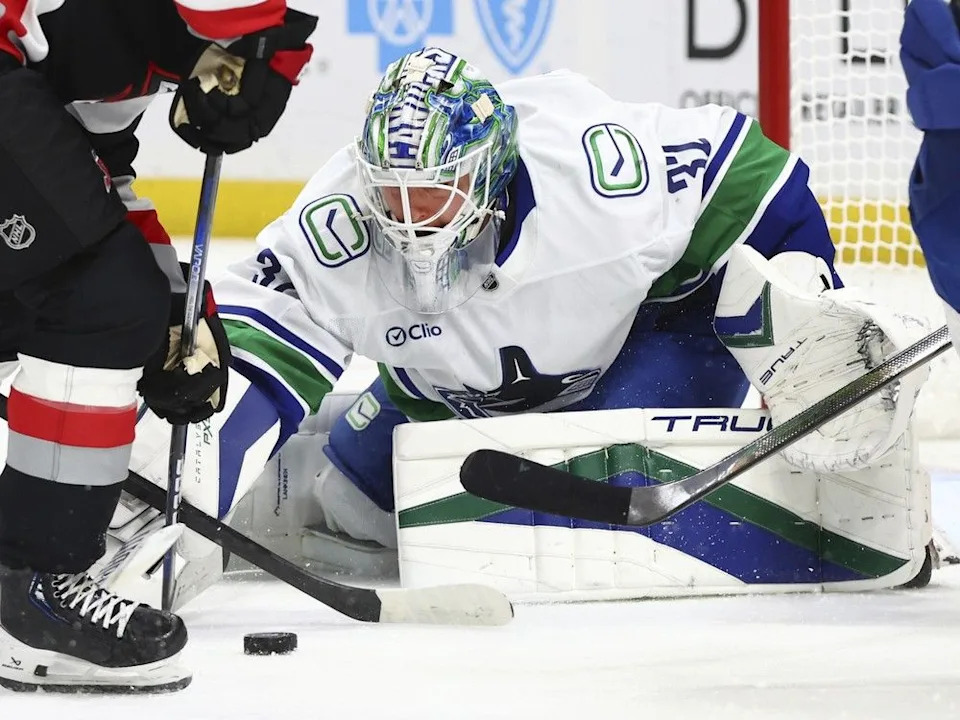
Kevin Lankinen makes a save against the Sabres on Nov. 29, 2024 in Buffalo. He made 31 saves in a 4-3 win.
We also know of Lankinen’s road run last season of 10-straight wins to start the campaign and set a league standard. What we don’t know is how the Canucks will split the cage. A starter usually carries a considerable load, but there are other considerations like fatigue and injury prevention plus the condensed and arduous schedule.
Consider what the Boston Bruins continued to do with the tandem of Jeremy Swayman and Linus Ullmark in 2023-24. They purposely rotated their stoppers despite Ullmark winning the Vezina Trophy the previous season by leading the NHL in wins (40), GAA (1.89) and percentage (. 938).
While performance played a deployment role in 2023-24, they pushed each other to similar records as the Bruins put up 109 points and went two playoff rounds before losing to eventual Stanley Cup champion Florida Panthers. Swayman went 25-10-8 with a 2.53 GAA, .916 save percentage and three shutouts. Ullmark was 22-10-3 with a .915 percentage and two shutouts.
Swayman got the post-season call because of a better track record against the Toronto Maple Leafs and backstopped the Bruins to a seven-game series triumph. He logged a dozen playoff games and Ullmark just two.
What does all this mean in Vancouver?
There’s an obvious pecking order with Demko the designated starter and getting a three-year contract extension that kicks in next season at $8.5 million in annual average value and a no-movement clause. He’s earning $5 million this season.
Canucks head coach Adam Foote thought his starter looked as if he were in midseason form in two periods of work last Wednesday in Abbotsford against the Calgary Flames.
“He was so solid with his decisions and also getting around and he was so square to the pucks,” said Foote. “He came out against two Grade A (chances) and knew what he was doing. It was good to see.”
Lankinen logged a career-high 51 games last season. He went 25-15-10 with a career-best 2.61 GAA, .902 save percentage and four shutouts. He got a five-year extension in February at $4.5 million annually. What’s all that worth this critical season in how the Canucks split the cage?