
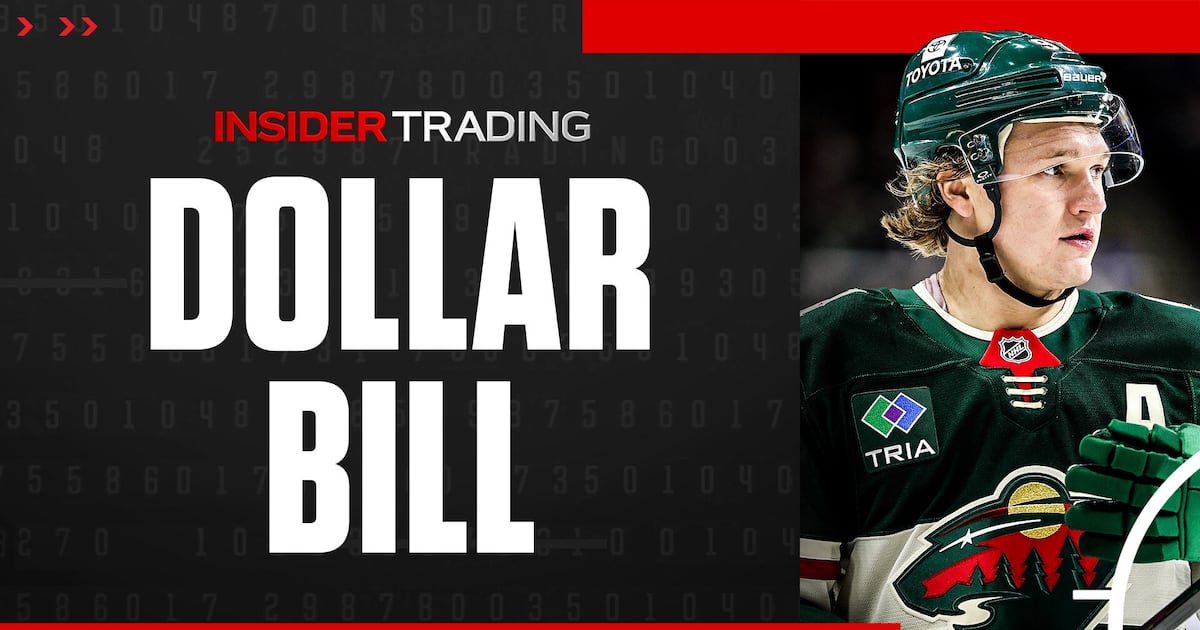
TSN Hockey Insider Chris Johnston joins Gino Reda to discuss the Minnesota Wild signing Kirill Kaprizov to an NHL-record eight-year, $136 million contract extension, what this deal means for Connor McDavid’s next contract, whether this deal will accelerate others that have been in the works and more.
Gino Reda: The Minnesota Wild have just made Kirill Kaprizov the highest-paid player in NHL history. And make no mistake, the trickle-down effect is going to be huge, especially for the best player in the game who’s looking for a new deal of his own. Major news on this early edition of Insider Trading. CJ, break it down for us.
Chris Johnston: Well, it’s a monster contract, and I think the first thing to understand here is this only comes together with a lot of different collisions of factors going on in the league.
Let’s start with the obvious: Kirill Kaprizov is a special talent, a rare player that does not exist in too many other places around the league, but you’ve also got the rising salary cap coming with it, going to 95 and a half million this season, 104 next year, 113 and a half beyond that, this is a new environment for all players in the league in terms of what they can hope to be paid.
And maybe the final one is that the Minnesota Wild were incredibly motivated to get this deal done. I’ll give Kaprizov and his agent credit; he turned down a 16 million per year offer on an eight-year deal earlier in September, and at that time, I spoke to a number of people around the league who thought he would not get better for him.
But boy, did it get much better. Eight million total over this contract. There are heavy signing bonuses involved in this. This is a monster payday for a player, and it really does move the bar forward in a significant way.
This is three million per season more than Leon Draisaitl will be paid; this is a sizeable jump for star players in the NHL.
Reda: Let’s give it a little bit more perspective. That 17 million a year is four and a half million a season more than McDavid is making going into this year. But that deal was signed when the cap was a lot lower; at that point, McDavid got 16.6 per cent of the cap. Kaprizov is now gonna be making 17.8 per cent of the cap on his deal.
If McDavid gets that same percentage, the Oilers would’ve to pay him 18.2 million starting next season. CJ, what does this do to the Oilers and their attempted negotiation with McDavid on a new deal?
Johnston: Depends who you ask on this. I’ll say there are split opinions from the people I speak to, and have spoken to this morning in the wake of the Kaprizov deal, in part because Connor McDavid is almost a unicorn, right?
I think that there’s an accepted opinion around the league that Connor McDavid, if he played for the maximum 20 per cent, which is what you’re allowed under the rules of the league. If he got a 19.1 million per year deal, which is the max right now, I think that would still be a fair contract.
But the problem that the Oilers have and that he has when he is trying to imagine a future there at Edmonton is that they just probably can’t build a winner if he takes that money because they don’t have as many key pieces of their team locked up long term. That’s one thing that was also in place in Minnesota; they have some other good young players signed already, have some of their core kind of locked in and so they can extend to a level where they give Kirill Kaprizov 17 million.
The other part of this, Connor McDavid, is not likely to sign an eight-year deal. And if you look historically, players who sign for that length of time tend to get the highest AAV. When you’re doing a shorter-term deal, generally speaking, you see the overall number for a star player in terms of his annual value come down a little bit. So, what it means for McDavid, I still think we’re sorting through that. You know, certainly everyone would expect him to be the highest-paid player when he signs his next contract, but I would caution anyone and say it’s not a guarantee. I think there’s a world if he signs a two, or three, or four-year extension with the Oilers at some point before next July, that the actual cap number is lower than what Kaprizov signed today.
Reda: Okay, so we see Kaprizov come in and set the new high watermark. I understand that. But there are a lot of other guys looking for contracts right now. Jack Eichel, Kyle Connor. What does this do to negotiations across the league when this is the new highest-paid player in the league?
Johnston: Well, if anything, it should probably compel the teams to get some of those deals done.
I know there’s been a lot of discussion between the Golden Knights and Jack Eichel, for example, and the position that the agents have been taking on that contract probably looks a little better today. They’ve been asking for a number quite a bit below 17 million, has the Eichel camp. I would think over time, this is certainly gonna have an impact on the marketplace.
When the next best wave of star players, forwards in particular, come due, they’re going to be pointing to this $17 million number. It’s hard to ignore it. What it does for some of these other deals that are kind of down the road already. If anything, I do think it should shuffle them towards the finish line because no one wants to mess with the idea that, hey, if you take a big breath and step back from those talks that maybe the numbers end up being higher over time. But we’re in this really unique period, Gino, in the NHL, where I still think agents are a little bit reluctant to do deals, teams are unsure what the right numbers are because we are gonna see a reordering, a restructuring of what a certain type of player gets paid.
And this certainly does arm other star players, other 50-goal scorers, even a hundred-point wingers, this gives them a new comparable to bring forward at the table. So it might not be felt immediately, is kind of what I’m getting at here.
Jack Eichel could sign an eight-year extension in Vegas in the near future, and I think it will be well below the $17 million number. But the players that come next summer and the summer after that with star power are gonna have some pretty powerful negotiating power in their back pocket.
Reda: What about the speed? Does this accelerate these guys who are sitting, waiting for contract extensions, waiting to negotiate? Oftentimes in the past, we’ve seen, we were all waiting for Kaprizov. As you mentioned, when he turned down that $16 million a season deal, we were wondering what this was going to do to the other current negotiations. Now that’s happened, is the damn broken beyond the numbers themselves? Do we see an acceleration now in the extending and resigning of these guys who are waiting for new contracts?
Johnston: I think it will, and this is just my personal opinion on this one. But when you look at it, we just have to get used to what the number is that you attach to a star player, to a difference maker on your team. The reality is that there are 32 teams in the league. There are not 32 players in the entire league anywhere near as good as Kaprizov or Jack Eichel, for that matter.
And so, I think whether it’s Kyle Connor, who needs a new deal in Winnipeg, and I know the Jets and Connor’s camp have been engaged in trying to get a contract done there. Each negotiation has almost got its own dynamics and there are sort of things that make each one a little bit unique.
But the big picture here is hard to ignore. That’s what NHL teams are gonna have to get used to paying star players a lot more money than they have in the past. This goes part and parcel with a growing league with more money going into owners’ pockets. Eventually, some more trickles down to the players, and we might be entering an era now where stars are actually gonna take up more percentage of that cap, even as the cap goes up.
Maybe that’s what we should be reading into this Kaprizov deal, 17, 18 per cent might become more of a norm than it’s been in the past. Because the reality is, when the cap was flat through those COVID years, the star players were relatively benign.
Connor McDavid set the bar at 12 and a half million, seven and a bit years ago on his eight-year extension. At that time, that was the high watermark for a long time. We saw Nathan MacKinnon go a little bit over it, and Auston Matthews came beyond that; he pushed it forward a bit. Ultimately, Draisaitl inched it up. This has just been raised in a significant manner, and I think it’s gonna benefit all of the star players in the league in time.
Reda: CJ, thanks for giving us a perspective on this new, groundbreaking deal. Again, Kirill Kaprizov, the highest-paid player in NHL history, eight years at $17 million per season.
Lots more on this with CJ, Dregs, and Pierre coming up on the full edition of Insider Trading on SportsCentre.