
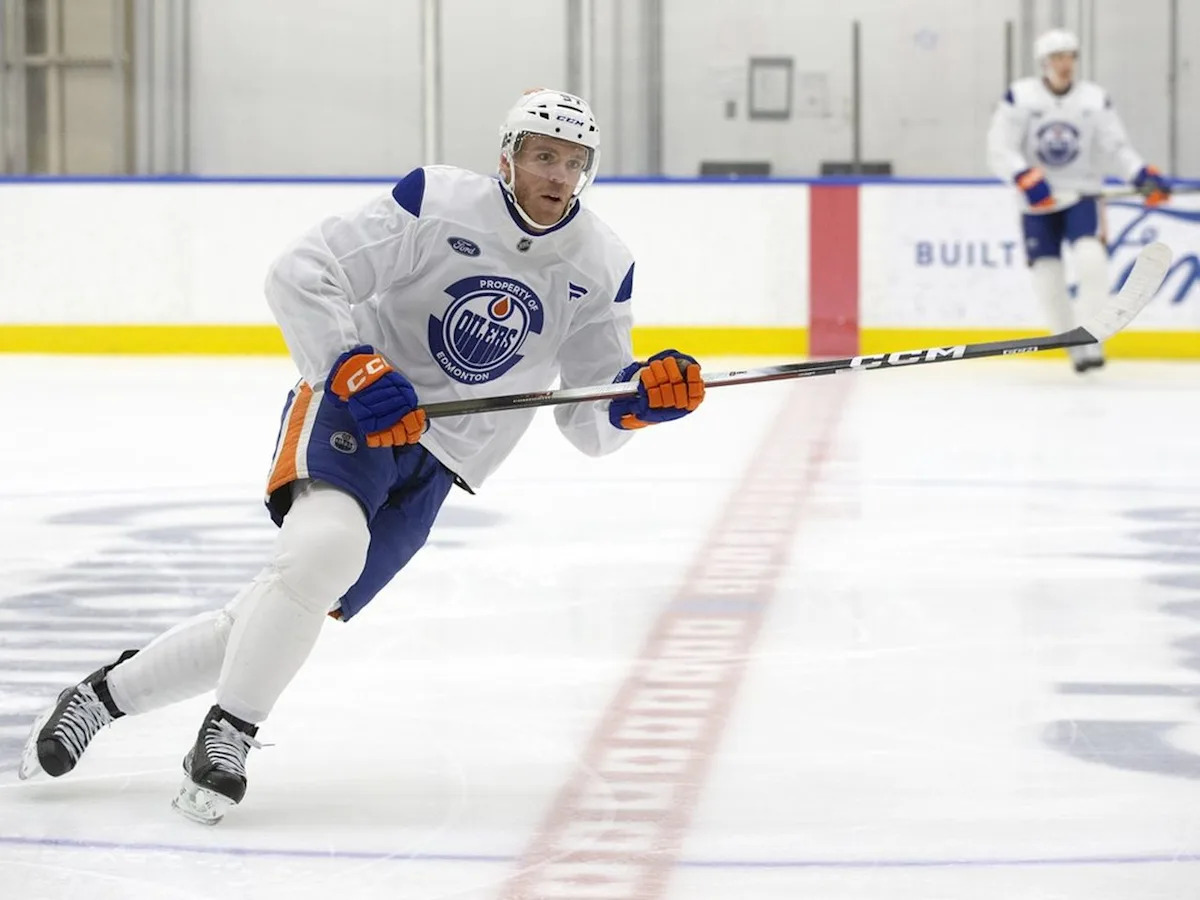
The ink wasn’t even dry before a mushroom cloud’s worth of fallout began raining down on Edmonton.
With Minnesota Wild winger Kirill Kaprisov setting the new contract standard by becoming the highest-paid player in NHL history, where does that leave Connor McDavid and the Oilers?
Kaprisov played hardball with the Wild, turning down $16 million a year before settling on $17 million over eight years to move the needle like it’s never been moved before.
To illustrate how big a jump this is, Kaprisov blows past former No. 1 Leon Draisaitl ($14 million AAV) to take over top spot on the money list. The $3 million jump in league-high AAV between Draisaitl and Kaprisov is now the single-biggest increase in the NHL’s cap era.
If McDavid is to assume his rightful place as the highest-paid player in the NHL, it leaves the Oilers in a delicate spot. It also leaves McDavid with some hard decisions to make.
When Kaprizov’s extension kicks in next season, he’ll be earning 16.35 per cent of the NHL’s projected $104 million salary cap. The most McDavid can make right now (20 per cent of the current 95.5 million cap) 19.1 million.
If he waits till next year, when the cap hits $104 million, then McDavid’s max deal jumps to more than $20 million a year. And so on, as the cap keeps rising.
If you’re McDavid, there is a lot to consider, no matter where you sign.
Do you take the shorter deal and watch your salary increase with the cap, knowing the injury risks that come with playing professional hockey? Or do you take the security that comes with knowing you’re guaranteed about $144 million over the next eight years?
Two of McDavid’s teammates are taking different approaches to the situation:
Draisaitl decided to lock in for the guaranteed money, even though his percentage of the cap will drop each year. Draisaitl’s cut falls from 14.6 per cent this year to 13.4 per cent next year and will drop with each subsequent season.
It’s just like McDavid’s $12.5 million contract represented 15.72 per cent of the $79.5 million salary cap in 2018, and falls to 13.0 per cent this year. Only the drops will be much steeper moving forward.
The cap rose very slowly ($19 million) over the past 10 years. Right now it’s jumping almost $10 million in the next year and projected to jump by nearly $18 million over the next two years.
When players of his ilk are making $20 million three or four years from now, Draisaitl will still be at $14 million.
Evan Bouchard, meanwhile, took the other option and signed for four years, knowing that Cale Makar and Quinn Hughes are both up for new contracts in two years and are about to move the bar for defencemen, like Kaprisov just moved it for forwards.
That’s a smart money move, but hockey is a hard game and there are no guarantees where any player will be in four years. Aleksander Barkov just blew out his ACL and MCL — in practice! — and will miss nine months.
Whichever way McDavid goes, Kaprisov’s big deal might be a significant challenge for the Oilers.
Even if McDavid takes a slight discount instead of the max, it still leaves the team in a tight financial spot. Even if he “only” signs for $18 million, then he, Draisaitl ($14 million), Bouchard ($10.5 million) and Darnell Nurse ($9.25 million) will account for 50 per cent of the entire cap next year. Can you win with $52 million tied up in four guys?
Somebody might want to check with the Toronto Maple Leafs Core Four on that one.
The Oilers will also being paying significantly more for their goaltending next year. Whether it’s Stu Skinner on a new contract — he’s currently a steal at $2.6 million — or someone else, they’re looking at $6 million or $7 million for a starter. And top-four defencemen Jake Walman and Mattias Ekholm are both up for new deals after this year.
It’s going to be tight, especially now that salary cap actually matters and teams aren’t allowed to ice lineups that are $10 million and $15 million over the cap at playoff time.
TIMING IS EVERYTHING
If McDavid doesn’t sign before the season, less than two weeks away, the odds of him playing out the season and exploring free agency increase. Not only do most players prefer not to negotiate during the season, it’s also important to remember this isn’t a negotiation — it’s McDavid deciding on whatever terms he feels comfortable with.
If he’s not comfortable by opening night, then there is more to the equation and than just term and money.
YOUNG AND CHEAP
The money being thrown around is why it’s absolutely crucial that the Oilers hit on some of the young players they’re bringing into camp. If four guys are making $52 million, Edmonton desperately needs a few guys making under a million — Matt Savoie, Ike Howard, and Noah Philp in the here and now and Josh Samanski, Atro Leppanen and others down the road.
The cost of keeping that Stanley Cup window open is about to get very expensive.
E-mail: rtychkowski@postmedia.com