
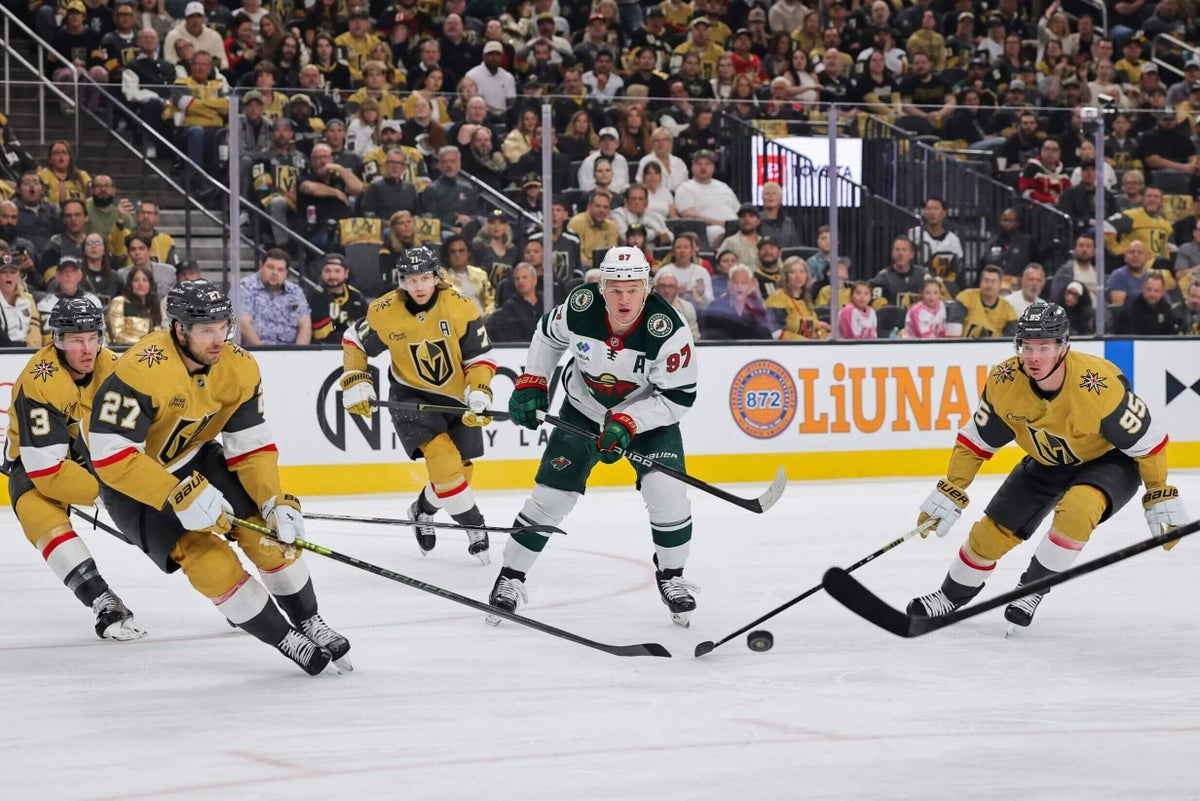
It’s worth taking a moment, the day after Kirill Kaprizov signed a record-setting contract, to put his newfound financial largesse in league-wide context.
Kaprizov’s eight-year, $136 million extension with the Minnesota Wild contains not only the most total dollars ever given to an NHL player in one deal, but it also marks the highest annual average value ($17 million per season) and one of the highest cap-hit percentages (16.3 percent of next year’s projected ceiling).
In fact, only four players in league history have made $136 million in their entire careers: Alex Ovechkin, Sidney Crosby, Evgeni Malkin and Anze Kopitar.
The 28-year-old Kaprizov is a remarkable, dynamic talent, tied for fourth in goals per game and sixth in points per game over the last four seasons. But he has yet to win a Stanley Cup or a Hart Trophy; be named to a year-end All-Star team; or earn any other major NHL award since being named rookie of the year five seasons ago.
That he’s now the owner of the league’s highest cap hit, by far — an incredible 21 percent more than Leon Draisaitl’s previous high-water mark of $14 million, and 42 percent above contracts signed by other high-end wingers like Mikko Rantanen and Mitch Marner — feels like a strange development, even in the NHL’s new rising cap environment.
The question going around league circles in the signing’s aftermath is whether it might be a one-off, brought about by unusual circumstances for this particular player in this particular market. Or could it be a sign of the new normal, with stars beginning to earn a bigger piece of the pie at the expense of players further down the depth chart?
You can argue the evidence on both sides.
Kaprizov held such a strong position with the Wild because he is so vital to their long-awaited success. Minnesota has finally cleared out the bulk of the remnants of Zach Parise’s and Ryan Suter’s bloated buyouts, to the extent that they “only” carry a combined $1.6 million cap hit for the next four years. They also have a very impressive youth movement poised to break through this season and one of the NHL’s better prospect pools, which could propel them into Cup contention for years to come.
This for a franchise that hasn’t advanced beyond the first round of the playoffs in a decade and is 22 years removed from its first and only Western Conference final appearance. After years in the (ahem) wilderness of the NHL’s mushy middle class, the Wild appear positioned for something more, finally giving one of the most passionate markets in the league something to cheer for.
But it only truly lines up that way for the Wild if Kaprizov stays at the top of the lineup as the face of the franchise, someone who can fill opposing nets 50 times a season and lead kids like Zeev Buium, Liam Ohgren and Danila Yurov up the standings.
That was the hammer Kaprizov and his representatives wielded, in an environment where so few superstars hit free agency despite unprecedented year-over-year cap growth. Factor in, too, that Minnesota is at best a middling draw as a landing spot for UFAs, and losing its lone superstar at this moment would be a crushing blow.
To their credit, Wild GM Bill Guerin and owner Craig Leipold were adamant that wasn’t going to happen and got a deal done. Even though the number seems completely out of sync with what’s come before, it projects to age fine if the cap skyrockets to $140 million by the midpoint of the contract.
After all, a star making 12 percent of the cap is downright normal; it’s the equivalent of roughly $10.5 million last season, a figure 13 players cleared against what was an $88 million limit in 2024-25.

In Year 1 of the contract, however, Kaprizov will be an extreme outlier: The NHL hasn’t seen a player make more than 16 percent of the cap since Ovechkin first signed his landmark 13-year, $124 million deal in 2008. Only Connor McDavid’s second contract — for $12.5 million a season under a $79.5 million cap in 2018-19 — comes close at 15.7 percent, and Kaprizov hardly has the same credentials as McJesus.
In the past, Kaprizov-like stars would have signed UFA deals for closer to 14 or 14.5 percent, as Jonathan Toews and Patrick Kane did 11 years ago at the height of their dominance with the Chicago Blackhawks. Instead, Kaprizov’s new AAV is the equivalent to an almost $2-million-a season-premium compared to those historical norms, a boost that will eventually come at the expense of players down the lineup.
Looking at other recent contracts signed across the NHL, what’s interesting is that most of the deals have been downright reasonable — even with the new CBA settling into place and the cap projected to hit $113.5 million by 2027.
The Toronto Maple Leafs, for example, seemed to get a discount on starting netminder Anthony Stolarz’s extension, which came in at only $3.75 million a season over the weekend. The Anaheim Ducks ended their stalemate with top RFA Mason McTavish for $7 million a year. Elsewhere, the Edmonton Oilers’ Vasily Podkolzin and the Calgary Flames’ Mikael Backlund and Connor Zary all signed extensions in the $3 million range that wouldn’t have looked at all out of place in the old flat-cap world of a year or two ago.
We’re only working with a few months of evidence, and Kaprizov could be the tip of the spear in terms of instigating this change, but the biggest beneficiaries of the new world order would seem to be players at the top of teams’ lineups.
Set McDavid aside, as he could command a max contract regardless of what Kaprizov got, and look at the next wave of pending UFAs like Jack Eichel, Kyle Connor, Artemi Panarin, Adrian Kempe, Martin Necas and Alex Tuch. Where does their number land in a world where a top winger is no longer making William Nylander money ($11.5 million) but dramatically more? Are they suddenly all now more than $11 million players? And how many more players around the league will suddenly be crossing the previously exclusive eight-digit threshold?
One high-profile agent I spoke to Tuesday argued that the new CBA will likely spur on this trend even more, as new limitations on contract structures lead to GMs offering higher AAVs to retain their top talents.
“As the cap rises year over year, top players will keep pushing higher,” the agent said. “The league knew this and that’s why they needed concessions on term, bonuses and year-to-year variance (in the new agreement).”
The biggest question for NHL front offices as this starts to play out: Will it work? Can you allocate that much more of your cap to fewer players, squeezing the lower part of the roster? And how much is too much to pay star players like Kaprizov, who have become so hard to replace on the open market?
After all, no team has won a championship with a single player making 15 percent or more of the cap. Toews and Kane had their big 14.7 percent deals kick in after they won their last Cup; Ovechkin’s cap hit was down to a reasonable 12 percent by the time he won his at age 32. Even McDavid’s Oilers didn’t start pushing their way to real postseason success until his cap hit slipped under the 15 percent mark the last two seasons.
Even if the overall pool is filled with more money, can you shift the payment balance higher in the lineup and still contend?
There have been cautionary tales on that front in the past, with the Cup-less Leafs dedicating 50 percent of their cap to their Core Four in the flat-cap era standing out as one good (or bad) example. Whether the math changes with $30 million more in the system and fewer ways to get creative with contracts remains to be seen.
If it becomes a trend, however, the Wild will have been the team that led the way with a big play to keep their best player. It’s really an unprecedented contract in an unprecedented time for the league, and one we’ll be talking about for years to come.
We’ll see if it ends up being remembered like Ovechkin’s deal — a bold gambit that eventually paid off — or as another overreach for a franchise that has swung and missed when it tried to break the mold before.
(Photo of Kirill Kaprizov: Ethan Miller / Getty Images)