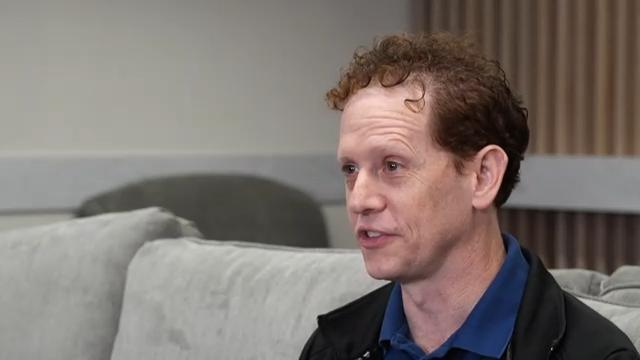
Eric, it feels like yesterday we were doing this interview right before the start of last season. You’ve just been named GM. How much more comfortable are you, not necessarily on this couch, but just in this job a year later. Yeah, no, it’s been good. It’s, you know, first year, there’s a lot to learn, getting up to speed on everything, building relationships around the league and, you know, second year I feel like I’m settled in a little more. Is there a confidence that comes with that, and an assuredness in what you’re doing? Yeah, I mean, I honestly, I don’t think I lack for confidence in anything I do, but it’s uh it it does feel like sometimes I have a little bit more of a sense of what to expect, and so, you know, I, I know more about what’s coming, I know more about what to expect from people, and, you know, it helps position us to make sure we’re doing the right things. Where does that confidence come from? I mean, obviously your resume speaks for itself, but what do you think like the root of it was even like going back to to being a kid, like how did you kind of like find yourself and what you wanted to do? Yeah, I don’t know. I mean, I just, I tend not to worry about things, right? I, I do whatever seems best to me and so far it’s worked out for me and, you know, just keep plugging away and assume things will keep working out until they don’t. Can’t really argue with the results so far. Um, I remember last year you referred to the start of the season as a pivot and some other people might have said a potential step back to take a step forward as you guys replaced so many pieces. This year, taking on a different character with a lot of continuity and a couple of new pieces. So how would you describe the start of the season? Yeah, I mean last year we laid the groundwork for what we were able to do this year, so we created a situation where we had a lot of cap space, we had a good young core. So we worked to get some of our younger players signed long term, make sure we could keep that core together, make sure we had the cost certainty that we wanted, and then we worked to make additions and tried to add some high-end talent to the team and position us to not just hold on to what we had, but keep taking those steps forward. When you look back on the big swing you made for Mikko Rantton and. Anything you take away from that whole saga, I mean it was obviously long and winding, and in a way it didn’t work out in a way it did where you find this gem in Logan Steinkov after all the dust settles. Yeah, I mean again it comes back to my feeling of, you know, do whatever seems right and trust things will work out and you know, you have to weigh upsides and downsides. Everything we do is a risk. We’re not afraid of risks, right? We know until we get where we want to be, we’re gonna be willing to take risks to keep trying to take a step forward. And we knew that was, there were a lot of different ways that could play out, and we just trust it if we’ve thought it through enough and have thought about the possibilities, in the end we’ll find a way through it. And, you know, I agree that where we came out of it, like, Logan’s been really good for us. Taylor’s been good for us. We got future capital that can help bring in more more players too, and help us keep taking steps to make the team better. Do you get the sense that when you call other teams for a trade or maybe pinpoint a player on their roster that other people don’t necessarily view as a prize prospect that they get their own radar up and how do you potentially combat that if you if. I do. I mean, I think that’s natural for anyone, right? It’s no matter who calls, if somebody’s calling to ask about your player, there’s probably a reason. And so you always start wondering what did we miss on this guy, but you also, you have to be willing to make moves if you’re gonna get your team ahead. And so it, it’s easy to start the conversation, and then it just comes down to a question of whether there’s a match and a fit where you, there’s something they can give you back that makes sense to you. Couple of the pieces that you brought in this year. Ke’Andre Miller, defenseman from the Rangers, and Nikolai Ehers forward from Winnipeg Jets. What specifically about them and their fit here was appealing to you? Yeah, so they’re very different players playing very different roles, and they fit for different reasons. I think the thing they both have in common is they’re really good skaters, and that’s important with the way Rod wants players to play, um. With Nikolai, he brings a sort of skill along with that speed that adds to the high-end talent in our forward group. He’s someone who can take the puck and create off the rush, create in own, generally just turn puck position possession into scoring chances and goals. Andre’s different. He’s a defenseman and. You know what he does with his skating is uses it to close plays down, and he’s, he can be very effective. He has a powerful stride and can get into guys quickly and he brings some size and strength with it, and he can really close plays out. And again, the way we want to play with the high pressure system, we need defensemen who can really not just get up to a guy, but get into him and make it hard for him and apply that pressure, and I think that’ll come naturally to him. You talk about the way these guys play and the strengths and weaknesses so fluently but obviously your background is in the analytics and the math. Do you evaluate players by watching them play or do you kind of leave that to the scouts and you truly just look at the numbers and the data that they’re presenting to you? Yeah, I mean both, you know, at this point as a general manager, my job is to take the opinions of the whole organization. So we have a data team that’s going through numbers and provide. Recommendations we have scouts that are going through video and providing their recommendations. We have coaches that are watching the game and providing. It’s my job, you know, I’m, I’m not an analyst anymore. I’m a general manager and it’s my job to take all those opinions and integrate them and make sure we’re doing the right thing for the organization. One of your kind of prized finds so far has been Jackson Blake, and this time last year we didn’t even know if he was gonna make the team. Now I was a $45 million player signed long term. That problem happens always so often, but is there anyone in camp that maybe fits that profile that could possibly happen again? Yeah, I mean, Jackson has been incredible for us, and it, you know, it goes back to coming in early last year and he worked really hard over the summer. Added strength and he always had the skill, he just needed to build that NHL body and we have some players who are in, you know, every 18 year old is in that position to some degree, and we’ve got some guys who’ve been working really hard. Bradley Nado’s added strength, Felix Ungerstorm’s added strength, um. You know, I think someone who people are probably not paying a lot of attention to yet, but, uh, Nystrom, Joel Nystrom has come over from Sweden and he’s been playing against men and has been doing well, and I think people are um going to have to get used to the ability he brings. Dominic Badenka was a high pick, and he’s come in and looked really good so far. We got a lot of prospects. I think Darren York and the Both the amateur scouting staff and the development team have done a really good job of making sure we have a continuous pipeline of players coming in, um, and now it’s just a matter of time to see them pan out. I’m gonna throw a theory at you here. I know your background worked in nanotechnology. One of your patents is related to, I think you told me, making rocks so small that they could emit light. So is this where your affinity for small forwards comes from? It’s a little bit different. I, uh, I, you know, it’s a little bit different. I would say, you know, I wouldn’t describe it as an affinity for small forwards, I would describe it as a uh You know, we don’t fetishize anything, right? So size is a useful attribute, it’s something you want to have on your team, but it’s not an absolute prerequisite to being an effective player. And what what is a prerequisite is being able to win battles. And if you’re small and strong and competitive, you can win battles, and size helps. It’s a lot easier for a guy who’s big to win the majority of his battles, but guys like Stan Coven and Blake battle really hard, and they make it so their size doesn’t hold them back. One guy who isn’t small is Alexander Nkin. And I heard it was quite the process to get him over here. Is there any funny or interesting stories you can share about the challenges that went into getting him from Russia over to here right before the playoffs last year? Yeah, I mean, it was wild, like, bringing someone over from Russia is always a process because they have to get a visa, they have to get an appointment at a consulate to get the visa placed in the, it’s a whole thing. What was different was we were under, you know, under a timeline where we wanted to get him over as fast as we possibly could, and any place we could shave a day off of it we would. And so we were doing things like having him fly to Istanbul because there are flights from there to anywhere and we didn’t know what consulate he would get into fastest, and that way he was ready to go wherever he would need to go and just, you know, sort of that process of having him. You know, we’re gonna put you in this hotel. Hopefully it’s just a day or two. If it’s longer than that, we’ll find you a rink so you can go skate on your off days and like we’re just doing everything we could to make sure we did not lose a day if we didn’t need to. How excited are you now that he’s here and presumably knows a little bit more English after the summer? Yeah, no, it’s great, it’s, I mean, he’s he’s got all the physical ability in the world. It’s a transition coming into. The NHL in general, but especially into our team with the way we play, it’s so different from the way most teams play. It’s always a transition for people. And so it’s gonna take some time. I don’t expect him to be at his peak in game one, but whether it’s game 3 or game 5 or game 50, we, uh, we’ll have to see, but the potential is so high, he’s got so much physical talent, we know it’s gonna be exciting to see him take those steps and hit what he can be. This has been a great seven year playoff run. No one wants to take away from that, but sometimes in sports you’re blocked by an even better one, and this Florida Panthers team just won’t go away. Have you started building this roster almost. To try to beat them or is that kind of putting the cart before the horse in a way too? Yeah, I mean, I don’t think you can really focus on any one opponent. You have to just build the best team you can. Um, part of it, you know, I think we have the cap space and the opportunity to keep taking steps forward and add the talent we need to get to where they’re trying to match up with us instead of the other way around. Um, we also, part of what we have going for us is our core is really young, and we have time on our side, you know, both, I think they and us are the two teams that have the most long-term contracts on their roster. For us, the average age of those contracts is 25, and for them it’s 30. So time is on our side here, and what that means is, as we have this room in our cap to keep adding, like, The players we have under contract are getting better and we have room to keep adding and you know I, I think we’re well positioned to get to where we want to be. 10 million in cap space is, is do I have that problem? What kind of flexibility does that offer you this season to continue to improve the team and how much do you view this roster as a finished product as it sits today? Yeah, so I think, uh, in season we have like cap space is never gonna get in the way of doing anything that The highest contracts in the league would only require us to move a tiny thing out to make it fit, and that’s not hard to do when all of your players are good players who teams want. We can always find a trade if we need to, um, and realistically, those players are not available very often despite what happened last year. Um, so we probably have we’re probably in a situation where cap space isn’t going to limit what we want to do. The limitation will be the availability of players who can make us better. We’ve built a really deep team that top to bottom, you know, every player we put on the ice is an effective strong player, and it’s hard to find players who really make us better, you know, the the Ca Andres and the Nicolas, there aren’t a lot of them out there, um. So the question about whether it’s a finished product, that depends on whether we find another opportunity to add a player like that. If we do, we’re always willing to add. If we don’t, we’re very comfortable with the group we have. It almost feels unfair for fans to view this year as Stanley Cup or bust, but I guess that’s the cost of the success that you in this franchise has had. Is this the year? Do you think this team can do it? Yeah, I mean, uh, you know, you’re right to, you know, the question about fairness, like, I get it, we’re all fans, everybody wants to win this year, you know, it’s not just the fans, the coaches, the players, everybody wants to win every year, and What’s unique here is we’ve reached a level where we make it to the Final Four, and that’s perceived as a disappointment. And that’s just incredible. Like we’ve set the bar so high, and I love that, frankly, like it’s great that we’ve set the bar so high that Final Four can feel like a disappointment. We want to have it that high, and we want to get to where Final 2 would be a disappointment, right? That’s where we want to be is we want to be winning the cup and You know, the goal is to keep taking steps forward until we’re there. Hey, you’re, you’re a college basketball town. Final Four is just the benchmark, so that’s a sign you guys have made it. Um, well, Eric, thanks so much for taking the time. We appreciate catching up with you before before the start of the season. Yep, thank you. Had a good time.