
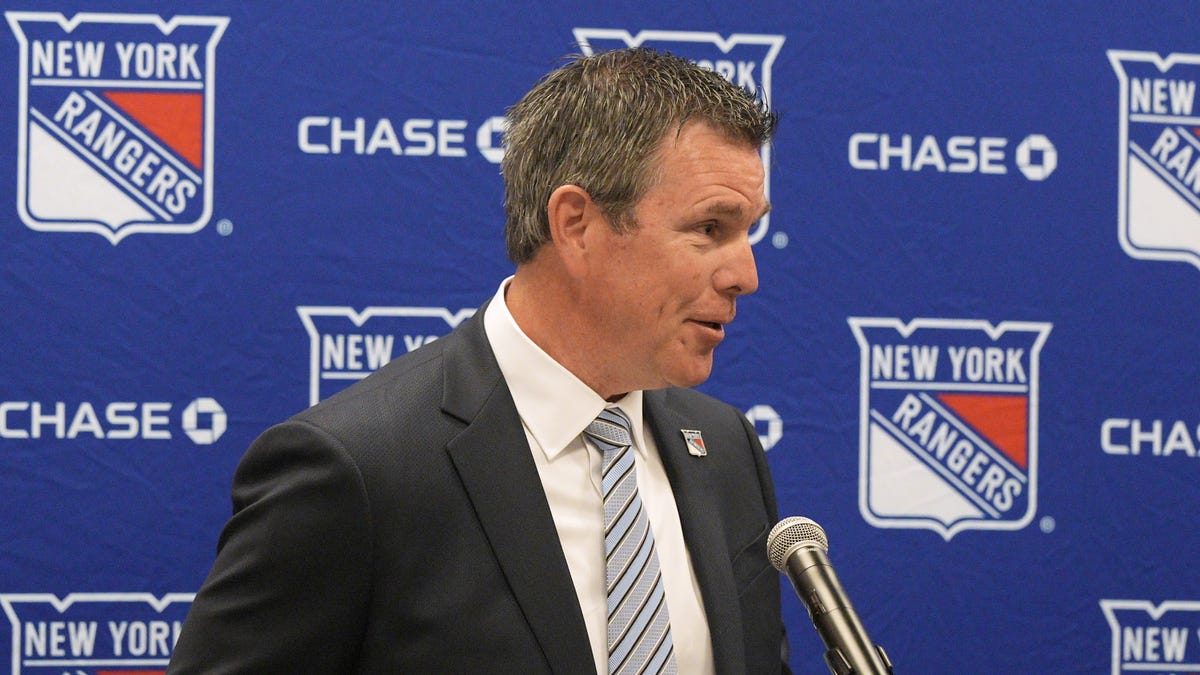


NY Rangers head coach Mike Sullivan introduced in Tarrytown
Rangers head coach Mike Sullivan is introduced during a press conference at the MSG Training Center in Tarrytown, New York, May 8, 2025.
Let’s play a quick game.
I’m going to rattle off three quotes from three different coaches, and you try to figure out who said what.
“We can be skilled, we can be talented, but if the work doesn’t come first, the skill and talent doesn’t get too far down the road.”
“There’s a lot of skill and a lot of talent on this team, from the goaltender to the back end to the forwards. … But when you watch the playoff games right now, the final four and the final two, it’s just a reminder that the compete inside the game is what makes teams great.”
“I know there’s a lot of talent in the dressing room, but as we all know, talent alone doesn’t win championships. Teams win championships, and I think that’s going to be our challenge from day one, is to become a team in the true sense of the word.”
O.K., do you have your guesses ready? Here it goes…
The first is from Gerard Gallant on June 22, 2021, the day he was introduced as the 36th head coach in Rangers’ history.
The second is from Peter Laviolette on June 20, 2023, the day he was introduced as the 37th head coach in Rangers’ history.
And the third − yup, you’ve got it − is from Mike Sullivan on May 8, 2025, the day he was introduced as the 38th head coach in Rangers’ history.
If it feels like all three quotes came from the same person, it’s because they probably could have.
Maybe it’s just the nature of these ceremonial press conferences, when new coaches carefully offer platitudes over substance. But all three arrived in New York delivering starkly similar messages, urging a team that’s loaded with high draft picks and accomplished point-producers to dig deeper and play harder. It’s been a constant theme for three straight coaches − four if you include David Quinn − with fleeting success before inevitably falling back on old habits.
This Rangers’ core, led by Adam Fox, Artemi Panarin and Mika Zibanejad, isn’t built to hit and disrupt and grind. They always revert to a finesse game that relies on soft perimeter play and risky east-west passes, as opposed to the tenacious, direct approach each coach hired by team president Chris Drury prefers.
It’s hard to fault the coaches pushing that style of play. As each has pointed out, the teams that tend to win at this time of year all bring a certain level of aggression, hustle and defensive commitment. Drury has attempted to move the roster in that direction at various points, but many of those acquisitions have fallen flat while the delicate core largely remains intact.
That could change this summer, with the Rangers motivated to bring in players who make them bigger, stronger, faster and tougher. But they’ll still have to rely on a number of culprits who contributed to this feeble season.
Will Sullivan be the one who finally gets through to them? Can he inspire the complete buy-in that evaded his predecessors?
Drury and the Rangers are banking on it, with reasons to believe he’ll be a step up behind the bench. But it’s hard not to feel like we’re hearing the same message from a different voice for the third time in four years.
Wasting little time
Sullivan is aiding that effort by working quickly to establish relationships.
“I’ve spoken to virtually every player on the roster in the last three days, just to introduce myself and let the players know how excited I am to be their coach,” he said.
That was an important first step considering all that’s gone on in the last 12 months.
Multiple players have expressed frustration over communication breakdowns within the organization, whether it be from coaching or management. Sullivan declined to comment on those issues − “It would probably be irresponsible for me, because I wasn’t here,” he said − but it’s clear through his actions that he recognizes the need to make sure players feel heard.
There is hope that the two-time Stanley Cup winner can serve as the peacemaker between Drury and the locker room and make sure everyone is on the same page. He’s known as a thoughtful, straight-shooter, and while he won’t shy away from being hard on players when the situation calls for it, they should always know what’s expected and where they stand.
Gallant took a hands-off approach to player relationships, and while Laviolette seemed more active in that regard, there were still several instances in which players longed for more.
Sullivan should take it a step further, with that process already underway.
Leaders required; captain optional
Which players will help spread Sullivan’s message throughout the locker room?
A trio who played for him with Team USA at the 4 Nations Face-Off − Fox, J.T. Miller and Vincent Trocheck − figure to be the leaders in that regard. Chris Kreider was also on that roster, but he took a step back in that role during a turbulent 2024-25 season and his future in New York is much less certain.
Sullivan referred to them as “fierce competitors” with “an insatiable appetite to win,” sending the signal that he plans to rely on those U.S. representatives to push the rest of the group.
If and when the Rangers name a replacement for traded-captain Jacob Trouba, expect one of those three to be the choice. But there is no timetable for that announcement, with Sullivan noting he and Drury have yet to discuss the topic.
Rushing to give out the “C” is less of a priority than reviving a locker-room culture that crumbled this season, which Sullivan indicated he wants every player to take ownership of.
“The one takeaway that I have from those conversations is I think there’s a fair amount of leadership in that room,” he said. “Whether you wear a letter or you don’t wear a letter, leadership manifests itself in so many different ways. I think there’s a lot of character in that room, just based on the initial conversations that I’ve had with these guys.”
A ‘push’ for Adam Fox
Fox was the only player Sullivan was asked about directly during a limited Q&A session, with the question specifically mentioning their time together at 4 Nations.
The 27-year-old was expected to be a go-to guy for the American defensive corps, especially with star Quinn Hughes out due to injury, but his role was quickly reduced. Fox was removed from the top power-play unit after one game in favor of Zach Werenski and ranked last among U.S. defensemen in average time on ice per game at 16:51. The dip was especially glaring in two games against eventual champion Canada, when Sullivan played him significantly less than any of the other five D.
That raised eyebrows around the NHL and amplified questions about whether Fox’s skill set is well-suited for those tight-checking environments, and now the task falls on Sullivan to better prepare him for those moments.
“I don’t think there’s any doubt that that Adam is an elite player in this league, and we’re going to push him to try to be at his very best,” the coach said. “I can only draw on my own experiences, and I think that’s an essential part of coaching – is pushing these guys to challenge their comfort zones, and that’s a daily endeavor.”
“I don’t know that there are many that do a better job quarterbacking the power play than he does up top, with the deception that he has, his ability to scale the (blue) line, the way he processes the game and thinks the game at such a high level,” he added. “The prospect of that certainly excites me.”
Philosophy on the youth
Sullivan must also find ways to get more out of the Rangers’ youth, many of whom seemed to hit a wall under Laviolette.
That’s certainly true for forward Alexis Lafrenière and defensemen K’Andre Miller and Braden Schneider, with the latter two both undergoing surgery recently that may explain some of this year’s struggles. But it extends to a group of rookies who broke in this season, including five up-and-coming forwards in Brett Berard, Adam Edström, Brennan Othmann, Gabe Perreault and Matt Rempe.
Sullivan will be charged with helping those players grow and become reliable lineup regulars, which will be especially important to offset salary cap concerns.
“It’s an individualized process,” he said. “I don’t think you can paint every player with the same brush. Everyone is different. The art of coaching, I guess, is trying to figure out what that daily recipe is that’s best for a player.”
Sullivan pointed to success stories from early in his tenure with the Pittsburgh Penguins, when several emerging prospects played key roles in back-to-back Stanley Cup wins. But he also made it clear he won’t blindly award ice time to young players without merit.
That, too, sounded much like the message from his predecessors.
“What I will tell you is that I think it’s important that every player earns their opportunities – that no one’s entitled to an opportunity,” he said. “I will tell you that as coaching staff, we’ll make the best decisions we can to try to help each player be at the very best, and most importantly, help the New York Rangers win.”
Vincent Z. Mercogliano is the New York Rangers beat reporter for the USA TODAY Network. Read more of his work at lohud.com/sports/rangers/ and follow him on Twitter @vzmercogliano.