
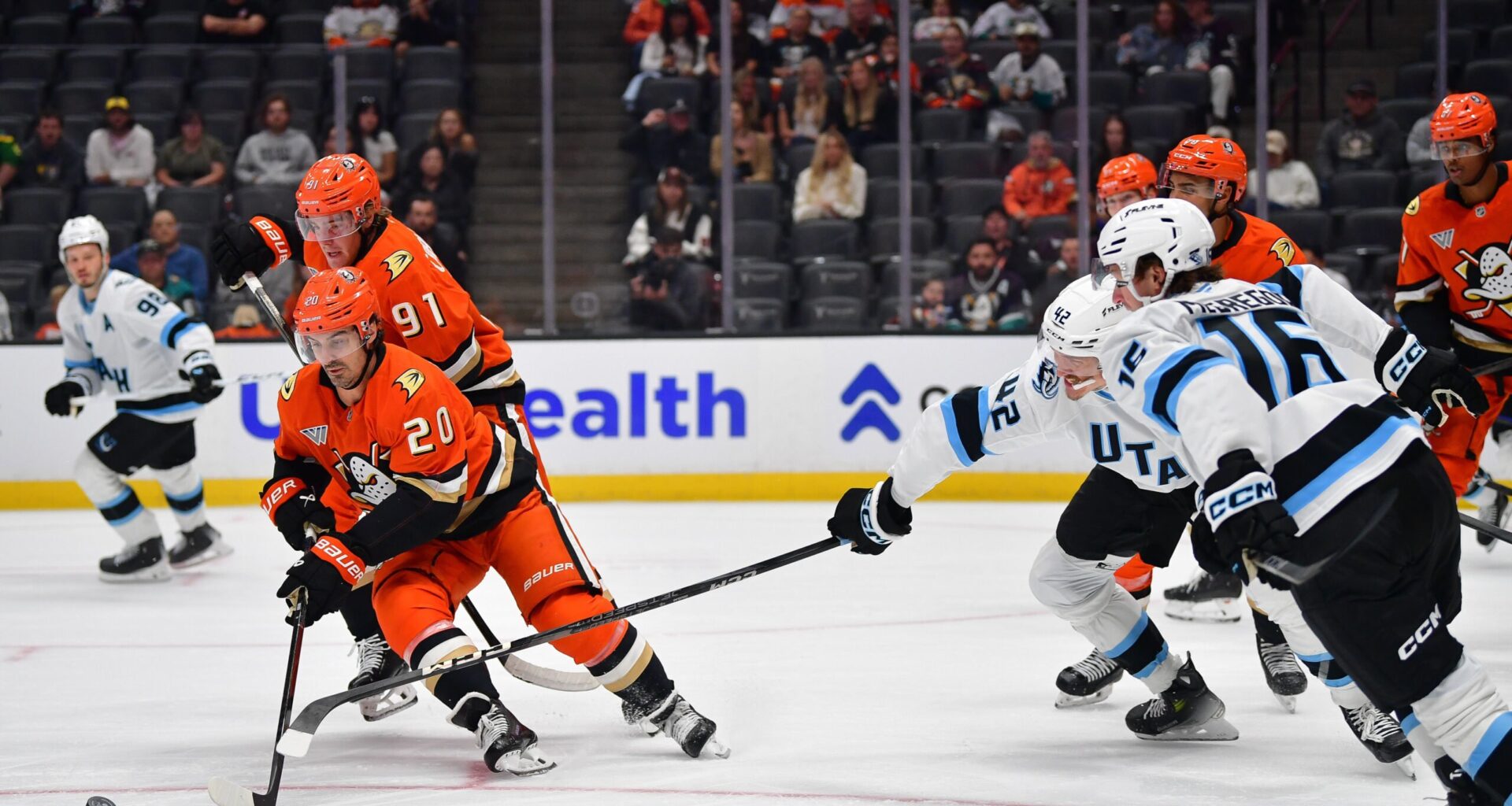
The Ducks made one of the splashiest trades of their offseason by acquiring Chris Kreider from the New York Rangers. General manager Pat Verbeek sent forward prospect Carey Terrance and a draft-pick swap to New York, betting that Kreider’s veteran scoring touch could accelerate Anaheim’s transition out of its long rebuild. Kreider is 34, on a $6.5 million cap hit, and coming off a 22-goal, 30-point season. The question Ducks fans are asking is simple, does he still have enough left to help push Anaheim toward the playoffs? That’s where our Chris Kreider point projection comes in.
Why Anaheim Made the Move
Verbeek has been explicit about the reasoning. “Chris Kreider is the type of player we were looking to add this offseason,” he said in the team’s statement. “He has size, speed and is a clutch performer that elevates his game in big moments. Chris also upgrades both of our special teams units, something we really needed to address.”
The Ducks ranked 32nd on the power play last season, and their penalty kill was only marginally better. Kreider, who has long been one of the league’s most reliable net-front scorers, directly addresses both issues. Anaheim already feels a bit like “Rangers West” with Jacob Trouba, Ryan Strome, and Frank Vatrano in the mix. Adding Kreider further signals Verbeek’s intention to fast-track Anaheim’s rebuild into a playoffs-or-bust mode.
Linemates and Role in Anaheim
Kreider is projected to slot into Anaheim’s second line, most likely alongside Leo Carlsson or Mason McTavish, with Cutter Gauthier as a potential winger rotation. On the power play, he will reprise his net-front role, screening goalies, tipping shots, and jamming in rebounds. That skillset is exactly what the Ducks lacked last year.
His 16:45 average time on ice in New York last season is unlikely to climb much higher, but Anaheim will lean on him for roughly the same minutes with significant PP usage. In short, for Kreider, the role is clear, and it plays to his strengths.
A Quick Primer on the Analytics
To make this projection more transparent, here’s what we’re looking at:
Expected Goals (xG): Measures scoring chance quality, instead of just goals scored. Kreider’s xG (29) closely matched his actual goals (27 forecast), which signals sustainability.
Percentile Ratings: To show how players stack up against peers. Kreider graded in the 78th percentile as a finisher, but just the 16th in playmaking.
Regression Analysis: We blend past performance with league averages to find the line of best fit, and to avoid giving too much weight or overreacting to one season. For Kreider, that means trimming his finishing slightly, while holding his PP role steady.
Monte Carlo Simulation: By simulating 10,000 seasons varying ice time, PP touches, and shot volume, we create a range of outcomes rather than one rigid prediction. These estimates are based simply on the empirical distribution of the available data. Monte Carlo simulations rely on historical data, probability distributions, and the correlation of the variables. Due to these assumptions, the generated outcomes of the simulation may not perfectly reflect reality. For instance, it may use a slightly different distribution mean and variance. However, it should help with the confidence in the prediction.
Usage and Age Curve
Kreider’s production has dipped from his 52-goal peak in 2021–22, but his finishing touch remains steady. Last season, he shot 14.6%, nearly identical to his career average. His decline has come from reduced five-on-five involvement and fewer total shots. Advanced models such as Dom Luszczyszyn’s forecast him for 27 goals and 36 points. However, they pegged him as a $3 million surplus value player, meaning his salary outweighs his projected on-ice value. HockeyStatCards similarly rated his overall impact at –0.8 net rating.
Anaheim, however, is less concerned with surplus and more with fit. They have nearly $14 million in cap space and are willing to spend to end their seven-year playoff drought. For them, Kreider’s contract is about adding finishing ability and playoff credibility.
Chris Kreider Point Projection (80 GP, 2025–26)
Category
Projection
95% Confidence Interval
2024–25 (NYR)
Goals
20
15 – 25
22
Assists
15
10 – 20
8
Points
35
27 – 44
30
Plus/Minus
-6
-12 – -1
-5
Power Play Pts
10
6 – 13
7
Shots on Goal
150
135 – 170
151
Hits
80
65 – 95
79
Blocks
25
18 – 32
26
PIM
24
15 – 35
24
TOI/GP
16:30
15:30 – 17:30
16:45
Ceiling vs. Floor
The ceiling of our estimates here are assumingly modest. Anaheim’s power play jumps from dead last to even league average, Kreider could touch 25 goals and 40 points. The floor, if the PP remains stagnant and his ice time dips, is closer to 15 goals and 30 points. Either way, his contributions will be goal-driven, not assist-heavy. His physicality and net-front skills keep him fantasy-relevant in leagues that count hits and special-teams production.
The Bigger Picture
This trade isn’t just about Kreider’s numbers. It’s about signalling Anaheim is finished waiting. Owner Henry Samueli has publicly committed to spending and pushing for playoff relevance. Kreider was the first domino in a series of moves designed to make Anaheim competitive again. If he chips in 20 goals and stabilises the power play, the Ducks will consider the bet a success.
Final Word
This Chris Kreider point projection points to a middle-six scorer with 20 goals and 35 points in 2025–26. That’s not star-level output, but it fills a glaring hole in Anaheim’s lineup and brings the veteran presence Verbeek covets. Whether this deal looks savvy or risky will depend less on Kreider hitting 40 points and more on whether Anaheim takes the step Verbeek has promised: from patient rebuild to postseason contender.
Main Photo Credit: Gary A. Vasquez-Imagn Images