
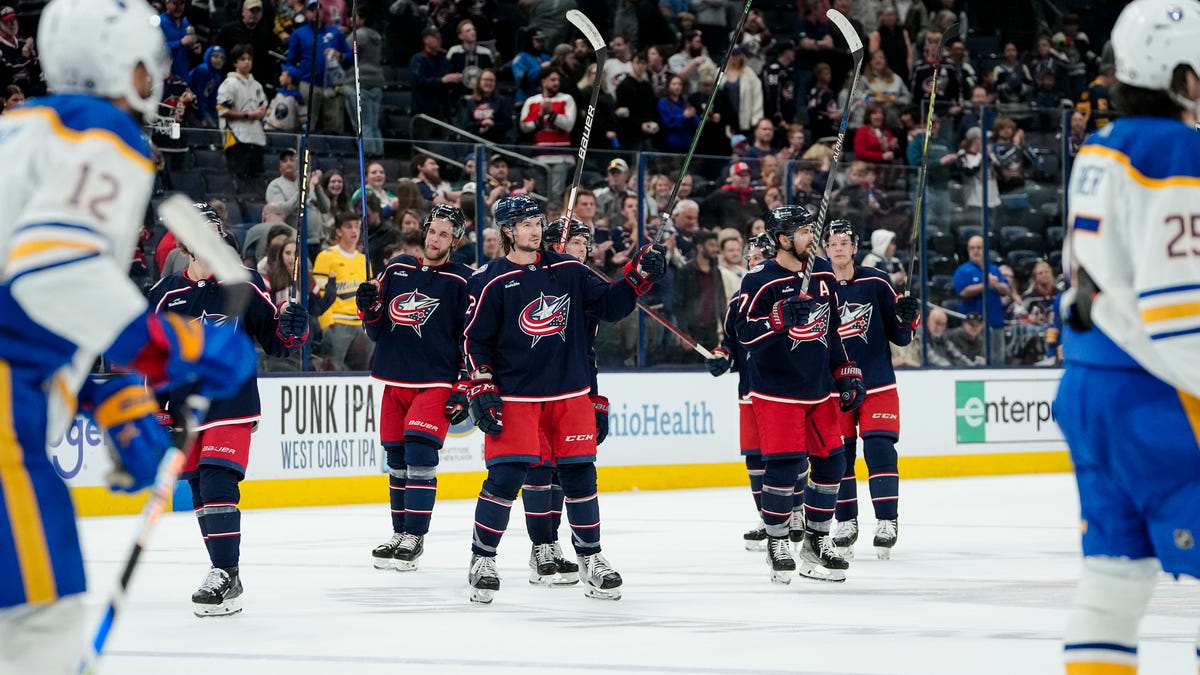
Zach Werenski has gotten used to it.
Despite logging nine NHL seasons and becoming a star for the Blue Jackets, there are still times when people in his hometown haven’t heard of his team.
“People will ask what you do, and you’ll go, ‘I play hockey,’ and then you’ll say which team, and they’ll go, ‘Oh, what league is that?’ ” Werenski said. “I’m like, ‘You know the Red Wings? We play them. It’ll happen when I go back to Detroit in the summer. I don’t care. I’m used to it, but it’s definitely a little frustrating.”
The frustration for Werenski, who was selected eighth overall by the Blue Jackets in the 2015 draft, is tied to his belief the NHL isn’t doing enough to promote teams and players in its smallest TV markets, such as the Blue Jackets.
That’s starting to change for Werenski, who was recently ranked the NHL’s 17th best player by NHL Network and is featured along with Sean Monahan in Prime Video’s “FACEOFF: Inside The NHL” docuseries. But he’s got a point.
The Blue Jackets don’t typically get a lot of national exposure and are sparingly discussed by NHL insiders unless one of their top players requests a trade. So, they’re left with primarily one way to change the narrative about Columbus.
Win more, and win big.
“We’d have to win the Stanley Cup, like the (Florida) Panthers,” Werenski said. “We could make the playoffs for three or four years in a row, and I still don’t think they’d talk about us much, but it would help. Great individual seasons help, making the playoffs helps, but at the end of the day you have to be a playoff contender, or you have to be the (Toronto Maple Leafs) or (Montreal Canadiens), and that’s about it.”
The NHL’s outdoor extravaganzas are a good example.
The Blue Jackets were among the last teams to be included in one of those premiere league events when a deal was finally struck with Ohio State to hold last season’s 2025 NHL Stadium Series game at iconic Ohio Stadium. The attendance of 94,751 for the Blue Jackets’ exciting 5-3 victory over the Red Wings was the second-largest crowd to attend an NHL game, while ESPN’s ratings ballooned to 1.6 million viewers.
That was the highest ratings the network has gotten for a regular-season game since re-acquiring NHL broadcast rights in 2021.
“It’s an awesome market,” Werenski said. “It’s a great place to play, it’s a great place to live. We have great fans here. It checks a lot of boxes, and I feel like the league would want to promote it more, based on our ratings for the outdoor game. I feel like we have great players and players who are going to have big years, but they don’t seem interested. You can’t get caught up in it, though. It just is what it is, and you’ve got to win.”
The Dispatch wasn’t able to reach an NHL spokesman for this story despite multiple attempts.
Columbus Blue Jackets fighting steep uphill climb to gain national notorietySteep uphill climb
Werenski isn’t the only Blue Jackets player, coach, staff member or employee to experience the team’s anonymity while traveling outside central Ohio.
Inside their bubble area, the Blue Jackets are known and popular for multiple reasons that include efforts to foster hockey participation among kids and helping the local community with an impressive charitable foundation that has contributed more than $15 million since its 2000 inception.
Outside the bubble, they’re shrouded in obscurity, which is an astounding dynamic for a major professional sports franchise now celebrating its 25th anniversary. It’s not entirely unique, though, which Blue Jackets president/general manager Don Waddell knows firsthand.
Prior to joining the Blue Jackets in May 2024, Waddell held similar executive roles with the Atlanta Thrashers, an expansion team that has since moved to Winnipeg, and Carolina Hurricanes, a small-market team like the Blue Jackets. The Hurricanes weren’t talked about much until they won more often, which put more weight behind organizational outreach efforts that boosted their brand.
“You can’t just assume that because you’re an NHL team people know who you are,” Waddell said. “It doesn’t work that way. I’ve been through it at multiple stops. Winning solves a lot of it, but you still can’t assume that winning’s going to do it all. Winning is number one, but it’s also your grassroots programs, and we’re trying to do more stuff. We’re trying to reach out.”
Trending upward
Waddell will soon meet with the Cincinnati Regional Chamber, a business and civic organization, and the Blue Jackets already have a presence in Northeast Ohio with the AHL’s Cleveland Monsters, their top minor league affiliate.
Gaining notice from all parts of Ohio could help the Blue Jackets’ exposure grow, but a much tougher battle waits beyond the state’s borders.
They entered the NHL the same season (2000-01) as the Minnesota Wild, a team from “The State of Hockey” that gets more attention from national NHL analysts in the U.S. and Canada. Prior to the Blue Jackets and Wild, the Nashville Predators (1998-99) and Thrashers (1999-00) were added in a three-year expansion rollout that pushed the league from 26 to 30 teams.
It’s now 32 after adding the Vegas Golden Knights (2017) and Seattle Kraken (2021), making the battle for prominence even tougher. The Blue Jackets are armed for that challenge with a promising roster filled with talented young players, led by Adam Fantilli, and a core group of driven veteran leaders.
“As far as the national stage, we just need our team to pop,” said former Blue Jackets star Rick Nash, who now is the team’s director of hockey operations. “Once our team pops and we become a consistent playoff team, I think we’ll get a bit more recognition.”
Winning hasn’t come easily
There’s a reason some Columbus sports fans roll their eyes when told the Blue Jackets are trending up.
They’ve heard it before, far too often, and losing has become the Blue Jackets’ most consistent organizational trait. They’re one of only two NHL teams since their inception to win fewer games than they’ve lost in regulation − 807-860 with 33 ties and 196 overtime losses − and rank second-to-last (.486) in points percentage.
That would be bad for any NHL team, but it’s magnified exponentially in Columbus, where Ohio State’s football program makes the place feel like you’re living in a Dr. Pepper “Fanville” commercial. The No. 1-ranked Buckeyes are looking for a repeat of last season’s national championship, so they’re expected to win every time they play. That tends to foster a nearly impossible standard for themselves and other Columbus teams to meet.
“It’s not for the lack of a good city or environment or arena or ownership,” Nash said of the Blue Jackets’ national anonymity. “It’s nothing like that. I think for a national stage, the media just wants to see a consistent winner. This is a sports town, and they’re just waiting for (the Blue Jackets) to explode.”
The good news for the Blue Jackets is that narrowing the focus to their more recent past pushes them higher up the list of successful NHL teams.
During former coach John Tortorella’s six seasons, for example, they went 227-173-54 with a .559 points percentage that ranked 17th in the league. They also qualified for the playoffs in four straight years, notching their lone playoff series win in 2019 with a sweep of the heavily favored Tampa Bay Lightning.
Filtering out Tortorella’s first and final seasons pushes the Blue Jackets even higher up to eighth in NHL points percentage (.608) during a four-year playoff streak.
“When we swept Tampa, the buzz was incredible,” former Blue Jackets star forward Cam Atkinson said. “Everyone wants to win the Stanley Cup, but if you make the playoffs, people come out of the woodwork. That’s why the Buckeyes have been such a dominant factor in college football. They’re expected to win every single year, and that’s what we were trying to do with the Blue Jackets.”
Columbus Blue Jackets are ‘small market’ despite large populationSmall market despite large population
Prior to this season, the Blue Jackets were commonly overlooked for national TV broadcasts by ESPN and TNT, the NHL’s two largest U.S. rights-holders.
In fact, they didn’t make a single national TV appearance in 2023-24 and had only the NHL Stadium Series game scheduled going into last season. A home game late in the season against the Washington Capitals was switched to a national ESPN broadcast, but that was only to make sure Alex Ovechkin’s pursuit of Wayne Gretzky’s all-time goal record would be broadcast nationally.
Ovechkin didn’t even make the trip to Columbus after passing Gretzky a week earlier, and the Blue Jackets routed the Capitals on a Saturday afternoon. This season, the Jackets have six national TV games on either ESPN or exclusive streaming via ESPN+/Hulu.
They were again excluded from TNT broadcasts, though, and have a bit of a conundrum on their hands when it comes to population size for Columbus vs. central Ohio’s Neilsen TV ratings Designated Market Area (DMA).
According to the U.S. Census Bureau, Columbus ranked 15th among the country’s 351 largest cities in 2024 with an estimated population of 933,263 that grew by 12,694 (1.4%) from 2023. That’s 252,969 more than Cleveland (365,379) and Cincinnati (314,915) combined, and just under those two cities plus Toledo (265,638).
Additionally, the Columbus metropolitan area forming the bulk of central Ohio has an estimated population of 2.3 million, so it’s not a quaint little college town. Columbus is massive, ranking as the NHL’s 10th largest city.
The problem for the Blue Jackets is the stark difference between population and Neilsen’s DMAs for each state. Columbus is a distant second to Cleveland, which includes Canton and Akron under its DMA umbrella. Columbus is 32nd nationally in DMA, while Cleveland-Akron-Canton ranks 17th.
That’s a problem for the Blue Jackets, who don’t move the needle for national TV broadcasts as a small-market team. Their DMA is larger than only four others in the NHL, which creates a challenge for securing national exposure. That’s why things such as Johnny Gaudreau picking Columbus as a free agent, the Blue Jackets’ emotional push without him, Werenski’s Norris Trophy chase and Fantilli netting 31 goals in his second NHL season were all boosts to the Jackets’ perception.
The next step, and it’s a big one, is becoming a Stanley Cup contender that qualifies for the postseason every year.
“Win more,” Fantilli said. “That’s it. I don’t think there’s much else we can do. We carry ourselves as professionals and we’re a first-class organization with that stuff. It’s just making it to the playoffs and climbing that ladder and getting to the top of the hill … and that’s pretty much it.”
Blue Jackets reporter Brian Hedger can be reached at bhedger@dispatch.com and @BrianHedger.bsky.social