
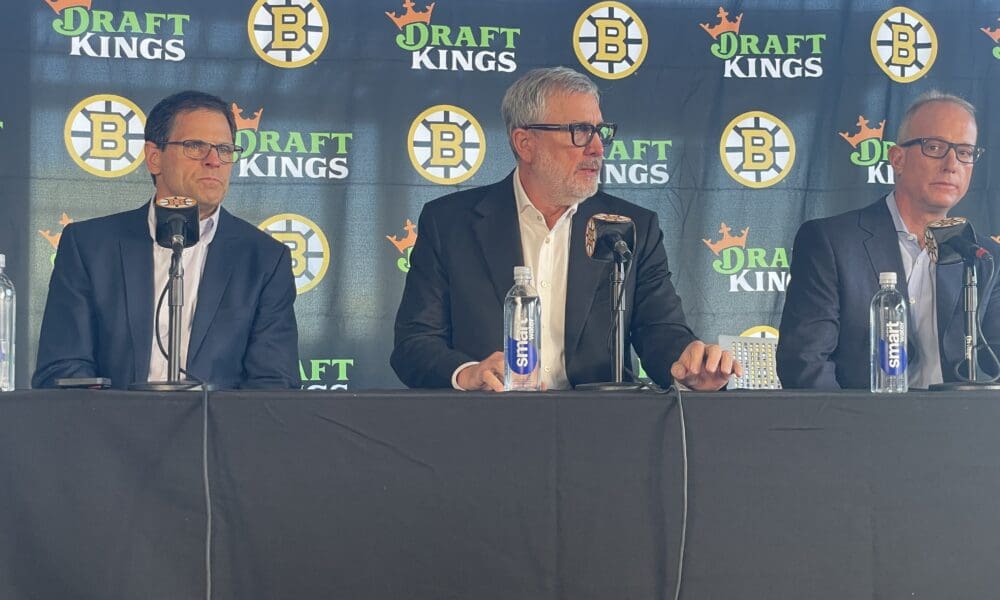
BOSTON — Before their players begin the 2025-26 campaign against the Washington Capitals later this week, the Boston Bruins front office held a season opening press conference Monday afternoon.
Way up above TD Garden, in the Verizon Tower that overlooks Causeway Street, Bruins CEO and Alternate Governor Charlie Jacobs, President Cam Neely, and General Manager Don Sweeney, spoke in front of media for half an hour, answering a wide range of questions on the current state of the team and its direction heading forward.
Here are the five key takeaways from the press conference.
1. No Illusions of Identity
The Bruins will not be a team that lights up the scoreboard this season, and they’re well aware of it.
They know that if they’re going to be one of the eight teams in the Eastern Conference to make the postseason, they’ll have to lean heavily on their defensive laurels.
“We’re going to have to play tight defense if we’re going to be one of the eight, as we’re structured right now,” Neely said. “We got guys that are going to be tough to play against, hard to play against. Teams are going to circle playing against the Bruins and go, ‘Oh, damn, we got to play them tonight.”
Becoming a “tough out” was at the forefront of the Bruins’ plans this offseason. Already a team built on physicality to begin with, they doubled down by adding the likes of Tanner Jeannot, Sean Kuraly, and Mikey Eyssimont.
“We really felt the bottom part of our lineup needed a little bit more piss and vinegar, if you will,” said Neely. “That was something we attacked first.”
The Bruins have always had a defense-first identity, but this year it’s something they’re emphasizing even more. They know their playoff hopes depend on it.
2. Still Searching For Scoring Help
While not a highly explosive team as they currently stand, the Bruins are very much looking to add some firepower to their lineup at some point this season.
Boston did try to bring in some scoring help during the offseason via free agency, but nothing came to fruition.
“We targeted a few players, and, unfortunately, it just didn’t work out for various reasons,” Neely said. “The free agent class was what it was from an offensive standpoint. When it was as limited as it was [compared] to some from previous years, it’s going to be a little bit more challenging to try to get a player that you may want.”
How exactly the front office plans to address what is a major need for the team is still unclear.
3. Need More From Youth Right Now
This was supposed to be the year the Bruins infused more youth into their roster.
Prospects like Fabian Lysell and Matthew Poitras were supposed to make the team. Same for offseason signings Matej Blumel and Alexander Steeves.
Ultimately, none of them made the final cut, and it was as difficult for the Bruins to make the decision as it was for the players to hear it.
“These are hard decisions you make,” said Sweeney. “Some of the [players] made it very difficult. They are going to go put the work in that’s required to be next in line. The message is going to be, we’re going to play the players that are playing the best, and that extends to Providence.”
The one young player who made the team out of training camp is center Fraser Minten. The 21-year-old quickly endeared himself to Boston’s coaching staff and front office during training camp with his maturity and high hockey IQ.
“Frazier, to his credit, took the opportunity, and he’s earned it,” Sweeney said.
Acquired from the Toronto Maple Leafs at last year’s trade deadline, Minten is one of a handful of young players the Bruins have added to their organization over the past few months. He, along with the likes of Poitras, as well as top prospect James Hagens and Will Zellers, have the Bruins very enthused about the development of their prospect pool.
“There’s no question we’ve deepened it. We’re happy about that,” said Sweeney. “That was the intention at the deadline, with our staff doing a good job. It’s an exciting time to start to think that we are trying to add to a deeper pool.”
4. Leadership Locked In
The Bruins may not be a team bursting with youth, but they feel they’re well stocked on veteran leadership, even without a definitive captain.
The locker room is still very much ruled by alternates David Pastrnak and Charlie McAvoy. One of them will undoubtedly get the almighty ‘C’ whenever the Bruins do decide to name a captain.
Until then, the Bruins, as well as Pastrnak and McAvoy themselves, are comfortable with the corps they have in place
“They’re not concerned about the captaincy part of things,” Sweeney. “They’re only concerned about the leadership and then coming together as a group.”
Along with Pastrnak and McAvoy, Hampus Lindholm, Elias Lindholm, and Nikita Zadorov are considered leaders within Boston’s locker room. Even newcomers in Jeannot and Kuraly have already been adopted into the group, and are expected to take on a more vocal role as the year progresses.
5. The Pressure Is On
The pressure to succeed is always present when you play in Boston. But when you call The Hub home and are coming off a miserable season like the Bruins are, it’s raised to an even higher level.
“The pressure is there whether we won the Stanley Cup last June or not,” Jacobs. “We’re very blessed to have the market that we have and the fan base that we have, not only in Boston, but New England. There’s pressure every day, and that just speaks to the veracity of this market and how much they love Bruins hockey.”
According to Jacobs, there are 12,000 people currently on the waiting list for Bruins season tickets and a 95 percent renewal rate despite last year’s struggles, so clearly business isn’t all too bad.
But can the Bruins afford another season like that? They don’t want to find out.
“We recognize that [fans] have their own expectations of their teams in the city,” Neely. “We have to match that, or do better. We’re not satisfied at all with last year. We know we need to be better, and that’s our mission.”
FOLLOW ANDREW FANTUCCHIO ON 𝕏: @A_FANTUCCHIO
FOLLOW BOSTON HOCKEY NOW ON 𝕏 AND FACEBOOK