
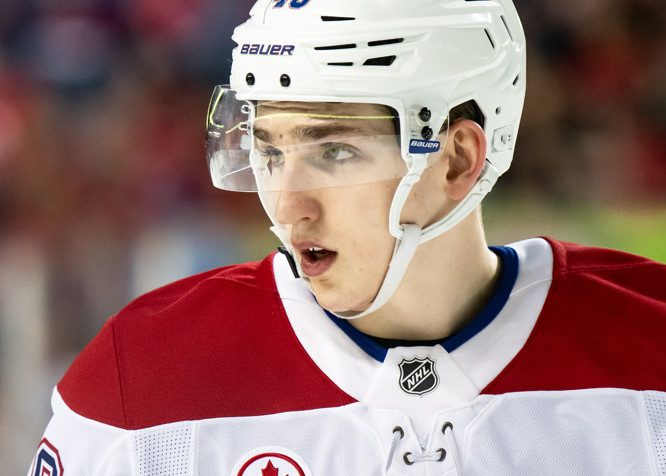
 LOS ANGELES, CA – FEBRUARY 05: Montreal Canadiens right wing Cole Caufield (13) skates in warm ups before a Los Angeles Kings game versus the Montreal Canadiens on February 5th, 2025, at the Crypto.com Arena in Los Angeles, CA. (Photo by Rob Curtis/Icon Sportswire)
For the past couple of years, the anticipation that’s built around the Canadiens rebuild and wondering when they’d finally emerge came to fruition. Montreal finished with the second wild card after putting up 91 points, a 15-point improvement from the previous year, and held off Columbus and Detroit for the final playoff spot and their first playoff berth since they went to the Stanley Cup Final in 2021. On paper, the Canadiens numbers weren’t exactly electrifying. At five-on-five they had the fifth lowest CorsiFor and expected goals for percentages. They allowed the eighth most goals at five-on-five and were tied for 18th in goals scored. Their power play was 21st in the league but they had the ninth best penalty kill. A great season from starting goalie Samuel Montembeault (.902 save percentage, four shutouts) was a key reason for their success and backup Jakub Dobes (7-4-3, .909 save percentage) made Cayden Primeau expendable. They were also buoyed by an incredible Calder Trophy-winning season from defenceman Lane Hutson who had 66 points and was third on the team in scoring behind 30-goal scorers Nick Suzuki and Cole Caufield.
What’s Changed?
Montreal was able to leverage their cap space and draft assets to make one of the biggest moves of the summer. The Canadiens acquired defenceman Noah Dobson in a sign-and-trade deal from the New York Islanders for Emil Heineman and two 2025 first-round picks. Dobson signed an eight-year, $76 million extension and by adding Dobson, the Canadiens have yet another high-end puck-moving offensive defenceman to go with Hutson. Coach Martin St. Louis likes his team to play high-intensity, fast hockey to get up and down the ice and with Hutson and Dobson they can do that much more often. As big as the Dobson move was, the rest of the summer was quiet. Defenceman Logan Mailloux was sent to St. Louis for promising forward Zack Bolduc and goalie Cayden Primeau was traded to Carolina for a pick. They also added forwards Samuel Blais and Joseph Veleno on one-year deals.
What Would Success Look Like?
If the Canadiens can continue where they left off last season and use their playoff appearance against Washington to spur them forward into perhaps a battle for second or third place in the Atlantic Division, that would show the path they’ve carved out in this rebuild continues to be the right one. While they’ve got aspects of their game to clean up all around, getting high-end performances from Suzuki, Caufield, Hutson, Dobson, Juraj Slafkovský and Patrik Laine again would make a very exciting team infinitely more dangerous to play against. Whether it’s Montembeault or Dobes who take control in net might be worth keeping an eye on, but the balance struck last season worked well. Montreal’s style of play and high-end talent make them exciting and if that can all be honed more, this is a team that can be frustrating for years to come.
What Could Go Wrong?
Montreal seemed to win despite having average-to-below-average shot and expected goal numbers and if the good fortune and goaltending that allowed them to buck those trends fails them, they’ll be in a battle to try and make the postseason in what could be a very crowded field, particularly in the Atlantic. Between Ottawa, Detroit, Buffalo, Boston, Columbus, the New York Rangers and Islanders, Pittsburgh and Philadelphia, things get messy fast in the East. Any slip-ups and losing streaks can dunk a team in the bottom of the standings and make up ground when everyone is so even is extremely difficult. Suzuki and Caufield must lead the pace while Slafkovský continue to press forward in his own development as a power forward. The balance between Dobson and Hutson bears watching too. Chemistry will be tested.
Top Breakout Candidate
With all the young talent in Montreal to watch, the biggest one to keep an eye on this season is Ivan Demidov. The Canadiens first-round pick in 2024, fifth overall, left his team in Russia last season and joined the team late in the regular season and playoffs. In two games he had a goal and an assist and in five playoff games against the Capitals he had two assists. At 6-foot-1, 190 pounds he’s a handful to defend with his moves, speed and skills. Plugging him into Montreal’s top six forward group makes this exciting team even more fascinating to watch. Expect more Calder hype to come for Demidov, he’ll be a blast to watch.
FORWARDS
Nick Suzuki
Predicted Stats
GP
G
A
PTS
PPG
82
33
57
90
1.10
The leader of Montreal’s surge to the playoffs, Nick Suzuki turned a lot of heads last season. After years of debates of whether he can be a 1C on a contending team, he carried Montreal’s offence on his back to get them from a lottery team to a playoff spot. How good was he? His point-pace after the Four Nations break would put him in company with some of the league’s elites. Getting on the scoresheet every night and seeing his responsibility with his ice-time reaching 21 minutes a game by March. Always a workhorse in the defensive zone and in the transition game, Suzuki’s offence reaching the next level was always a work in progress. Something clicked the last two season with him shooting the puck more and playing with more pace off the rush. Areas where he’s improved the most is playing the give-and-go game and creating more sustained offence. Last season was the most shots per 60 minutes he created off the cycle in his career, as most of his offence was primarily off the rush in previous seasons. This is what can make a great playmaker like him turn into an elite one, as it’s tougher to create chances when the game isn’t open and space is hard to come by. Suzuki took a huge step in improving his game here and it bodes well for him long-term. Repeating what he did in the second half will be difficult, but the Habs don’t have any questions of who to build their roster around now.
Predicted Stats
GP
G
A
PTS
PPG
82
42
34
76
0.93
While Suzuki was the engine of Montreal’s run to the playoffs, Caufield was the motor all season long. He reaped some of the benefits of Suzuki’s playmaking as a small, pure shooter who gets lost in the weeds of the offensive zone. Doesn’t always need great setups to score, but his own play is enhanced when surrounded by elite playmaking. He led the NHL in shots off high danger passes last season, which was a product of his linemates and Caufield’s own instincts as a goal-scorer. Helped him become a high-20’s goal guy to someone who could push 40 over multiple seasons. The nice thing about Caufield is his game isn’t one-dimensional, and he doesn’t always need to be the shooter. Him, Suzuki and Slafkovksy did a great job of reading off each other and Caufield added another wrinkle to his game by passing from areas that he typically shoots from, giving his linemates tap-in chances for easy goals. He’s also grown as a player who can help drive the play in the neutral zone, gaining more confidence with making plays across the line rather than chipping it in. The only area where his size has set him back is as a defensive player. He’s not a good enough puck-carrier to dodge forecheckers and can have shifts where he’s stuck in his own zone when he’s the one leading the exit. It’s something Monteral can live with if he produces like he did last season. Caufield is one of the league’s young stars and entering his prime.
Predicted Stats
GP
G
A
PTS
PPG
81
27
34
61
0.75
While his point total might not show it, those who watch Montreal will tell you Slafkovsky turned a corner this past season. Moved to the top line, Slafkovsky reaped the benefits of playing with the Habs two best players and finally showed some high-level skill. He was one of the best forwards in the league at setting up high danger passes, using that long reach to win pucks behind the goal line and showing the finesse that got him drafted first overall. He was also a critical piece in the defensive zone, taking some of the heat off Suzuki starting most of the breakouts and giving them a little more stability than Caufield did with getting pucks out. It’s still hard to say if he’s a future star or a third wheel on the top line because most of the skills he is rated best at are better utilized when paired with an elite talent. A good example being how most of his shots came off deflections and one-timers and how most of his setups were from behind the goal line or across the slot. Those are great qualities to have, but not the most repeatable on a year-to-year basis if you’re not going to be with the same linemates. That said, Slafkovsky progressed in the skills that are more repeatable too. His ability to gain the zone with control has improved dramatically since his rookie year. His shot assist rate is also climbing to a first line level after two seasons of bad to mediocre numbers. Slafkovsky is more involved in the play in general and Montreal is hoping that he will keep adding to his toolbox next season. He’s setup nicely to be a contributor on the top line, but taking the next step to becoming someone who can drive his own line is what you want to see from him as he gets older.
Predicted Stats
GP
G
A
PTS
PPG
75
24
18
42
0.56
The Blues moving on from Bolduc was a little surprising even if they weren’t expecting him to sustain a goal scoring pace of 16 percent. He had somewhat of a roller coaster rookie season with 19 goals despite multiple games as a healthy scratch and inconsistent deployment. The St. Louis top six isn’t an easy group to break into, and the deck was stacked against him with Jake Neighbours scoring more and locking down one of those spots. Combine that with the team wanting to put newcomer Jimmy Snuggerud on the top line and Bolduc might have become expendable. He’s an intriguing player, who isn’t big but uses his upper body well to separate himself from defenders to get to pucks first. His wrist shot is hard, deceptive and he’s very good at using his body to “catch” pucks in the slot and settle them down from there. Uses his feet well to chase down pucks and he’s very quick at making passes along the wall, both to set up shots and help exit the zone. The Blues liked him enough to use him in the bumper spot on the power play, where he scored seven of his goals. He has a lot of tools Montreal can use as a deceptive scorer in the middle of the roster. He has the most balanced all-around skillset of the players he’s competing with for a top six spot and his track record of scoring on lower lines should also give him an edge.
Predicted Stats
GP
G
A
PTS
PPG
55
20
17
37
0.67
Looking to restart his career, Laine’s season almost began on a disastrous note after taking a brutal knee-on-knee collision in his first preseason game. Thankfully, he didn’t require surgery, and his first year in Montreal was what you would expect from the young Finn. Recording yet another 20-goal season with 15 of them coming on the power play, there wasn’t much that changed with Laine. He’s always going to score at 30+ goal pace but will rarely ever play 82 games and his five-on-five play is always going to be erratic. For as much as he likes to shoot the puck on the power play, he deferred to the point a lot when playing at even strength and only shot unless he could get himself set up for a great chance. The quality over quantity approach isn’t a bad thing, but taking things to an extreme degree has been the problem with Laine over his career. He likes being the first player on the puck in the defensive zone to skate it out but has never been good when having to fight a forechecker for it, getting knocked off the play and turning it over frequently. He’s never been a fast player and knee injuries have made him look like he is skating on concrete at times, which limits his game to that of a one-dimensional power play specialist. He might have a grace period with all the injuries he’s battled, but there is going to be some heat for his roster spot next season with rookie Ivan Demidov and newcomer Zach Bolduc in the fold now.
Predicted Stats
GP
G
A
PTS
PPG
70
15
17
32
0.46
The lanky centerman is still an unfinished product and Montreal still doesn’t know what they have in him with Dach spending more time on injured reserve than on the ice. A torn ACL cost him his entire 2023-24 season, and he was limited to only 54 games last season after having surgery on his knee again. He’s a tall player who can skate fluidly and protect the puck well. Using his teammates has been his drawback, has he has tunnel vision in the offensive zone, and the game slows down for him to a troubling degree after he gains the line. He is very deliberate with his decision making both off the rush and on cycles, but he isn’t precise with his passing and a lot of plays die on his stick. He tried to make up for it last season by playing more of a net-front role alongside Alex Newhook and Patrik Laine, which was a fit stylistically with Dach using his big body as a screen. Converting on rebounds was the challenge for him, as it would take him a couple of tries to finally locate the puck when it was loose around the net. Possibly still feeling the effects of a broken wrist that happened early in his career. The stop-start nature to Dach’s career has made it tough to properly evaluate him and the multiple knee surgeries aren’t going to help some of his issues with acceleration and getting away from defenders. He has shown flashes of brilliance with Montreal as recently as two years ago, but it’s hard to say if he can regain that form.
Predicted Stats
GP
G
A
PTS
PPG
82
13
15
28
0.34
Taking fliers on former first round picks from other teams has provided the Habs with mixed results. The journey of Alex Newhook best exemplifies that. He shows flashes of being a special player and it’s usually when the table is set for him by his linemates. When he skates downhill from high in the offensive zone, he’s got one of the more dangerous shots on the Habs. The puck snaps right off his stick with a lot of elevation and accuracy. When his linemates drive the lane, he can make beautiful cross-seam passes and change the complexion of the game. Newhook can do enough to carry a third line but struggles when the game gets difficult and he has to make more plays under duress. He usually defers to his linemates at the first sign of pressure and doesn’t like to challenge the defence to risk a turnover. The safe style of play earns you some trust with the coaching staff, but it’s also frustrating to watch when you see glimpses of game-breaking skill from Newhook. He showed some signs of improving that last season, carrying the puck more and posting shot and scoring chance contribution rates that were around the league average. Becoming a threat on the power play has been the other challenge with him scoring only one goal with the man advantage all season despite consistent deployment on the second unit. Now 25, a skilled low-producing depth player might be all Newhook is, but he always shows just enough to make you want more.
Predicted Stats
GP
G
A
PTS
PPG
75
18
15
33
0.44
A mainstay in the Habs lineup for over a decade, Gallagher has a more important role in the locker room than he does on the ice, but last year was a return to form. While injuries have plagued the back half of his career, he is coming off his first 20-goal season in five years while playing mostly on the lower lines and second power play unit. Gallagher still plays the same, gritty style he always has. A pest by nature, he’s always around the net and taking a few extra pokes at the loose puck after the whistle just to stir the pot. This is part of why he’s had so many injury problems, as he’s eaten a lot of cross-checks in front of the net over the years. This is despite him not being that old at 32 years old, but with more miles logged and harder minutes. He formed an effective line with Josh Anderson for most of the season, the duo playing a straight-head game and doing an excellent job of driving play. They don’t score as much as they should for how many chances they get from close range, but they’re done with more brute force than finesse. Gallagher’s season was somewhat of a saving grace for Montreal with their need for more productive depth players. With how straight-ahead his game is, staying healthy will be key for Gallagher sustaining this level of play.
Predicted Stats
GP
G
A
PTS
PPG
79
16
13
29
0.37
Josh Anderson is one of the few players you could describe as a runaway train and have it be considered a backhanded compliment. He is a huge forward who skates like a bullet and makes a beeline for the net regardless of if he has the puck. He’s noticeable with how quick and powerful he skates and how many shots he takes. You also notice how he never looks to pass to teammates, lets chances go to waste by shooting into the goalie’s crest and how often he turns the puck over while trying to bolt out of his own zone. If there is such a thing as a one-way player, Anderson fits the description because his positive traits are all related to shooting and speed. He was one of the Habs best forwards at scoring chances at even strength despite having the lowest shot assist rate on the team. It’s also made him regularly deployed on the penalty kill, where he’s only out there to create shorthanded rushes and keep other power plays honest. Some of his flaws were covered by playing on a line with Brendan Gallagher last season, as the duo were a positive line for the Habs thanks to Gallagher’s knack for generating second chances and creating sustained possessions, so all of Anderson’s rushes weren’t of the one-and-done variety. Montreal values Anderson’s size and speed, so he will continue to be a trusted member of their forward corps.
DEFENCE
Lane Hutson
Predicted Stats
GP
G
A
PTS
PPG
82
11
64
75
0.91
The early part of last season was all about letting Lane Hutson cook. They gave the young blue-liner free reign to do whatever he wanted with the puck, letting him control the cycle from the outside and dissect the coverage from up high. It took a couple months for the results to show, but he was one of the most productive blue-liners in the league during the second half. If there was anything it proved it was that Hutson is a quick study because he learned his teammates’ tendencies well and got better at reading off them as the season went on. His footwork makes it difficult to challenge him high in the zone, frequently making defenders miss and if he got any room, he could easily get the puck to the net or find someone open within a second. Leaving him alone is also dangerous because he excels at getting shots through and shooting for deflections. His game in the defensive zone is ahead of his years, handling the bulk of the work on puck retrievals and using his stick to disrupt rush chances well. Hutson doesn’t trust his defensive game to the point where he can aggressively challenge forwards yet, so he makes up for it by playing deeper in the zone and letting the play come to him. We will see if he changes this part of his game now that teams can pick up on his tendencies. His play with the puck, however, is very tough to prepare for and the sky should be the limit as Montreal’s forwards continue to improve.
Predicted Stats
GP
G
A
PTS
PPG
80
12
42
54
0.68
After enjoying one season as one of the league’s highest scoring defencemen, Dobson didn’t get the same level of puck luck on assists this past season and saw his point total take a drastic fall. Not that scoring is the only thing Dobson brings to the table. He’s a rangy, mobile defenceman who can get you out of the zone quickly and log heavy minutes. The burden he carried on the Isles defence corps proved to be a little too much last season, as the team got heavily outscored with him on the ice at five-on-five. This made fans notice his flaws more than the things that made him special. The turnovers are pointed out more instead of the subtle plays with the puck. You see him missing the net with the booming slapshot more than you notice how smoothly he plays the fourth forward role with joining the rush. He is a high-risk/high-reward defenceman by nature, so it’s understandable that he can be a lighting rod when things aren’t going well. That pressure likely won’t be going away now that he is Montreal’s undisputed number one defenceman. On paper, he complements young Lane Hutson nicely. They can both skate and split the workload in the defensive zone on puck retrievals. The hope is that they don’t have to spend too much time in their own zone defending because the potential for them to be a high-octane offensive-D pair is really exciting to think about. Players like Dobson don’t come along very often, especially at only 25 years old, so this raises the bar very high for an ascending Habs squad.
Predicted Stats
GP
G
A
PTS
PPG
80
6
23
29
0.37
While Hutson was still getting used to the NHL, Matheson played the role of Montreal’s top defenceman by default. He has the physical tools and the endurance to play the minutes, but not the awareness to handle the workload. Spending so much of your shifts in the defensive zone takes its toll on your body after awhile and Matheson felt the effects of it in some games. He’s an explosive, puck-rushing defenceman by nature and was pigeonholed into more of a defensive role with Habs short on proven options. Montreal even tried pairing Hutson with Matheson for a brief spell before forming a shutdown pair with midseason acquisition Alex Carrier. The duo did a good job of keeping the puck out of their net but had to put out a lot of fires in their own zone. Which goes back to Matheson being asked to do too much as the team’s do-it-all defenceman last season. The weight is going to be taken off him next year with Noah Dobson in the fold and Hutson stepping up on the top-pair. It likely spells the end of him getting power play time in Montreal and his role possibly being shifted to more of a defensive specialist with heavy minutes on the penalty kill. Matheson’s skating and ability to be a one-man breakout is always going to keep him in the top four, it’s just a question of if he’ll perform better in a lesser role.
GOAL
Samuel Montembeault
Predicted Stats
GP
W
L
OT
SO
SV%
GAA
58
29
20
7
4
.903
2.85
It could be easy to criticize what the Montreal Canadiens are doing in net at the moment. As they enter the final year of Carey Price’s albatross contract, five full years after his last NHL appearance for the club, their options in net are a former mid-tier Florida Panthers prospect, a 24-year old who split last season between the big club and AHL’s Laval, and former Minnesota Wild draft pick Kaapo Kahkonen – who served as a backup for the Wild, then the San Jose Sharks, before getting claimed off waivers twice last year and then getting traded. As much as Sam Montembeault, Jakub Dobes, and Kahkonen might seem like a motley crew of cast-off toys, though, they could be the first trio of roster figures Montreal has strung together in net in years that won’t cause fans to hold their breath in nervous anticipation. Montembeault’s numbers last year looked just barely better than league average, but he managed to maintain those over one of the league’s heaviest workloads – and his more situational analytics have slowly been trending upward with each year that he’s given more responsibility. Dobes did an admiral job stepping up as well, splitting the net with Montembeault in the postseason to give him both regular season and playoff NHL experience to take into next year. And Kahkonen, while on an admittedly wild ride the last handful of seasons, provides the perfect opportunity for Dobes to start the year getting plenty of reps in the AHL to warm up for the back half of the season; it’s not the flashiest trio in the league, but it seems perfectly built to keep Montreal battling for playoff contention for yet another year.