
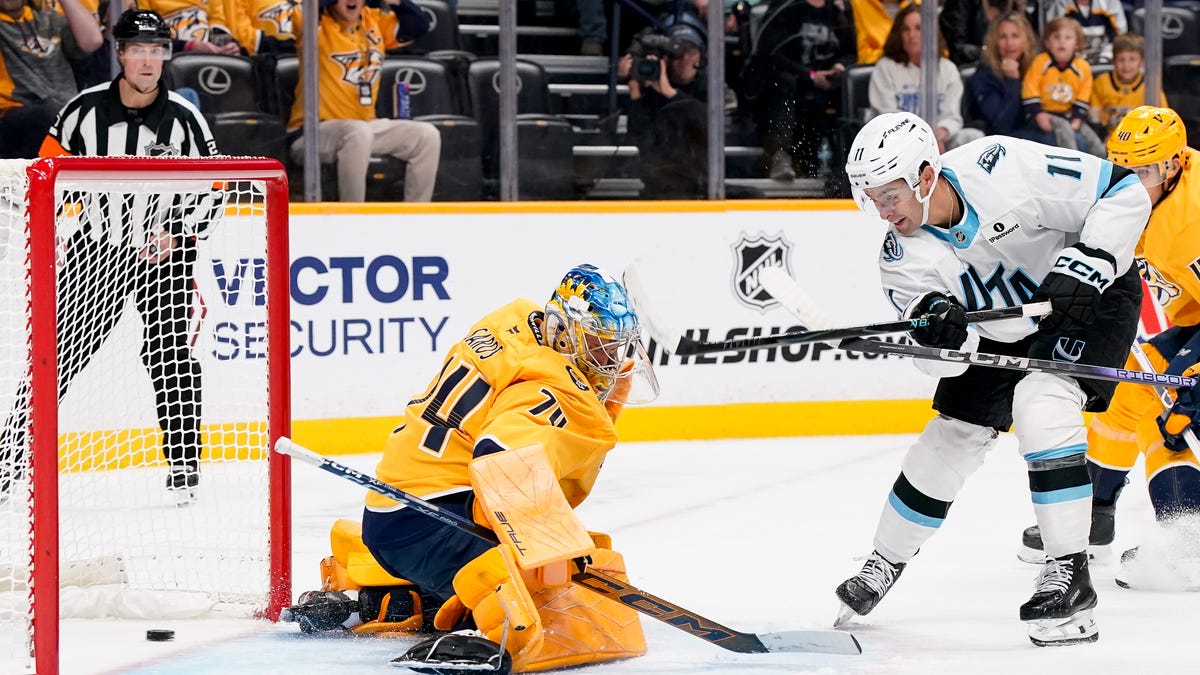
The first time the Nashville Predators touched the puck in overtime of their 3-2 loss to the Utah Mammoth on Oct. 11, it was to retrieve the puck from the net following Dylan Guenther’s game winner.
After 60 minutes of exciting hockey — two lead changes, a penalty-fest in the second period, disallowed goals, a broken glass pane and several near-fights — the game came to a grueling halt for three painful minutes of overtime.
In overtime, Utah won the opening face-off, then played keep-away hockey, weaving in and out of the zone, never even attempting a shot — that is, until 2:56 in, when Guenther slipped past Fedor Svechkov and scored on goaltender Juuse Saros. It was the period’s only shot attempt.
Overtime has become hockey’s equivalent of four corners in basketball, or the shift in baseball — remove all excitement from the game in service to risk mitigation.
And it’s not exactly what the NHL had in mind when they introduced the 3-on-3 overtime format.
“It takes a little bit of the entertainment value out of the overtime,” Predators coach Andrew Brunette told reporters after the loss. “When (3-on-3) first started, it was a lot of back and forth, with 2-on-1’s and exciting hockey.”
Prior to 2015-16, NHL’s overtime format was 4-on-4, but the league made the change to 3-on-3 to add excitement and reduce the number of games decided in a shootout. For a while, it worked: The first seasons with 3-on-3 were truly berserk, and shootout results declined.
But now teams have started minimizing risk in overtime, putting all of the pressure on defenders to not make mistakes, which makes for a less-intriguing product. It’s defense-focused offense, and it sanitizes hockey of its messy chaos.
“Coaches are smart, teams are smart,” Brunette said. “They figured out a way to keep the puck, to control it, and wait to get that opportunity. Like (Utah) did tonight.”
Though it may come off as excuse-making following a loss, Brunette’s right. Teams have discovered that puck possession is everything in overtime. Holding the puck anywhere on the ice, not just in the offensive zone, is more important than shooting it. Regularly, teams will ease into the offensive zone, then retreat at the first sign of danger. Defenders rarely have to clear the puck out of the zone — the attackers will do it for them, skating back toward their goalie and to safety.
Until one critical mistake allows a very high chance of danger, like what happened in Nashville’s game with Utah. Svechkov had a chance to swipe at the puck and head the other direction, but he over-skated. His poke check missed the mark and Guenther skated unabated to the Nashville net.
“(Utah is) a highly skilled team, they’re a fast team,” Brunette said. “When you lose the opening draw against them, it’s going to be hard to get it back. We were a little passive in certain situations, but a lot of these (overtime periods) are coin flips.”
There’s not much Brunette or anyone can do about overtime at this point. The NHL is committed to the format and has no plans to change it. And anyway, Brunette admitted that his team has taken advantage of the flaws in the past.
“We’ve been on the other end of those, where we’ve had it the whole time and (the other team) made a mistake and we scored,” he said. “So I can’t complain about it too much.”
Next up for Nashville (1-0-1, 3 points) is a visit to the Ottawa Senators on Oct. 13 (noon CT, FanDuel Sports Network).
Alex Daugherty is the Predators beat writer for The Tennessean. Contact Alex atjdaugherty@gannett.com. Follow Alex on X, the platform formerly called Twitter, @alexdaugherty1. Also check out our Predators exclusive Instagram page @tennessean_preds.