
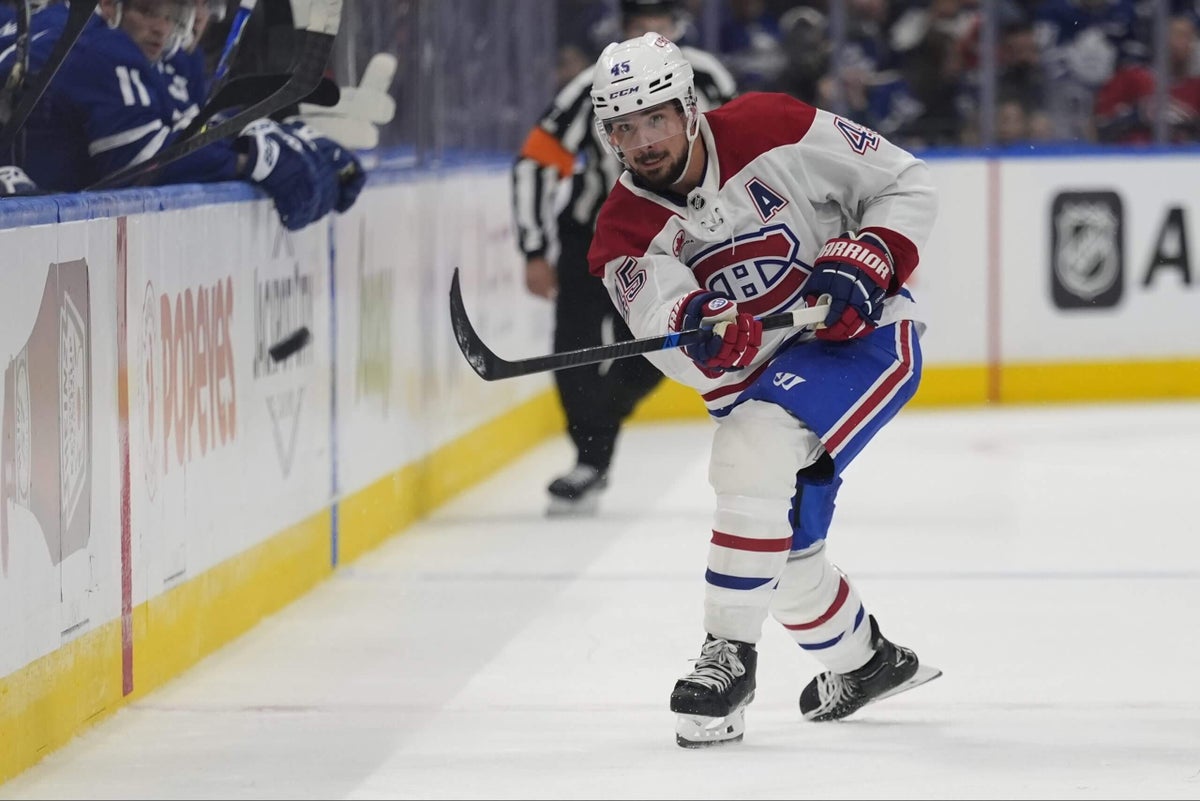
When you have 10 power plays in one game, as the Montreal Canadiens did in their 3-2 win Saturday in Chicago, it renders any analysis of the team’s five-on-five play in that game essentially useless.
But it definitely allows for analysis of the power play, which was supposed to be a real strength for the Canadiens this season because of how many weapons they have on both units. With Noah Dobson, Patrik Laine and Ivan Demidov on the second unit, the Canadiens have three players who would play on the first units of the majority of NHL teams.
Except on Saturday, the top unit got the bulk of the minutes, topped out by Nick Suzuki, who played 10:46 on the power play compared to 11:10 at even strength. By comparison, Kirby Dach got less than half that amount on the second unit at 5:12, though it should be noted there were some minutes that were split by members of both units when the Canadiens had a five-on-three power play midway through the first period. (Suzuki, Cole Caufield, Laine, Demidov and Dobson were on the ice.)
Still, it was the top unit starting most power plays and because they were spending extended stretches in the offensive zone, which is obviously a good thing, the second unit was generally getting leftovers. In fact, aside from starting the first power play of the game because the Suzuki line was on the ice when Ryan Donato shot the puck into the stands, the second unit watched the start of the rest of the Canadiens’ five-on-four power plays from the bench.
The more-or-less even split we thought we would see entering the season simply isn’t happening.
“It’s always my intention, but sometimes the group is doing a good job, they’re possessing and they’re creating stuff and they stay out there a little longer,” coach Martin St. Louis said after the game. “Sometimes the puck gets iced with 30 seconds (gone), they go back in and they get it going. I feel like the first two in the second (period), they scored, they were hot, so I kept going to them.
“I don’t have an agenda that this group’s going to play this much and that group’s going to play that much. Sometimes you get steered during the game, but we have two units where I feel that we’re comfortable and can be productive with. In a perfect world it’s 50-50, but that’s not going to happen.”
Fair enough, but starting a power play with the second unit from time to time might create a better split of the time, which is admittedly harder to do in a tight game than it is in a blowout. In their 5-1 win in Detroit on Thursday, the Canadiens got three power plays, and the top unit started all three.
The numbers – using Lane Hutson and Dobson as proxies for the two units – would suggest this is the correct strategy, though it is more difficult to create power-play momentum when you only have 20 or 30 seconds to work with at the end.
PP1 vs PP2 through 3 games
PlayerMPCF/60SF/60XGF/60GF/60
14:52
92.83
52.47
13.21
12.11
8:47
109.3
40.99
6.01
0
The other change from a strategy standpoint came at the very end of training camp. Suzuki is operating from the left circle instead of his usual spot on the right flank. He has Cole Caufield below him near the goal line, with the two sometimes swapping spots, and then there are left shots available to him everywhere else: Hutson up top, Zack Bolduc in the bumper and Juraj Slafkovský in the right circle, with him diving down to the back post when Caufield has the puck near the goal line.
“As a righty, that’s your playmaking corner, and he’s looking at lefties,” St. Louis explained last Tuesday before leaving for Toronto. “And he can work with Cole, who’s got the right stick to do that as well, and we can have Cole attack from there too as a righty. To me, it’s putting Suzy in his playmaking corner and looking at guys who can pull the trigger.”
Let’s just call this change a work in progress. Bolduc has been a threat in the bumper, but while Hutson’s shot has improved, he’s still not really a threat up top, and thus far at least Slafkovský has not been able to connect on one-timers very often from his preferred spot in the right circle.
The look has some potential, though, and might just need some more time to come together. Meanwhile, the second unit looks like it will have to wait for its opportunities.
Playing hockey in ‘sneakers’
When St. Louis first arrived as coach of the Canadiens, one of the first things he tried to do was get Josh Anderson to slow down every now and then, to pick his spots of when to floor the gas pedal and when to take that foot off the gas, depending on what the game was asking of him.
Controlling your speed is one of St. Louis’ tenets of hockey: going as fast as you can all the time is not necessarily a good thing. Cole Caufield points to his ability to control his speed better now than he did three years ago as his biggest improvement — bigger than his improved defensive awareness, his improved effectiveness in puck battles and his increased goal totals.
On Saturday morning, prior to facing the team that drafted him, St. Louis was asked about Kirby Dach’s defensive game through two games. It was something Dach emphasized as being a priority for him after finishing last season tied for the 10th-worst plus-minus rating in the NHL at minus-29 despite playing only 57 games.
St. Louis’ answer was specifically about Dach, but it applies to the whole team. And it was perhaps the best explanation he’s given of something he says all the time.
“To me it’s controlling his speed,” St. Louis said. “I think it’s hard because we have blades, so it’s easy to glide away. It’s not much, sometimes it’s three, four feet. You have to have a mentality that you have sneakers on, that you can actually not glide away. And that’s on both sides of the ice, offensively and defensively, controlling your speed is huge. Sometimes it’s accelerating to prevent something, sometimes it’s decelerating to prevent something.
“So I think it doesn’t come naturally for some players, and we’re really focusing on that.”
It didn’t come naturally to Anderson, and part of the reason for his success last season was de-emphasizing the need for him to control his speed. Not to completely forget it, but just letting him floor it a little more often.
Another player who applies is Alex Newhook. His wheels are a big reason why he made the NHL, and it’s been difficult for him not to open the throttle all the time. But it came up when discussing his line with Oliver Kapanen and Demidov prior to the game Thursday in Detroit.
Referring to the speed on his line, he mentioned it was important to “use it wisely.”
“There’s definitely different ways speed can be used on our line with two guys that can push the pace and use their skill in their own ways,” Newhook said. “It’s always about controlling your speed, and that’s been an adjustment for me since being here. I think that’s a part of my game that’s improved a lot, knowing when to decel and knowing when to control my speed and knowing when to push it as well.”
An important aspect of how the Canadiens want to defend this season, both at five-on-five and on the penalty kill, is increased pressure further up ice to prevent controlled entries and force teams to dump pucks into their zone, which is when their mobile defence can break the puck out quickly and avoid spending time in the defensive zone.
Controlling speed comes into play here as well.
“You have to be skating at all times and be able to do stops,” Alexandre Carrier said. “You can’t always loop.”
This goes back to what St. Louis said about playing the game with sneakers. You don’t always have time to loop around, but stopping and starting takes more energy.
“Sometimes you need to loop,” Carrier continued, “but most of the time you’ve got to put the brakes on and slow down a bit and see and adjust.”
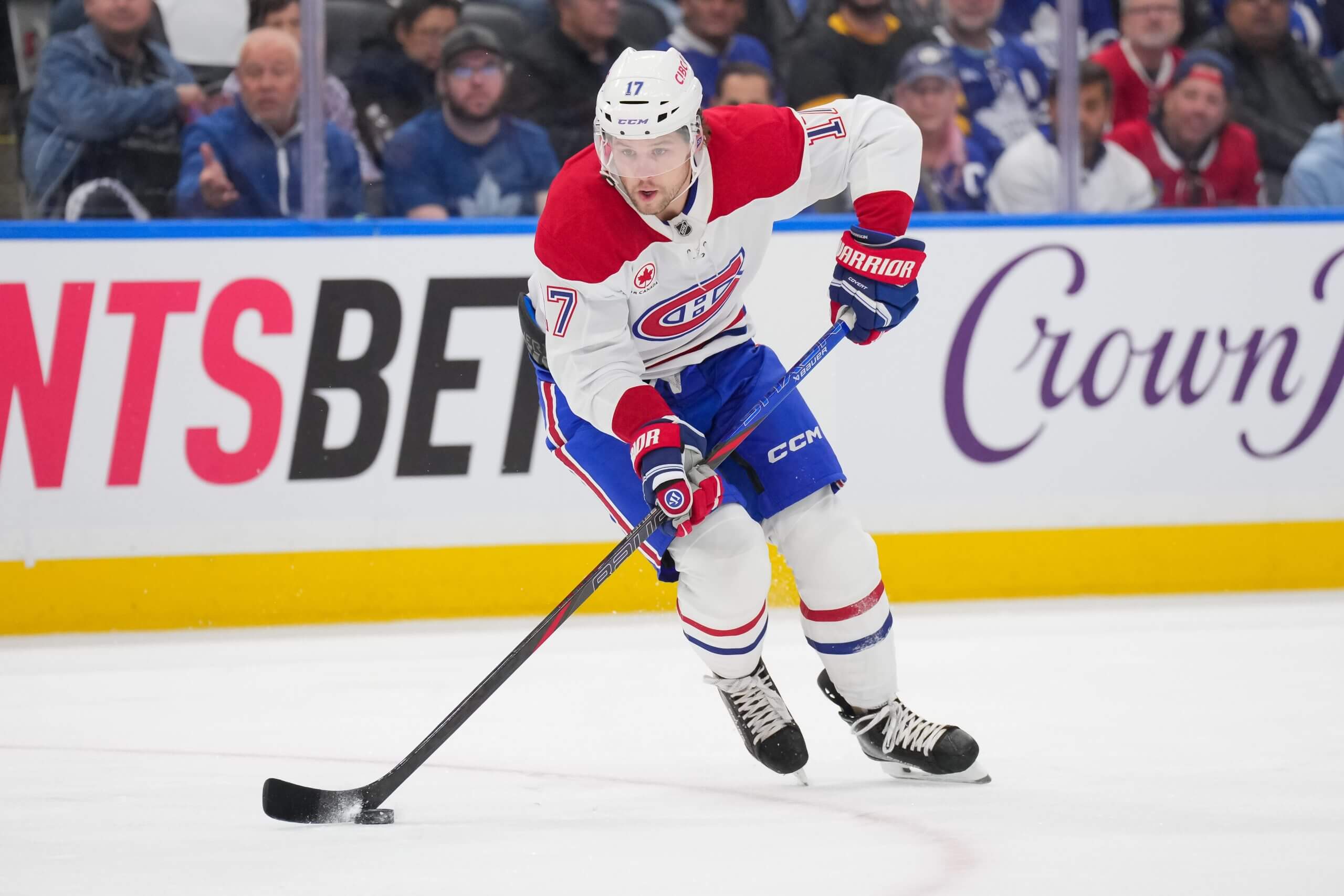
For Josh Anderson and the Canadiens, managing speed has become a key focus. (Chris Tanouye / Getty Images)
When a birthday is bad news
Speaking of Carrier, it was his birthday on opening night Wednesday in Toronto. He turned 29, and when told he’s approaching that dreaded decade for a hockey player, Carrier laughed.
“Yeah,” he said, “don’t tell Kent.”
Canadiens general manager Kent Hughes surely won’t mind Carrier getting a year older, because the youth of his team is something that is exciting for the future, but needs to be mitigated in the present.
At 29 with an October birthday, Carrier is the fifth-oldest player on the Canadiens, just ahead of Sam Montembeault, who turns 29 on Oct. 30, and just behind Jake Evans, who turned 29 on June 2.
“It is weird being the fourth-oldest now,” Evans said.
The Canadiens are the youngest team in the NHL with an average age of 25.8, far behind the next-youngest team, the Buffalo Sabres at 26.5.
“I don’t feel old, but I’m one of the oldest guys in the room,” Carrier said. “But I think that might be one of the reasons why we’re so close. The guys are younger, the guys don’t have kids, they go eat together at home and on the road. It makes us closer. We have a nice energy in the room, guys are always positive.
“We have a bunch of guys who have been here four, five years. Even (Juraj Slafkovský), he’s 21, but this is his fourth season. We have several guys like that: Newhook, (Kaiden) Guhle, I can name a bunch. We have a lot of maturity in the room, even with young players.”
This is why St. Louis is not sweating the youth of his team.
“Yes, we’re young, but we have experience,” he said. “Our youth has experience, it’s not like they’re new to the league. We’re in a stage where we’re more advanced, we want to keep evolving as a team. Our youth, I don’t think it’s a weakness. I almost see it as an advantage.”
How the Canadiens are handling the new dress code
It was a bit jarring walking by Joe Veleno and Jayden Struble in the press box in Detroit and seeing them dressed casually. The NHL has done away with the business-attire dress code that has ruled the game forever. Players can now arrive for games dressed however they want.
Struble, for one, felt a lot more comfortable in a pair of nice black pants and a simple black sweater, but that’s not how everyone is approaching the newfound freedom.
In fact, most of the players are still arriving at the game in suits. They’ve just done away with the ties.
For the most part.
“I think (Noah) Dobson wore a suit and tie to the first game, and then he realized he was the only one. It’s still a work in progress,” Evans said Saturday morning. “And then Patty wears stuff way more expensive than all of us, so you’ve got to let that slide.”
Patty is, of course, Patrik Laine, the most progressive dresser on the team, if not the entire league. His suits were always unique and eye-catching, but now that he has increased liberty, he has a blank canvas on which to work.
“I think in Toronto he still wore a pretty outrageous thing,” Evans said. “It was like a suit, but … I don’t know how to describe it. I don’t know the material. It was like he was wearing armour. I don’t know.”
To be fair to Evans, what Laine wore on opening night is indeed difficult to describe.
Si vous lisez ceci, c’est que nos gars sont arrivés
If you’re reading this, the Habs have arrived#GoHabsGo pic.twitter.com/9D7fdnPFyG
— Canadiens Montréal (@CanadiensMTL) October 8, 2025
Laine did tone it down the following night in Detroit…
📍 “Mich”#GoHabsGo pic.twitter.com/U64ECeiTaZ
— Canadiens Montréal (@CanadiensMTL) October 9, 2025
… and on Saturday in Chicago.
𝓒𝓗icago#GoHabsGo pic.twitter.com/HGBX6T9wuo
— Canadiens Montréal (@CanadiensMTL) October 11, 2025
As Evans said, the Canadiens are still trying to come up with a set of guidelines. But so far, for the majority of the guys, the new loosened dress code has simply meant not packing ties. Don’t more players want to take advantage of the new rules to express their fashion sense like Laine does?
Apparently not. The suits are still a thing for the majority of players.
“Habit? I don’t know,” Mike Matheson said. “It’s what we’re used to.”