
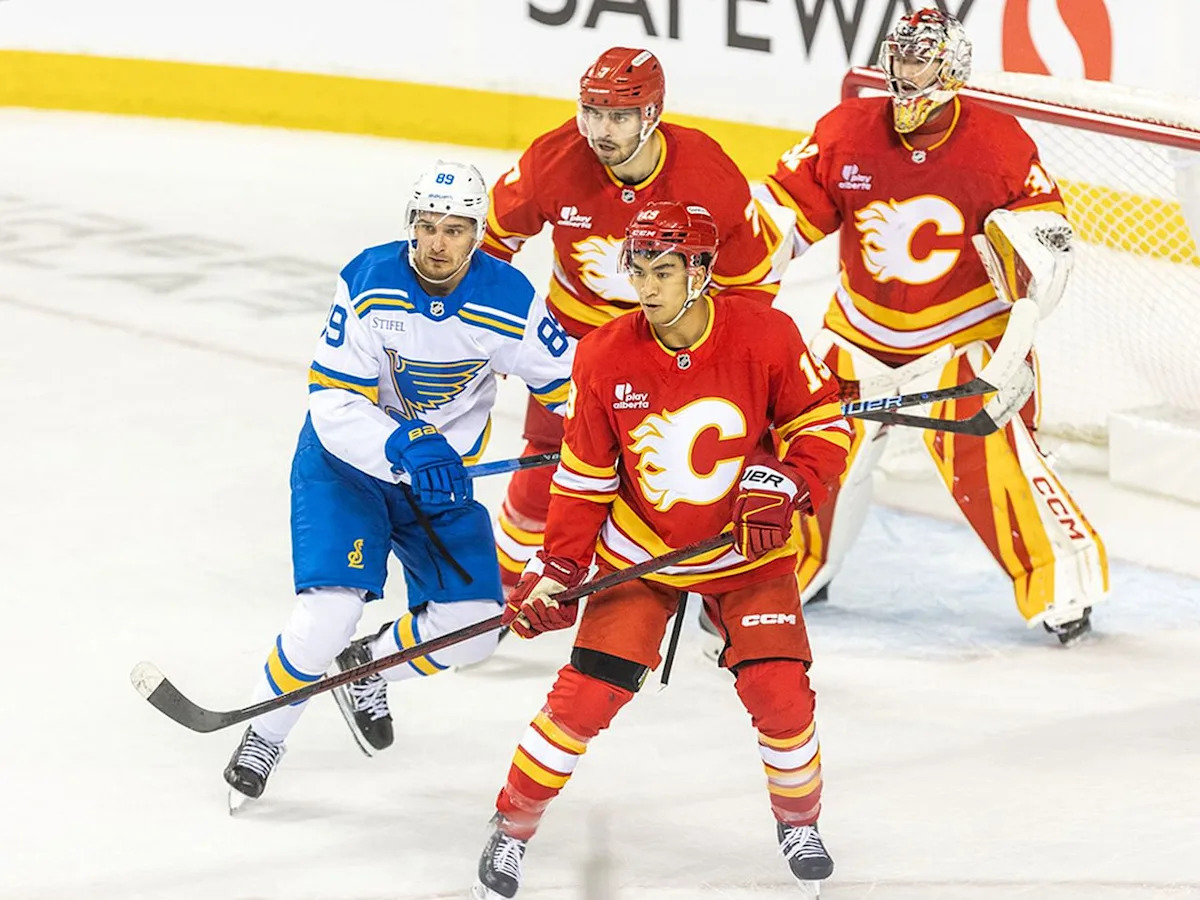
Zayne Parekh hasn’t exactly burst onto the scene…yet.
Through the Flames’ first three games, Calgary’s most exciting prospect has appeared only once, logging just over 11 minutes at even strength.
That’s not the type of usage fans expected for the teenager who lit up junior hockey last season with 107 points, one of the highest single-season totals ever by an 18-year-old defenceman.
So why the hesitation? Why isn’t Calgary giving its most gifted young player a real shot when the offence already looks anemic?
The short answer is that the coaching staff has its reasons — and none are without merit.
Defencemen inherently are higher-risk bets than forwards. It’s easier to shelter a forward versus a defender. Every mistake at the blue line has the potential to become a breakaway. Every failed pinch can end up with the puck behind your goalie.
Coaches live and die by those moments and it’s why most of them instinctively err on the side of safety.
Especially when it comes to a 19-year-old rookie.
Parekh’s style amplifies that tension. His instincts are elite. He loves to jump into the rush, carry the puck through the neutral zone and make plays most defencemen wouldn’t attempt. But that same creativity can quickly backfire at the NHL level, where time and space disappear in an instant.
Ryan Huska and his staff know Parekh’s offence could energize a stale attack, but they also know he’s still learning how to defend pros who are faster, stronger and far more ruthless than anything he saw in junior.
There’s also the matter of a difficult development path. In a perfect world, Parekh would be playing 24 minutes a night in the AHL right now, learning the subtleties of pro spacing and defensive reads without the nightly pressure of NHL mistakes.
But under the CHL–NHL transfer agreement, 19-year-old major junior players can’t be sent to the AHL. So Calgary had two choices: Send him back to the OHL’s Saginaw Spirit, where he’s already dominant, or keep him in the NHL and manage his minutes carefully.
They chose the latter, which makes sense on paper. Sending Parekh back to junior after a record-breaking season would offer little developmental value. But keeping him in the NHL only to have him frequently watch from the press box creates its own dilemma. If he’s here, he needs to play.
All of this plays out against the backdrop of a franchise trying to walk a very fine line. The Flames insist they aren’t rebuilding, only “retooling.” In practice, that means trying to develop the next core without taking a step back from playoff contention.
It’s a philosophy that can make teams risk-averse. When you miss the post-season by a tiebreaker, as Calgary did last year, there is very little room for error. That kind of pressure trickles down to the bench. Coaches in that situation have little incentive to take developmental risks.
But for all the logic behind caution, there’s one simple reason to play Parekh more: He provides the one thing Calgary doesn’t have enough of: Offence.
Heading into Tuesday night’s game, the Flames had scored just six goals in three games. The power play mostly has looked disorganized and the five-on-five attack has been plucky, but not really imposing. It’s the same problem that haunted them last season, when they ranked near the bottom of the league in even-strength scoring.
Parekh isn’t just another offensive defenceman — he’s a playmaker in every sense.
Someone who processes the game at a speed that creates opportunities others can’t see. Watch him skate and it’s obvious why scouts call him a “rover.” He moves like a forward but thinks like a quarterback, manipulating defenders with subtle feints and shoulder fakes before threading passes through traffic.
That ability to generate offence from the back end is rare and it’s something the Flames haven’t really had since the prime years of Mark Giordano.
Yes, there will be mistakes. There will be turnovers and ugly defensive sequences that make the coaching staff wince. But there will also be power-play entries that don’t die at the blue line and breakout passes that actually hit forwards in stride.
For a team starving for creativity, Parekh represents something they simply can’t manufacture elsewhere.
Related
How Calgary handles Zayne Parekh will reveal a lot about what kind of organization it wants to be. If the goal is truly to build toward a new core, then there has to be room for players like him to grow, even if it costs them a few goals in October.
If the focus remains solely on chasing the final playoff spot, the Flames risk delaying the emergence of the one player who could genuinely change their present, let alone their future.
Patience is understandable. Every NHL coach worries about breaking a young defenceman’s confidence. And the franchise wouldn’t want to risk rushing the player and damaging his progress by giving him too much, too quickly.
But given his pedigree and talent, the Flames don’t need to be overly cautious with Parekh. They need to let him experience NHL hockey, mistakes and all. Because if this team is ever going to move past mediocrity, it won’t happen through more of the same cautious, grinding hockey.
It’ll happen through boldness. Through creativity. Through players like Parekh.