

SAN DIEGO – Willie O’Ree no longer spends much time in airports. He used to crisscross the continent to spread the gospel of hockey, especially to thousands of youngsters who knew little about the sport.
O’Ree traveled countless miles to give speeches, teach and coach kids, start programs, receive honors and awards — even act in a sitcom. For decades, he told his story, long after he became the first Black man to play in an NHL game in 1958. It was a lot of fun. Every minute of it, in his words. But he’s had his fill of airports. “It’s not fun traveling today, to me,” he said.
These days, O’Ree can most easily be found at a suburban eatery a few minutes from his La Mesa home in suburban San Diego. Five, maybe six times a week, he meets up with a coffee group that sometimes numbers up to a dozen. That’s if he isn’t taking early morning walks with his wife, Deljeet, and their 4-year-old dog.
“And we talk about sports and life in general,” O’Ree said. “There’s two things we don’t talk about. Religion and politics. Those are out. We can talk about anything else.”
It speaks to O’Ree’s nature that he prefers to avoid the touchiest of hot-button topics among his longtime friends, even though he is the embodiment of the NHL’s racial integration, of the inclusion of Black players in a predominately White league and, ultimately, of the recognition and acceptance of all people of color and backgrounds that have permeated throughout the sport.
As O’Ree turns 90 today, it’s a time to reflect not only on what he meant to hockey’s past, but what he means today and going forward, how his reflections and experiences still matter — and always will.
“And it’s the stories that he’s told me that haven’t been told publicly either,” said Anson Carter, a 10-year NHL forward who is now one of the regulars on TNT’s studio show. “Some of the stuff is pretty graphic. Some of the people were like, ‘Well, I can’t believe that even happened.’ And it wasn’t like it happened in the 18th century. You know, this happened like the ’50s and the ’60s.
“To see and understand what he went through and watch him persevere — I think probably the most resonating thing with me is the fact he decided to still be involved with hockey, too. And that really is what drove me to still stay involved with hockey, too.”
What drove O’Ree to play in the NHL and endure the racially-based taunts, threats and obstacles to chase his dream is a creed he has lived by and an endless well of love for the game: hard work. The values instilled in him and his siblings by his parents, Harry and Rosebud. One of his often-quoted sayings speaks to that: “If you think you can, then you can. If you think you cannot, then you’re right.”
“Right now, I can honestly say that the game is much better today than it was,” O’Ree said. “More exposure now to kids of color to get into playing hockey and to make a choice whether they want to pursue it or not. But you have to believe in yourself, what you want to do. And you have to set goals for yourself, and you have to stay focused on what you want to do and work hard.
“There’s no substitute for hard work and if anybody tells you there is, they’re lying to you. You only get out of it what you put into it.”
But as he sat on a downtown San Diego hotel rooftop last week while groups of family, friends and fans gathered for a celebration of his 90th birthday, O’Ree understood his appearance goes well beyond marking a milestone. He is a novel that is very much alive, full of stories to be told and never forgotten.
“It’s like an encyclopedia or a museum if you want to say that,” Carter says. “I never get tired of them.”
“What’s that sign say? Yeah, you’re right. I thought it was 89. But it’s 90. You were right.”
Gregarious as ever, O’Ree then let out a big laugh as he looked at the numbered candles atop a birthday cake in his honor. A large group that included San Diego Gulls players and coaching staff — the American Hockey League team that’s long identified with O’Ree, and with whom he played seven years in the original professional Western Hockey League — were among those who sang “Happy Birthday.”
To O’Ree, turning 90 is just another birthday. He feels blessed, though, citing good genes for reaching an age as others in his family did. “My mom and dad both lived into their 90s,” he said. “My mom was 96 when she passed away. My dad was 97. I have a brother that was in his 90s. Another brother that was 92.”
“I’ve slowed down,” he adds. “I just take it a day at a time.”
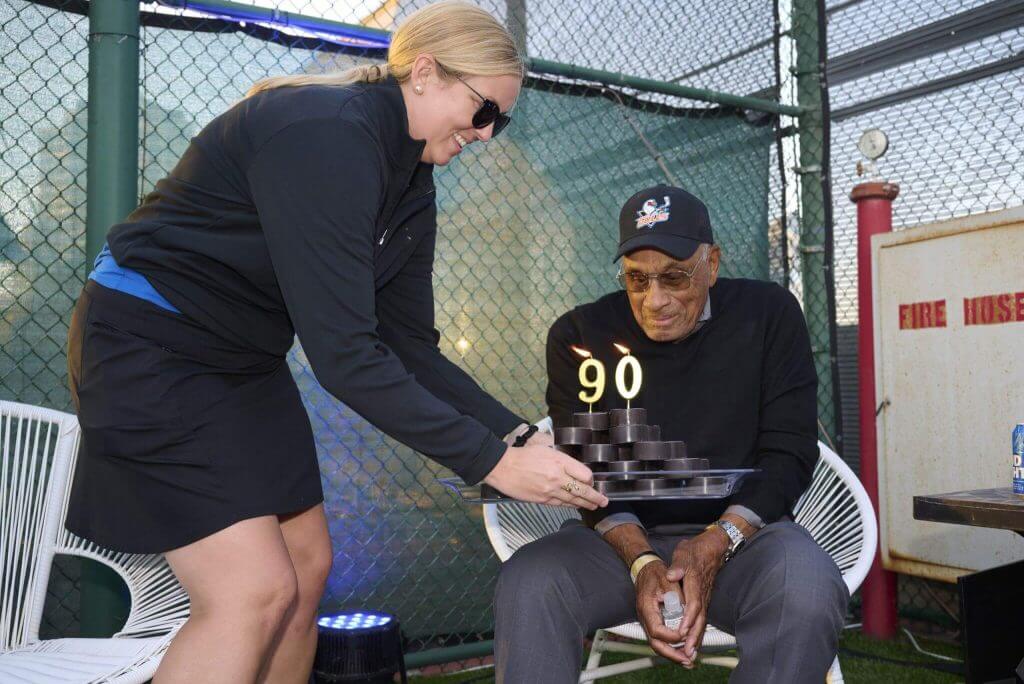
Willie O’Ree at a party for his 90th birthday. (Courtesy of San Diego Gulls)
For nearly three decades, O’Ree served as the NHL’s diversity ambassador and has been a leading figure in the league’s “Hockey is for Everyone” initiative. And in that time, he led or figured directly in grassroots efforts across Canada and the United States, with the goal to bring hockey to communities that otherwise don’t have easy access to the sport. All children were encouraged to participate. Youngsters of color were particularly targeted as inclusiveness was the goal to foster.
Former NHL forward Jamal Mayers thinks of the endless energy O’Ree possesses. The enthusiasm and excitement he has for kids is genuine and reciprocated when they’re in his presence. “I don’t know how you don’t get tired, but he never got tired,” Mayers said.
“He did the work,” continued Mayers, who with Carter is part of the NHL Player Inclusion Coalition. “And I think what’s amazing when you think about Hockey is for Everyone, the emphasis was all his idea. The whole execution of it was him. And what’s amazing to me was it wasn’t just about kids of color and people who didn’t have access. It was giving everybody the opportunity to play this great game. That, to me, really resonates.
“The fact that he had the vision to see that it should be for everybody. Everybody should have the opportunity to try hockey and to be around the game. It’s pretty cool to see what it’s become since then.”
For Justin Bailey, an 11-year pro who has bounced between the NHL and AHL, O’Ree matters as much to hockey today as he did in 1958, when he broke the color barrier, or in 2018, when he was inducted into the Hockey Hall of Fame as a builder. Through Bryant McBride, a former league executive who created the diversity task force that evolved into Hockey is for Everyone, O’Ree found a second act with the NHL that may be his enduring legacy.
More than 130,000 boys and girls have been exposed to hockey through the programs he has helped establish. But proper widespread recognition of the significance of a Black Canadian winger playing for the Boston Bruins at the old Montreal Forum against the Canadiens came more in recent decades than it did at the time. In 2022, O’Ree’s No. 22 was retired by the Bruins.
Bailey, whose father is Black and mother is White, was eager to reconnect with O’Ree, who has been an inspiration. Now 30, the Buffalo native first met O’Ree when he was 14 and was involved in the youth program founded by legendary Sabres goalie Dominik Hasek. He knew about Jackie Robinson breaking baseball’s color barrier. He says O’Ree serves as a constant reminder because of how he paved the way for players like himself.
What O’Ree did — and endured to make it happen — can’t be told enough.
“They brought him on all those years ago, but I think his message is kind of getting a yearly refresh throughout the league,” Bailey said. “I’ve played on a bunch of teams that have done (those) Black History Month jerseys. And I think just collectively the league has done a better job. I think obviously there’s still room to grow. There’s room to grow with everything. But you have to start somewhere.
“I think having that conversation is the biggest part of it. In the past, I think it was something that was almost like an unspoken thing. Continue to have that dialogue.”
It was another 13 years before Mike Marson became the second Black player in the NHL with the Washington Capitals. And if he had been born in a later age, Herb Carnegie would have made the league. O’Ree has long stated that Carnegie was talented enough to be in the league before him.
Now he sees people of color in all realms of hockey. And the gift he was determined to leave was opportunities. Maybe a kid would find something new to love. Maybe it would kick-start a life in hockey.
“I just opened the door and made it possible for these kids to get into the game,” O’Ree said.
Baseball remains a favorite for O’Ree, who played it while growing up in New Brunswick. He was good enough that in 1956 he tried out for the Milwaukee Braves at a camp in Waycross, Ga. The time spent in a segregated South where Jim Crow was the law of the land — a fulcrum of racial strife and intolerance that O’Ree hadn’t experienced much of in his hometown of Fredericton — was enough for him to return to Canada and dive completely into hockey, his other love.
But baseball is often on in his La Mesa home. Football, too, and basketball. Hockey, though — that’s where he has the NHL Center Ice package and when the season gets going he’s got a game on all the time. Especially his Bruins. “I watch a lot of hockey,” he said. “That ain’t going to leave my blood.”
The love is what kept him going as taunts and epithets were hurled, what drove him to impress Bruins general manager Lynn Patrick and coach Milt Schmidt while with the Quebec Aces, what had him playing with the San Diego Hawks of the Pacific Hockey League at age 43.
Mayers marvels at O’Ree’s lack of rancor over the experiences from his younger days.
“It had to be the right person,” Mayers said. “And I think it speaks to the quality of teammate, quality of person and quality of player he was. Because he had everything stacked against him, right? And it’d be easy to dismiss if he wasn’t a great teammate.
“I already know he cared about people. You don’t accomplish what he’s accomplished, the environment he did it in without that.”
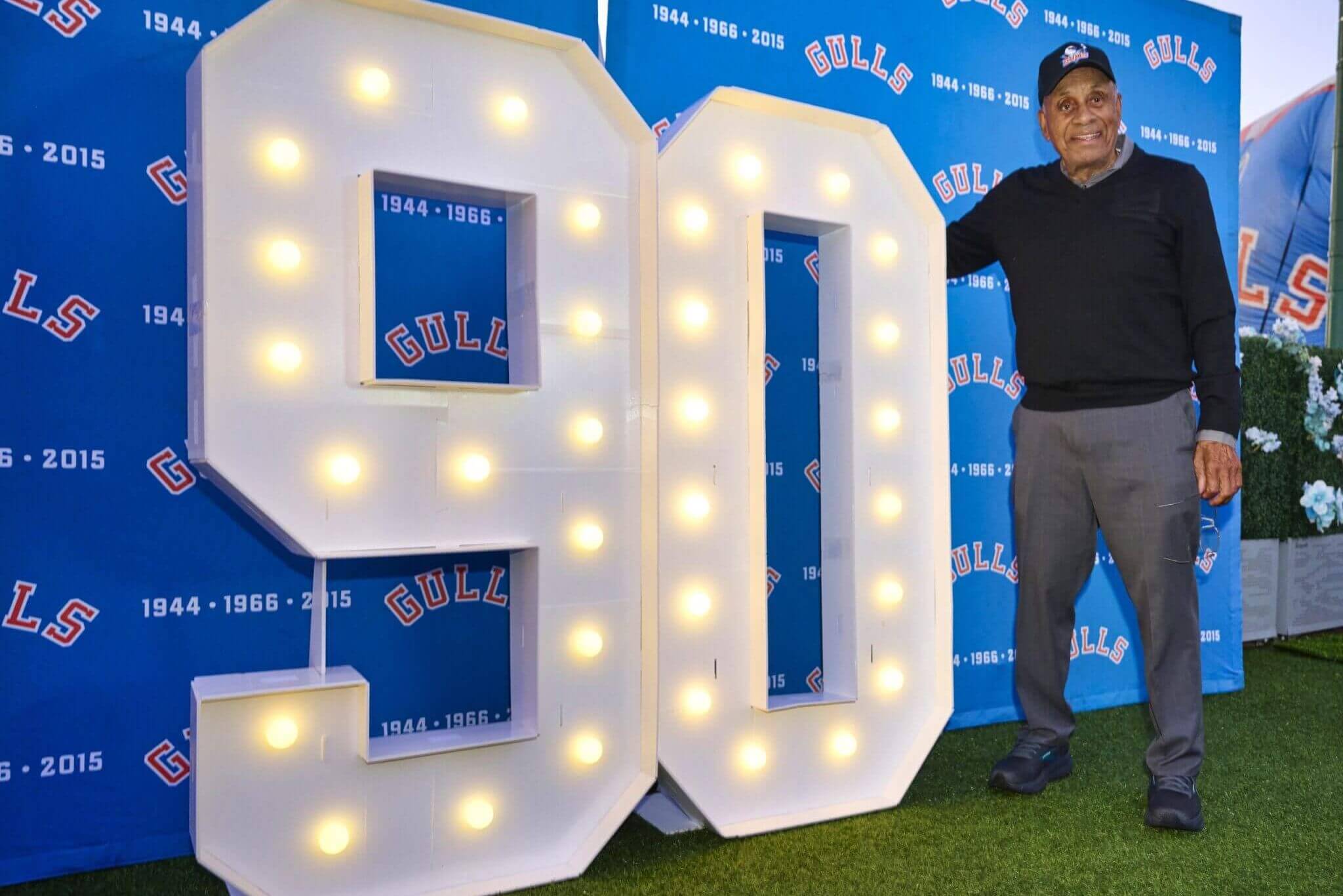
Willie O’Ree at a party for his 90th birthday. (Courtesy of San Diego Gulls)
The impact continues to this day. Mike Grier, the NHL’s first Black general manager, runs the San Jose Sharks. Quinton Byfield, the No. 2 overall pick by the L.A. Kings in 2020, is the highest-drafted Black player. Joel Ward is an assistant to Bruce Cassidy with the Vegas Golden Knights.
In addition to being a television personality, Carter is a minority owner of the ECHL’s Atlanta Gladiators and fronts a group that is out to bring the NHL back to the city. When he played at Michigan State, the former NHL winger didn’t envision being in hockey after he was done playing. Carter, 51, now is compelled to be in the game in any form. He didn’t know about O’Ree while growing up in the Toronto area. He now makes it his mission to ensure that time doesn’t reduce O’Ree to a footnote.
“I think he matters because you hear all these stories about Black history being erased and being forgotten and being glazed over,” Carter said. “And history is important. … You teach history to make sure you don’t make the same mistakes in the future that happened in the past. And the history is also important to let your players know that this is what someone went through to give you that privilege of playing in the NHL.
“It’s not a right to play in the NHL. That can be taken away from you just like that. Snap your fingers. I really think it’s important to understand our history. Not just Black players but White players, too. Understand the history of our game when it comes to players who have made an impact not just on the ice, but off the ice.”
“For that,” Byfield said, “he allowed people like me to come into the game. Always grateful for that.”
This month, O’Ree is to receive the Congressional Gold Medal for his contributions to hockey. The bill to bestow the honor passed in 2022 by unanimous vote in the House of Representatives after it was confirmed by the U.S. Senate, and then-President Joe Biden signed the legislation into law. O’Ree had already received the Order of Canada, a similar civilian honor, in 2010.
It means he’ll soon be back in an airport on his way to Washington, D.C. But at 90, it’s not the travel that brings joy.
“I miss the handshakes and the hugs from these people that I’ve met over the years,” O’Ree said. “The memories are there. And life is good. Really. My health is good. I’m just enjoying a day at a time.”
(Photos courtesy of San Diego Gulls)