
The Montreal Canadiens’ season ended after they lost to the Washington Capitals in the first round of the playoffs in only five games. Which sounds upsetting, except it wasn’t. They’re a club that surprised nearly everyone by qualifying for the playoffs and making each of those five games as hard on the Capitals as possible.
Related: Montreal Canadiens Should Use Offer Sheets to Address Needs
The fan base enjoyed that season, even with the early elimination, and will enter the offseason satisfied with the progression of the young players and the outcomes they saw this season. That doesn’t mean management will be satisfied, as general manager (GM) Kent Hughes has a very busy offseason ahead of him, but it is one that is made somewhat easier due to his lack of trade action at the 2025 trade deadline.
Setting the Stage for the Canadiens
The good news keeps rolling in as the Calgary Flames didn’t win the draft lottery and move their pick into the top 10; therefore, the Canadiens get that pick as part of the Sean Monahan trade that sent him to Montreal. This means that the Canadiens will pick 16th and 17th in the 2025 NHL Entry Draft. Next, Nick Suzuki’s 30 goals and 89 points made him Montreal’s first point-per-game player since Alex Kovalev in 2009. Also, Lane Hutson has had a season worthy of being nominated as a Calder Trophy finalist as the NHL’s top rookie. As a defenseman who led all rookies in points (third on the Canadiens for points), was used as the quarterback on the power play and finished second on the team in average time on ice (22:44 minutes), he is the front-runner to win the award.
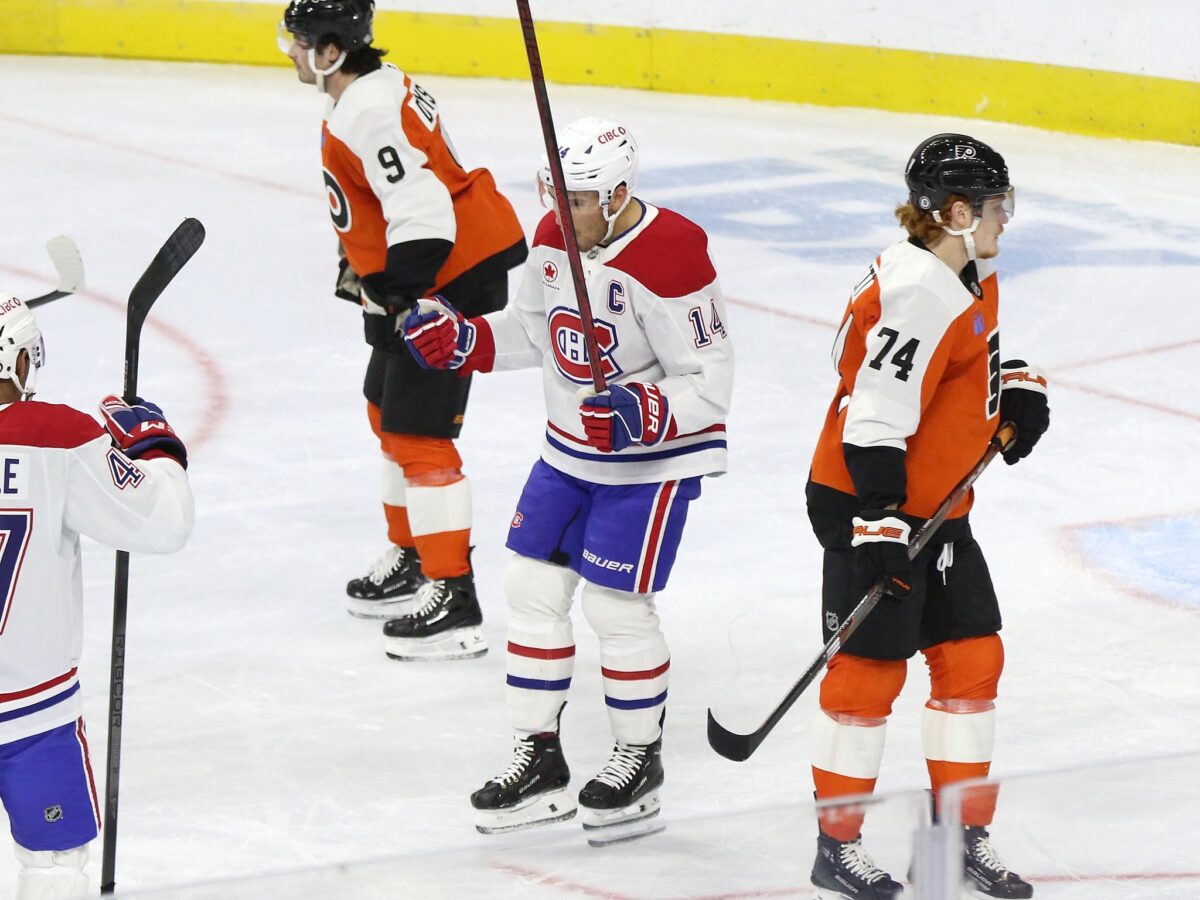 Nick Suzuki, Montreal Canadiens (Amy Irvin / The Hockey Writers)
Canadiens management, by not making deals at the deadline to trade away veteran unrestricted free agents (UFA), did more than just keep a promise to their young captain to keep the roster together to make a push for the playoffs. It gave the team the best chance to make its playoff push. Hughes also gave the young core more time with their veteran teammates to give them more time to hoist in the lessons from their accumulated experience, especially with someone like Stanley Cup champion David Savard. The contributions of Christian Dvorak and Joel Armia cannot be overlooked. Their approach to games and their demeanours in difficult situations on the ice provided the young core excellent examples of what needs to be done to win those tight, hotly contested games late in the season.
What Hughes showed the NHL was that Montreal is no longer just accumulating futures; he’s now focused on assembling his vision of a contending team and won’t make holes in the lineup just to get a mid-round pick. He’s now shifted focus to find players that fill certain roles that need to be filled. Also, a balance between veteran players and graduating more youth will be a difficult balance to find.
Canadiens’ Needs
There’s going to be a focus on internal growth. Hughes is still unsure if the players they’re developing will be able to fill all of the roles on the team, which means he will need to make difficult decisions and find players who can. But that doesn’t happen in one offseason. Montreal has a highly competitive American Hockey League (AHL) team in the Laval Rocket that is a legitimate Calder Cup (playoff champion) contender, filled with several of their top prospects. The longer the playoff run lasts, the better, as it can give Hughes more time to assess his prospects, but also give those prospects, like David Reinbacher, more playing time to develop, something the young defender admits he desperately needs.
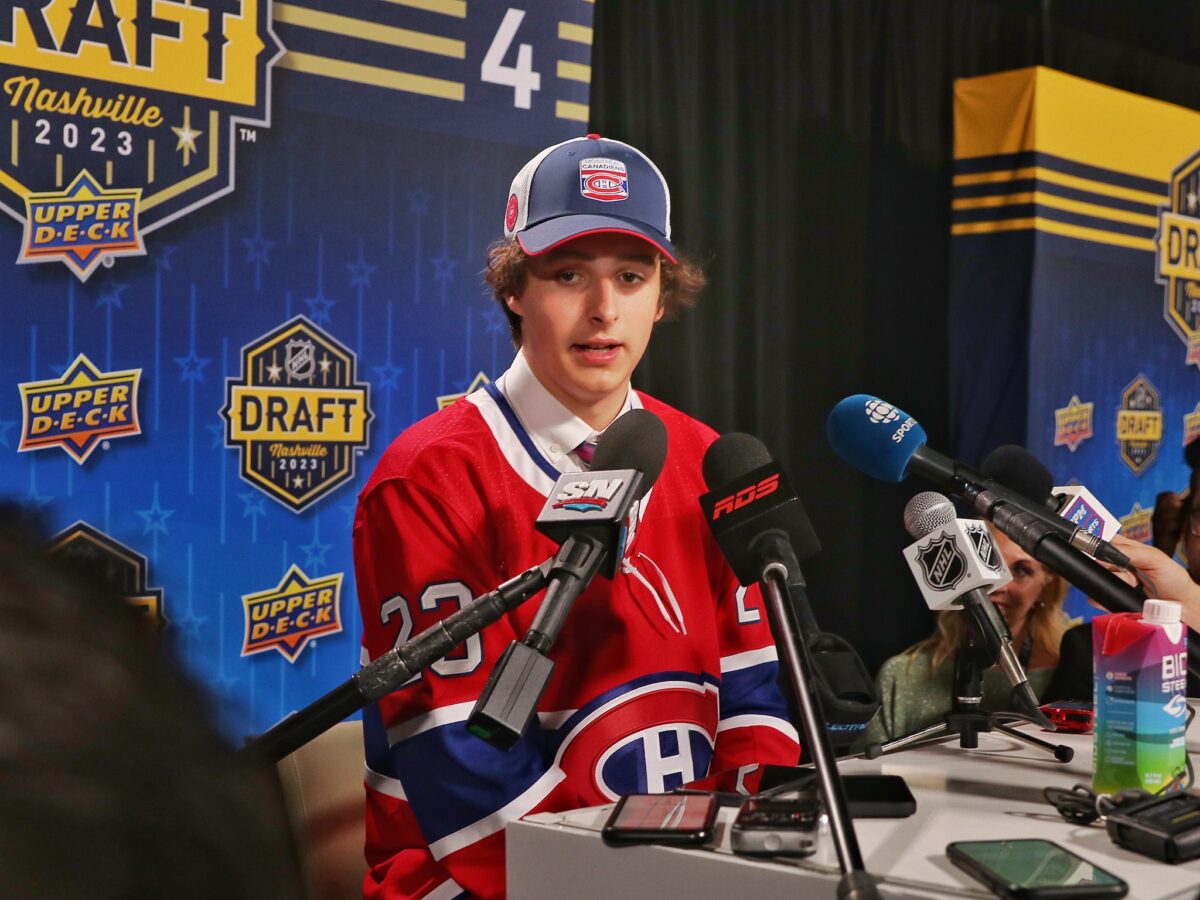 David Reinbacher, Montreal Canadiens (Amy Irvin / The Hockey Writers)
The hope would be to see some of those young players graduate to the NHL as soon as next season. But hope isn’t going to help fill needs. That said, there is lots of good news, and lots of data that will help Hughes fill in some of the blanks in his rebuild plan. This leads to what will dominate the news cycle all summer long in Montreal: identifying and filling team needs. What the series against the Capitals showed is that team size, especially in the playoffs, does make a difference. But just being big isn’t enough: there needs to be elements of speed, an ability to play with pace, and even adding in a mean streak are all necessary to find success.
This is where adding strategically means filling needs without blocking the upward progression of their top prospects. Everyone needs to remember that the deep prospect pool, while a great asset, means that not all of them will make the NHL with the Canadiens; some will be used as trade bait. Also working in Hughes’ favour is the number of draft picks the team owns, including the 16th and 17th overall picks. But it is obvious that, positionally, Montreal needs to address its centre depth and find a reliable replacement on the right side of the blue line vacated with Savard’s retirement.
On the blue line, there are a couple of open slots, one that looks as though Reinbacher or Logan Mailloux are penciled in to fill. That leaves one spot open. It could be filled by one of the many left-handed defencemen in the system, or a trade or UFA signing for a veteran. There is even a remote possibility of an offer sheet on a restricted free agent (RFA).
Centre depth? Yes. With Dvorak likely gone as a UFA and the uncertainty surrounding Kirby Dach, something will need to be done. During his end-of-season interview, Hughes said, “He has so much potential as a player … but we still have a lot of questions about Kirby.” This does look as though they see him as a winger now. This is basically confirmed by executive vice president Jeff Gorton.
“There’s certainly a place for him in our lineup; it’s going to be up to him where that’s going to be…. I think a lot, unfortunately, is going to be what kind of summer he has and what kind of start he has to camp. He’s going to need a big camp to get himself going and get started early.”
This points to management looking externally for a second-line center. They do have internal options at center: Owen Beck or Oliver Kapanen, for instance. Yet no one is ready, and by their own admissions, that includes Dach.
While there is an expectation that Hughes will be busy in the week leading up to the NHL Entry Draft, looking to fill one or two holes in his lineup, it is all just a continuation of the work he did at the trade deadline. I noted all the on-ice and locker room reasons, but one that applies to the front office is that he has opened conversations with his counterparts; identified areas that he can use his salary cap space, draft and prospect capital to exploit. Just because he didn’t make a trade doesn’t mean he didn’t do the legwork to pave the way to a deal that can provide the team with long-term benefits.
