
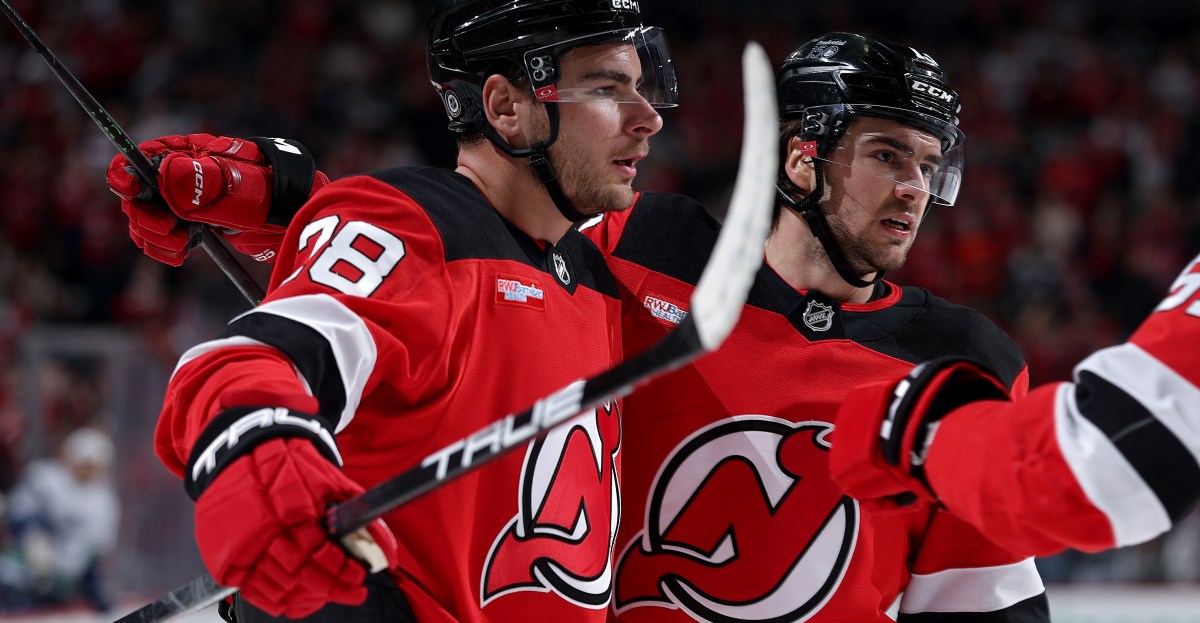
Nico Hischier, Timo Meier, and Dawson Mercer spent a lot of time together last season. According to Natural Stat Trick, in 264 minutes together at 5-on-5, that trio posted an Expected Goals For% of 50.90%. They out-attempted (51.08% Corsi For%) and outshot (51.14%) their opponents in their minutes, and they won the Scoring Chances For (53.01%) and High Danger Corsi For (53.27%) battles as well. And for good measure, they outscored their opponents 9-4. They won in the run of play, and they won on the actual scoreboard.
And keep in mind, head coach Sheldon Keefe always gave the Hischier line the most difficult matchups. It’s impressive enough that this trio won their minutes last season, but doing so against elite competition night in and night out? Only the best lines in the league can do that.
So since this line had success in 2024-25, it made sense that Keefe would want to keep it together entering this season. The addition of Cody Glass for a full campaign opened the door to the Hischier line logging less brutal minutes, but I guess Keefe figured that if it ain’t broke, he shouldn’t fix it. Through five games this season, Hischier and pals continue to log some of the most hellacious minutes in the league.
So how has the Hischier line been doing in the face of such difficult assignments? At a macro level, they’ve been dominating. Per NST, this trio has been together for 48:31 of 5-on-5 time this season, and they’ve posted a stellar xGF% of 60.87%. They have also outscored their opponents 4-1 in their minutes, once again winning both on the spreadsheets and on the scoreboards. And these are just the Natural Stat Trick numbers. If you listen to Moneypuck, this line is even better than what NST would have you believe. Moneypuck has the trio of Meier-Hischier-Mercer at a 5-on-5 xGF% of 67.3%. Pure dominance.
But what about at the micro level? Those numbers above do not isolate for specific matchups, so while it looks like the Hischier line is dominating top competition, we can’t say for certain just looking at raw xGF%. Fortunately, Natural Stat Trick allows one to isolate how a player does against every other player individually. So for example if you want to see what Hischier’s xGF% numbers were against Sebastian Aho, you could do that.
So with that in mind, I wanted to see not only who the Hischier line was getting matched up against through the season’s first five games, I wanted to find out just how the line performed against their primary matchup. I went through the game logs at Natural Stat Trick and compiled the numbers, and while NST’s model isn’t the be-all end-all, it should give us a general indication of how Hischier and Co. have performed against elite competition.
The season opener wasn’t a good one, and at the time of this writing is the only loss on the season for New Jersey. But the Hischier line did their job. In 10:45 together, they posted a 65.84% xGF%, a stellar mark against an elite team like Carolina.
What makes this even more impressive is that Hurricanes head coach Rod Brind’Amour, using his last change privileges, threw the Jordan Staal line at Meier-Hischier-Mercer. Staal has been one of the premier shutdown centers in the NHL for a long time now, and with Jordan Martinook and William Carrier as his wingers, they’ve combined to suffocated opponents.
But they didn’t slow down the Hischier line at all:
MatchupTOIXGF%Hischier vs. Staal9:3073.84Hischier vs. Martinook8:4674.27Hischier vs. Carrier8:0070.18Meier vs. Staal11:3068.51Meier vs. Martinook10:2268.59Meier vs. Carrier9:2471.80Mercer vs. Staal10:4374.91Mercer vs. Martinook9:5875.35Mercer vs. Carrier8:5871.80
It was a clean sweep. Hischier, Meier, and Mercer won every single matchup handily. The Hurricanes have developed a reputation of being extremely difficult to play against in Carolina. Brind’Amour uses last change so effectively, he’s a master of getting the matchups he wants. Well his preferred matchup not only did not win their minutes, they got completely obliterated by the Hischier line. The rest of the game went pretty poorly, but when the Hischier line was on the ice, the puck was in Carolina’s end.
New Jersey got their season on track in Tampa Bay, posting a 5-3 victory. This was a much better effort overall from the Devils, they controlled play from basically the word “Go” and never looked back. In this contest, the Hischier line played 9:19 together, registering an xGF% of 61.87%.
Lightning head coach Jon Cooper decided to sic his defensive ace, Anthony Cirelli, on Meier-Hischier-Mercer in this game. Cirelli has three top-five finishes in Selke Trophy voting in his career, including his first nod as a finalist a season ago, finishing third in the voting. The rest of his line consisted of Jake Guentzel, one of the best wingers in the NHL, and Yanni Gourde, a player in the twilight of his career but who can still bring it on the defensive end. Cooper also used Victor Hedman against the Hischier line. It’s true that Hedman is not the player he once was, but he’s still an imposing force.
Here’s how the Hischier line fared individually:
MatchupTOIXGF%Hischier vs. Cirelli7:2448.67Hischier vs. Guentzel6:0333.27Hischier vs. Gourde2:5711.14Hischier vs. Hedman7:0649.50Meier vs. Cirelli8:4344.51Meier vs. Guentzel7:3122.95Meier vs. Gourde3:0011.14Meier vs. Hedman6:5427.52Mercer vs. Cirelli7:5245.57Mercer vs. Guentzel6:5523.85Mercer vs. Gourde3:1011.14Mercer vs. Hedman7:0627.52
This one was not a win for the Hischier line. They weren’t totally awful against Cirelli (and Hischier handled Hedman reasonably well), but Guentzel and Gourde were an issue for the Hischier unit.
The good news is that while they lost their primary matchup, they absolutely feasted on everybody else Tampa Bay threw at them. That’s how they got to that terrific 61.87% xGF% overall during this game.
This game was notable for both of New Jersey’s goaltenders suffering injuries, Allen with cramps, Markstrom with a lower-body injury that he is still recovering from. It was also notable for this being the game the Devils’ power play finally got going, finding the back of the net twice in a 3-2 victory. They certainly needed the power play to come through, as the team got buried in the run of play, posting a team-wide 39.21 xGF%. In fact, New Jersey did not score a 5-on-5 goal in this contest, as their third tally was an empty-netter that proved to be the game-winner.
But even though the team as a whole struggled, the Hischier line did not. In 9:13 of ice time, the trio posted a 72.48% xGF%. Columbus decided to use the unit of Dmitri Voronkov-Sean Monahan-Kirill Marchenko against the Hischier line. Here’s how it went:
MatchupTOIXGF%Hischier vs. Monahan8:2137.03Hischier vs. Voronkov7:4945.16Hischier vs. Marchenko8:1537.03Meier vs. Monahan7:3163.62Meier vs. Voronkov6:4364.70Meier vs. Marchenko7:3364.66Mercer vs. Manahan9:0136.74Mercer vs. Voronkov8:1343.61Mercer vs. Marchenko8:4036.74
As you can see, Hischier and Mercer didn’t do too well (though not egregiously so compared to the rest of the team), but Meier dominated the Monahan line. So this one was not as big of a loss as the Tampa Bay game thanks to Meier, but it’s another game where the Hischier line did not control the run of play overall.
So how did their overall numbers looks so good despite their lack of success against the Monahan line? Because whenever they were on the ice against anybody else, they thrived. You would like to see the Hischier line control play against a line like Voronkov-Monahan-Marchenko, but at the very least it was nice to see them post huge numbers against everyone else.
At long last, the Devils were able to utilize last change themselves. In their home opener, a game they won 3-1, the Hischier line played 8:46 together and registered an xGF% of 54.86%.
Florida was without Aleksander Barkov and Matt Tkachuk in this game, but the Panthers are still a dangerous team. In this game, Keefe decided to hard-match the Hischier unit against Florida’s top line: Carter Verhaeghe-Anton Lundell-Sam Reinhart. Injuries aside, that is still a potent line to have to deal with. And for good measure, there was also a healthy dose of Brad Marchand and reigning Conn Smythe winner Sam Bennett mixed in, so I’ll include them as well.
MatchupTOIXGF%Hischier vs. Lundell3:5285.15Hischier vs. Reinhart4:3792.19Hischier vs. Verhaeghe5:0185.15Hischier vs. Bennett4:2148.59Hischier vs. Marchand3:0452.23Meier vs. Lundell4:0985.15Meier vs. Reinhart5:0024.67Meier vs. Verhaeghe5:1024.67Meier vs. Bennett4:0123.94Meier vs. Marchand2:4341.19Mercer vs. Lundell5:2275.55Mercer vs. Reinhart6:1923.80Mercer vs. Verhaeghe6:4223.80Mercer vs. Bennett4:3123.94Mercer vs. Marchand3:1041.19
Everybody owned Lundell, but Meier and Mercer struggled against Florida’s other four top forwards. Hischier, on the other hand, consumed everyone in his path. He obliterated the entire Lundell line, and while he basically broke even against Bennett and Marchand, he did outscore them 2-0 while they were all on the ice together. That goes for Meier and Mercer as well, so while they didn’t win that matchup in the run of play, they certainly did on the actual scoreboard. Another mixed bag overall, but considering Hischier’s individual brilliance, plus this line producing a pair of goals against this deployment, I would say it was a matchup that the Devils got the better of.
On Saturday, the Devils welcomed Connor McDavid and the Edmonton Oilers to town. It was another slow start, but New Jersey eventually found their game in a 5-3 win. Meier-Hischier-Mercer played 10:25 together, posting a 62.58% xGF%.
As you probably guessed, Keefe called Hischier’s number for the McDavid assignment. Not only that, but Keefe fed the Hischier line a steady diet of Edmonton’s top pairing of Evan Bouchard and Mattias Ekholm. We’ll include those three players, plus the wingers on McDavid’s line: Ryan Nugent-Hopkins on one side, and a rotation of Andrew Mangiapane and David Tomasek on the other:
MatchupTOIXGF%Hischier vs. McDavid9:2549.98Hischier vs. Nugent-Hopkins7:3753.99Hischier vs. Mangiapane4:2271.33Hischier vs. Tomasek4:0454.14Hischier vs. Bouchard7:0752.96Hischier vs. Ekholm6:5461.70Meier vs. McDavid10:0658.79Meier vs. Nugent-Hopkins7:2563.51Meier vs. Mangiapane5:2183.46Meier vs. Tomasek3:4954.14Meier vs. Bouchard7:1874.00Meier vs. Ekholm7:0759.62Mercer vs. McDavid9:1260.03Mercer vs. Nugent-Hopkins7:0665.04Mercer vs. Mangiapane4:3374.73Mercer vs. Tomasek3:3754.14Mercer vs. Bouchard7:2753.19Mercer vs. Ekholm7:2853.93
Aside from Hischier losing the xGF% battle to McDavid by an absolutely microscopic margin, it was a wall-to-wall victory. Against Edmonton’s top line and defense pair, including the best player in the world, Meier-Hischier-Mercer stepped up in a huge way.
Final Thoughts And Your Take
So in the end, what does this data tell us? It tells us that the line of Meier-Hischier-Mercer is still getting the toughest matchups night in and night out. It also tells us that through five games, this line has two decisive wins (Carolina, Edmonton), one bad game (Tampa Bay), and two mixed bags (Columbus, Florida). So not total domination. But keep in mind, that’s only if we’re looking at their primary matchups. As mentioned at the top, according to Natural Stat Trick, this trio has combined for an xGF% of just under 61% (while outscoring opponents 4-1) in 48:31 together this season. Meanwhile, Moneypuck’s model is even more complimentary to this unit, tabbing them at a 67.3% xGF%. They may not be dominating against their primary assignments every night, but they’re holding their own, and when they skate against anything less than elite competition, they are utterly unstoppable. It makes me wonder just what they could do if they weren’t tasked with absorbing brutal deployment every game.
But that’s the benefit of having a line like this. Because the Hischier line can take care of elite competition, it frees up the rest of the roster to do some serious damage to other teams’ depth. This is less possible on the road of course, but as we’ve seen from the numbers, other teams throw their best players at the Hischier line when they have last change anyway. That’s how highly regarded the Meier-Hischier-Mercer unit has become.
So expect the Hischier line to continue logging the most difficult minutes on the team. And expect them to come out on top more often than not.
What do you think of the Hischier line’s performance thus far? Do you want them to continue getting the hardest assignments, or would you want another line to take on that role? Do you expect this line to continue their success, or are you concerned they’ll stumble down the road? As always, thanks for reading!