
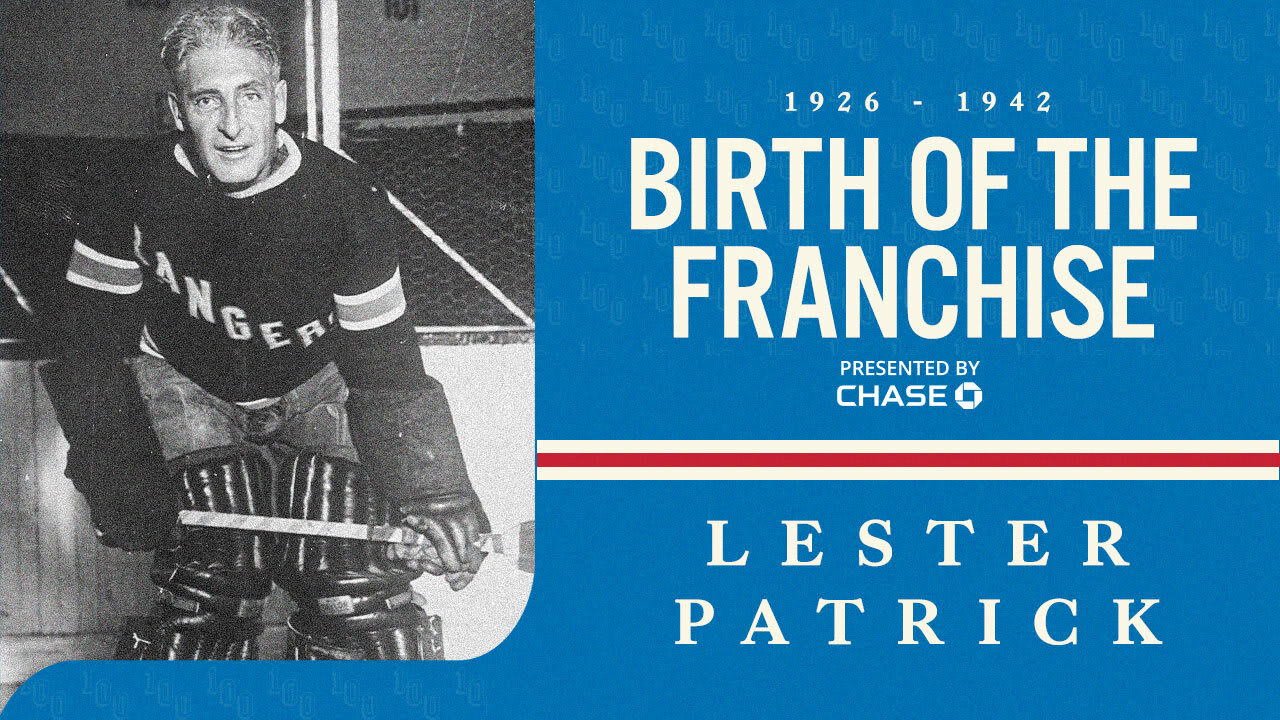
In the Rangers’ inaugural season in 1926-27, Patrick guided the team to the best record in the American Division. The following year, the Rangers won their first Stanley Cup in franchise history, thanks to Patrick’s impact in the front office, behind the bench, and even on the ice.
In Game 2 of the 1928 Stanley Cup Final, Lorne Chabot – who up until that point had played in goal for every second of every regular season and playoff game for the Rangers in 1927-28 – was struck in his left eye with the puck on a shot from the Maroons’ Nels Stewart. Chabot had to be helped from the ice to the locker room, and the game was stopped to give the Rangers time to determine how they would replace him.
In an era where there was not a backup goaltender, the Rangers’ options were limited. Alec Connell, a future Hall of Fame goaltender who had tied for the NHL lead with 15 shutouts as a member of the Ottawa Senators in 1927-28, was in attendance to watch Game 2 of the Stanley Cup Final, and the Rangers asked NHL President Frank Calder if they would be allowed to use Connell. Calder consulted with the Maroons’ Head Coach, Eddie Gerard, about this idea; Gerard refused to give the Rangers permission to do so.
After several minutes of contemplating what to do next, Boucher and Bill Cook asked Patrick if he would be willing to play in goal. Patrick agreed to do so. He was 44 years old at the time, and although he had been a Hall of Fame player, he hadn’t been a goaltender in his career. The Rangers tightened their play defensively to help support Patrick as much as possible. As Boucher described in his autobiography years later, “Taffy Abel and Ching Johnson never played better in their lives.”
Bill Cook scored the first goal of the game 30 seconds into the third period to put the Rangers ahead, but Stewart tied the game late in the period, and the contest went into overtime.
Just over seven minutes into overtime, Boucher scored to win the game, tying the series at one game apiece and putting Patrick’s performance into hockey lore.
The Rangers went on to win the Stanley Cup in a winner-take-all Game 5. Led by Patrick, the Blueshirts advanced to the Stanley Cup Final in 1928-29 and 1931-32, and in 1932-33, they won their second Stanley Cup.
While the team was having success, Patrick also had the foresight to prepare for when the core group of the original Rangers team would retire. Patrick’s idea, taken from the success that teams in Major League Baseball were having, was to develop young talent with minor league teams that the organization would run. The Rangers would identify these players first – primarily from an amateur tryout school that the team launched in Winnipeg, where they would hold their Training Camp in the mid-1930s through the mid-1940s – and then have them play for these affiliates.
This system would come to be known as the “3-R” Chain at first, with the links being the Rangers, the New York Rovers of the Eastern Amateur Hockey League (who played their home games at MSG), and the Philadelphia Ramblers of the Canadian-American Hockey League (which would eventually become the American Hockey League). This system would then become the “4-R Chain” after the Rangers had a junior hockey affiliate in Canada as well, which at first was the Edmonton Roamers and then became the Regina Rangers.
The Rangers’ farm system would evolve over time with different affiliates, particularly with affiliations for junior teams in Canada, but the “4-R” chain that Patrick initially created would pay dividends for the franchise in the years that followed.
Prior to the start of the 1939-40 season, Patrick turned over the coaching duties to Boucher and focused solely on his role as general manager. That season, the team was led by players who had been identified and developed through the Rangers’ system. Among them were all three members of the “Bread Line” – Alex Shibicky, Neil Colville, and Mac Colville – and forwards Bryan Hextall, Phil Watson, Dutch Hiller, Kilby MacDonald (who won the Calder Trophy as the NHL’s rookie of the year in 1939-40), Clint Smith, and Alf Pike, as well as defensemen Muzz Patrick (Lester’s youngest son) and Babe Pratt. Behind this group of players, the Rangers won their third Stanley Cup that season.
The same core of the team also helped the Rangers finish the 1941-42 season with the best regular season record in the NHL. Things were in place for the Blueshirts to have success for years to come, and had it not been for the start of World War II – when several Rangers players left the team to serve their country – their farm system might have led to even more success throughout the decade.
Near the end of the 1945-46 season, Patrick relinquished his post as general manager, ending a distinguished 20-year run in the role. On December 3, 1947, the Rangers held a night to honor Patrick’s legendary accomplishments with the franchise upon his Hockey Hall of Fame induction; he was the first member of the Rangers organization to receive such a recognition.
As the Rangers celebrate their Centennial and recognize those who helped establish the foundation on which the franchise stands today, there is perhaps no figure who helped shape their legacy in their formative years more than Lester Patrick.