
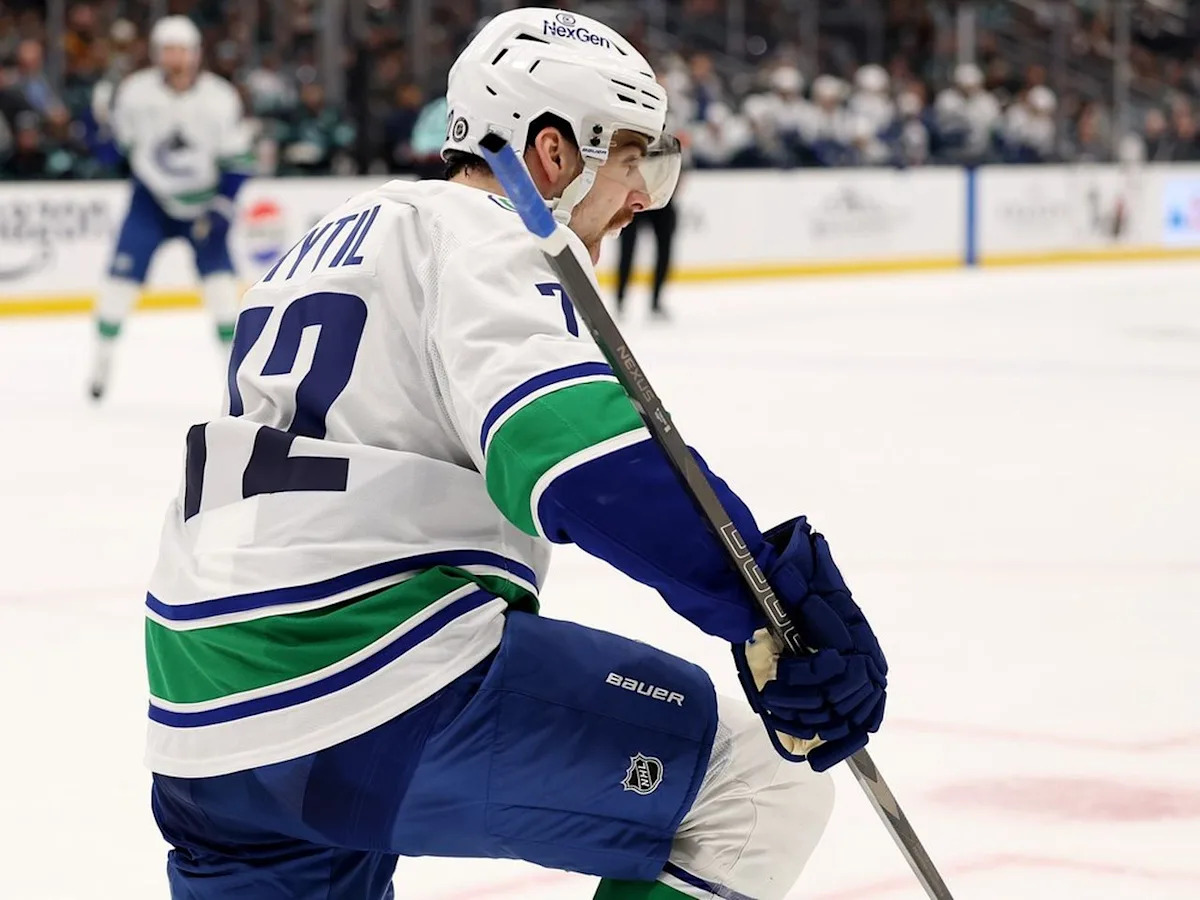
Let’s be honest. The Vancouver Canucks’ quest for a support centre — long before Filip Chytil succumbed to what appears to be his sixth career concussion Sunday to put his season and career in jeopardy — was built on the hope that Elias Pettersson would rebound from a sour, drama-filled, 15-goal season and return to a place of prominence.
And while his defensive awareness, penalty-kill presence, power-play potential, and willingness to block shots are encouraging, they have always been part of his game. What’s missing is offence. He has teased with quick releases and a heavy slapper, but one goal and 10 shots through seven games doesn’t scream No. 1 centre.
And neither does a poor 40.9 per cent success rate in faceoffs. First-line pivots dominate all facets of the game.
It is why the ongoing search has become more difficult. It’s not just a supply and demand issue, it’s the cost of landing a centre who can be supportive and also take over the top spot if needed. Pettersson does have points in three of his last four games, but he is being paid $11.6 million US for six more seasons to score.
Had Chytil remained healthy, the Canucks had more time to solve their riddle in the middle. He was playing like a top-flight centre with three goals in six games, driving play with speed, and using size to ward off defenders and get to high-danger scoring spots.
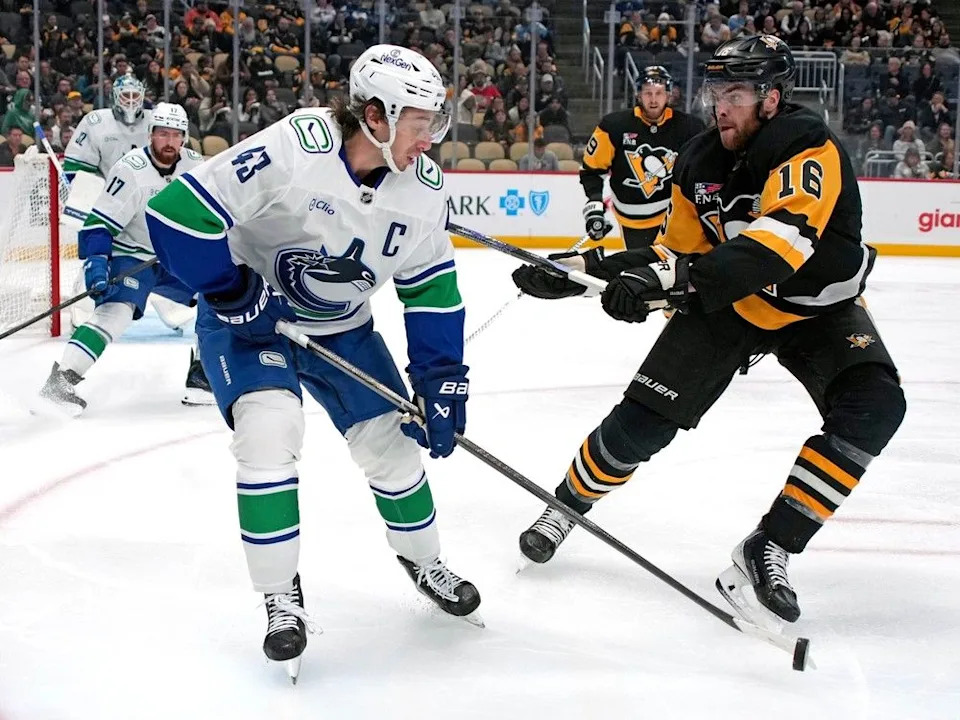
Quinn Hughes is pressured by Penguins forward Justin Brazeau during Wednesday game in Pittsburgh.
Lost in all this is Quinn Hughes. What is he thinking?
Making prudent moves to ensure the Canucks are more than just annual playoff hopefuls is part of the roster Rubik’s Cube exercise to align all sides. That would resonate with the captain, who has one more year left on his deal before free agency beckons. Being thin down the middle is not a path to the postseason, or appeasing for a generational player.
“Obviously, Quinn’s future is so important to this franchise and this city,” said Canucks president Jim Rutherford. “Everybody is aware of it. Everybody will talk about it until we get dizzy.”
Hughes has significant centre-ice connections, and in a dream sequence, landing Brady Tkachuk, Josh Norris or Dylan Larkin would have been a win-win scenario of the team and Hughes. Norris, 26, was dealt by the Ottawa Senators to the Buffalo Sabres in a multi-player swap March 8, five weeks after the Canucks made a major move by trading J.T. Miller to the New York Rangers.
Norris and Hughes were U.S. National Team Development Program teammates. Norris was the 19th selection by the San Jose Sharks in 2017 and traded two years later to the Senators. The 6-foot-2, 196-pound centre had a 35-goal season with the Senators in 2021-22, and 20 goals in 53 games last season before being dealt to the Sabres.
“He’s my best friend and we’re really tight,” Hughes told Postmedia. “He lives 20 minutes from me (in Michigan) and we pretty much see each other every weekend in the summer.”
However, Norris has battled injuries, had shoulder surgeries, and is currently on injured reserve. So it’s always buyer beware, whether Norris or Chytil, who arrived in the Miller swap with Victor Mancini and a first-round pick in 2025 draft.
Now Canucks general manger Patrik Allvin has to get creative to fill the Chytil void.

Nils Aman and Flames captain Mikael Backlund battle during last season’s opener Oct. 9, 2024 at Rogers Arena.
It may mean deviating from a path to protect prospects because that is going to be the currency to get a good deal done. And so is surrendering a high draft pick, or picks, depending on the stature of the acquisition. The Canucks have first- and second-round selections in 2026. And if they have to surrender a top prospect, is it Tom Willander?
The problem is where is that deal? Everybody wants a proven and productive pivot. A support piece plucked from a team in trouble might be the only play.
The Calgary Flames are reeling and need to do something. They lost six straight before hosting the Montreal Canadiens on Wednesday and are deep in the Pacific Division basement. Do you pursue second-line centre Mikael Backlund, 36, whose $4.5 million cap hit drops to $3.25 million the next two seasons?
Like so many Flames, he’s struggling with one goal through seven games, but is 52 per cent in faceoff efficiency and capable of more on a better team. He has had a trio of 20-plus goal seasons, and there’s a 2018 world championship title connection with Pettersson.
It’s not that the Canucks haven’t tried to improve.
Offseason pursuits of centres Marco Rossi, 24, and Mason McTavish, 22, were valiant because envisioning a long-term, one-two punch down the middle — especially with a re-invigorated Pettersson — is the stuff of GM dreams. However, Rossi would cost a roster player and 2025 first-round pick that turned into potential-packed pivot Braeden Cootes.
As much as Rossi was at odds with the Minnesota Wild because of his deployment, a three-year, $15 million bridge extension on Aug. 22 provided incentive for a bigger haul down the road, or look elsewhere. McTavish was always an Anaheim Mighty Ducks signing priority because he’s big, nasty, and has an enviable skill set.
McTavish signed a six-year, $42 million extension Sept. 27 to support first-line centre Leo Karlsson, 20. It’s the perfect platform to improve and produce. Would the Canucks have parted with a roster player and top prospect to get that trade deal done? Maybe. But the Ducks could have pushed for more.