
PITTSBURGH — One is a polite Canadian, a student of the game, one of the most cerebral players in history and the consummate, gentlemanly hockey player.
The other is a brash Bostonian who once guaranteed a series victory in his hometown, bullied defensemen and roared with delight after every goal.
So different, so perfect together. And together again.
Ron Francis and Kevin Stevens, a couple of giants in Penguins history who are as opposite as could be, were always great while playing on the same line and will be inducted into the Penguins’ Hall of Fame on Saturday night before their former team hosts the Columbus Blue Jackets at PPG Paints Arena.
“Talk about a couple of legends,” former Penguins winger Bob Errey said. “They didn’t come any better than those two.”
For Stevens, the event is a sentimental one. The former power forward has been very open about his battle with addiction and has devoted his life to sobriety and helping others get sober through his foundation.
Alcohol and drug abuse derailed his career and will likely prevent him from ever being inducted into the Hockey Hall of Fame; his career numbers are not what they could have been because of his off-ice demons. There is no denying, however, that he was a shoe-in for induction into the Penguins Hall of Fame.
In 522 career games with the Penguins, Stevens registered 260 goals and 555 points. His greatest feats in a Penguins jersey came in the playoffs. He remains the all-time single-season franchise leader for goals in a postseason, notching 17 in the spring of 1991 when the Penguins won the Stanley Cup for the first time. He followed with 13 the next spring as the Penguins repeated. Stevens scored 46 goals in 103 playoff games in Pittsburgh.
“He’s family to me and he always will be,” Hall of Fame center Bryan Trottier said. “He’s been through hell off the ice and I’ll always have his back. All of the guys on those Penguins teams would say the same thing because we love him so much. But aside from the problems he has had, I just hope people remember how great of a player he was. I hope they never forgot. He’s one of the greatest power forwards of all time, and in the early ’90s, he was the best power forward in the world. A generational power forward.”
Stevens might well be the most popular man among his teammates on those early ’90s teams. Many will be on hand for the Hall of Fame induction.
“Truly one of the most amazing teammates I ever had,” Errey said. “When Kevin would speak, we’d listen and do exactly what he’d say. We had Mario Lemieux, Ron Francis, Bryan Trottier, Paul Coffey. Talk about leaders. But Artie was the leader of our team in many ways.”
Stevens, who has worked as a scout for the Penguins for much of the past two decades, acknowledged that the Hall of Fame induction is going to be one of the great honors of his life.
“I’m from Boston,” Stevens said. “But, truthfully, I really consider myself to be from two different cities. Pittsburgh is the other one. It’s the only team I’ve ever loved, and I love that city more than words can say. Best times of my life were there and I love that place. It’s still the team I work for, still the team I love. I still get mad when they lose and get happy when they win. Every night. I’m a Penguin and very proud of that. So, to be honored like this, it’s a really big deal to me. It means the world. I can’t wait to get to Pittsburgh to be a part of it.”
Stevens has been sober for many years now and his former teammates beam with pride when discussing this. It will make tonight’s ceremony all the sweeter to see how well the big man is doing.
Phil Bourque, a fellow Boston native who won the Cup twice with Stevens in Pittsburgh, often says that it simply makes him feel good every time he sees Stevens.
“It really does,” Bourque said. “He’s a friend. A good friend. I know what he’s been through behind the scenes. We have had a lot of personal talks that we keep to ourselves. We know that every day is a battle for him. I just appreciate the fighter that is. And you better believe I appreciated the teammate and the person that Artie is. We don’t win those Cups without Kevin Stevens, both because of what he did on and off the ice. He has more conviction than anyone I’ve ever known. He was our leader. When he talked, the room stopped what it was doing and listened.”
Francis didn’t always speak and, when he did, he was so quiet that it probably would have been difficult to hear him in a locker room that boasted boisterous types such as Stevens and Ulf Samuelsson.
However, the soft-spoken center was a remarkable student of the game and one of the great players of all time.
“You better believe he was,” Stevens said. “Let’s talk about Ronnie for a moment here. He was one of the best defensive forwards in the history of the sport. He was also one of the best penalty killers in the history of the sport and one of the best faceoff men in the history of the sport. So, you think that’s all pretty good, and it is. Then you remember that he’s fifth all-time in points. Seriously. Think about that.”
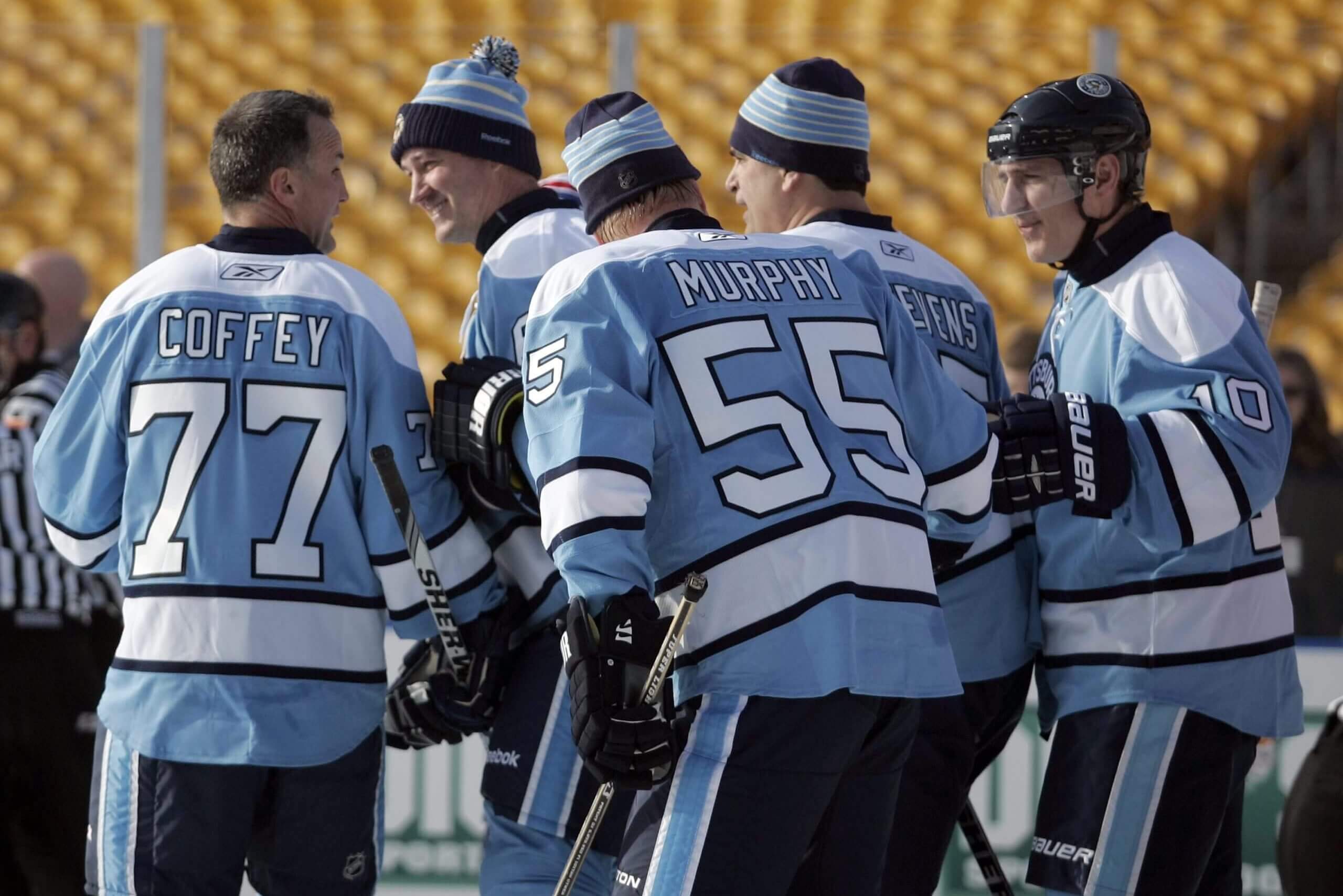
Ron Francis with teammates Paul Coffey, Larry Murphy, Kevin Stevens and Mario Lemieux during the 2011 NHL Winter Classic alumni game on Dec. 31, 2010 at Heinz Field in Pittsburgh. (Justin K. Caller / Getty Images)
Francis’ name is rarely mentioned when the greatest players in hockey history are discussed, but Stevens isn’t wrong. A defensive master who routinely shut down the opposition’s best center, Francis still managed to produce 1,798 points. Only Wayne Gretzky, Jaromir Jagr, Mark Messier and Gordie Howe produced more NHL points.
“He was so far ahead of his time,” Errey said. “Think about all the expressions you hear these days. You hear about guys who know how to play in the middle of the ice, from circle to circle. Be on the right side of the puck. Be above the puck. Managing the game. Playing the game the right way. It wasn’t part of the vernacular back then. But Ronnie Francis was literally all of those things. He was just smarter than everyone else on the ice.”
So gifted were the Penguins that, in their 1991 Stanley Cup run, Stevens (who scored 17 goals that spring) and Francis were on the second line. That’s because Mario Lemieux and Mark Recchi were on the top line. The 19-year-old Jagr played on the third line.
The Penguins didn’t truly become championship caliber until Craig Patrick’s trade on March 4, 1991 that brought Francis to Pittsburgh. His two-way play was something they badly needed.
“I don’t know that many people truly appreciate what Ronnie did,” Recchi said. “Do you know how hard it is to be that good, both ways, for that long? The consistency every year was unreal with him. His IQ was off the charts, like very few players who have ever played.”
Recchi is very close to Stevens but has a special place in his heart for Francis, too.
“He was a quiet leader, so different than Artie,” Recchi said. “Artie was yelling at the other team, or referees, or at us, all night. Ronnie didn’t yell. He studied. He just thought everything through before speaking. Artie wasn’t always thinking. He just said what he was feeling, and that made him a great leader in his own way. Ronnie was a great leader, too, because he could have calm conversations with you in the middle of a game. Not everybody can do that. But at the same time, he was such a competitor. So was Artie. It’s why they were perfect leaders on that team. They were so different, but wanted the same thing. They just wanted to win.”
Francis and Stevens often played on a line with Joey Mullen. It was a trio that almost never failed.
The two-way play of Francis, the guile of Mullen and the brute force of Stevens was a combination that was difficult to defend.
“We just clicked from Day 1, me and Ronnie,” Stevens said. “He was so easy to play with. Always made the right play. Always. He wasn’t Mario, because no one was Mario, but he was an incredible passer and had this vision. He just knew how to get you the puck. Incredible hockey player.”
They’ll be together again on Pittsburgh ice on Saturday and will be inducted into the Penguins Hall of Fame along with Scotty Bowman and Eddie Johnston.
“Two all-timers right there,” Trottier said. “We don’t win the Cups without those two. Pittsburgh would have been a dynasty in the early ’90s if not for the injury to Kevin (in 1993). That’s how great he was. And Ronnie is an all-time player. We’ve been really lucky in Pittsburgh.”
If Stevens lets out a hearty laugh and if Francis studies the ceremony as it takes place, it will be just like old times.
“They were opposites,” Bourque said. “But they were magic together.”