
It was the end of the Pittsburgh Penguins‘ four-game winning streak, but as defenseman Kris Letang noted, a point in October counts the same as a point in April.
The Penguins’ late two-goal rally in the final five minutes forced overtime and a shootout, but the Columbus Blue Jackets scored on all three SO attempts for a 5-4 win at PPG Paints Arena.
Columbus should have buried the Penguins under the mountain of the Penguins’ mistakes, but Letang’s bit of logic cannot be assailed. The point still counts, and get this nugget–the Penguins have the third-best winning percentage in the Eastern Conference.
In fact, on Oct. 25, the Penguins are just two points shy of having as many points as they amassed in the last two Octobers combined.
But that doesn’t mean they played well, or even reasonably close on Saturday. It seemed more like a carryover from Florida’s attack on Thursday, but against a much lesser opponent. The Penguins were outshot 40-28.
“I think there was too much up and down in this game instead of having more like a sustained effort, or managing the game,” said Kris Letang. “I think we had some really good moments, but the bad moments were pretty high for them. So if we reduce that, limit the time that we spend in our zone when they’re having the momentum, we’re going to have a better chance to control the game.”
The Penguins started well and finished well, but the 45-minute gap in between was a listless, mistake-filled, sloppy … sometimes lazy, soft, performance that turned a 2-1 first-period lead into a 4-2 early third-period deficit.
“I would say (it was one of our sloppier games). That was one where we were on our heels,” said coach Dan Muse. “I think there are some different things–if you go through the game–I thought early on it was probably more execution based. I think we were trying to do the right things, but we weren’t executing.”
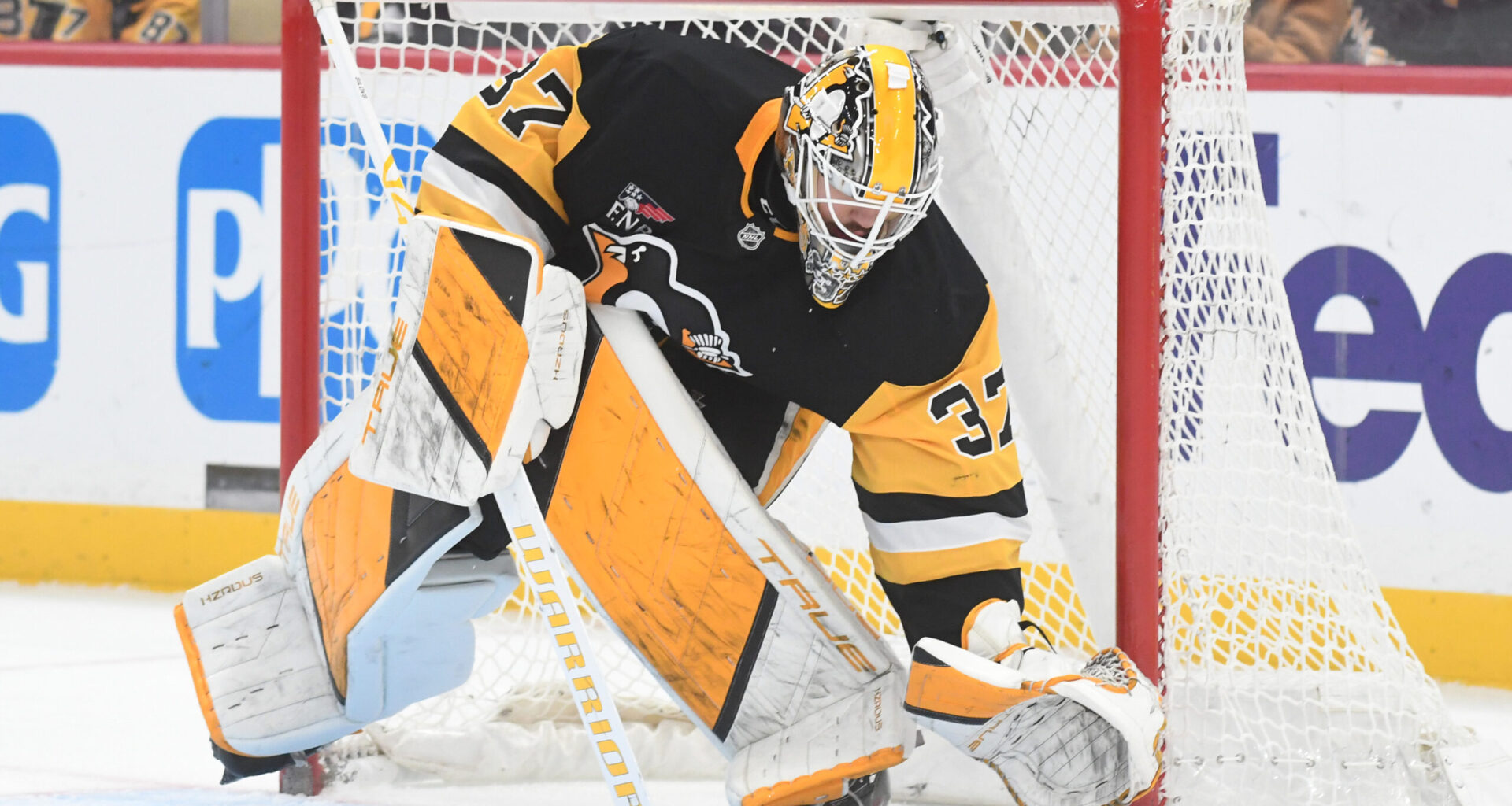
They earned a fate much worse, but Columbus fritted and fumbled away glorious scoring chances and odd-man breaks. Penguins goalie Arturs Silovs balanced a leaky goal with some excellent saves … at least until the shootout, when he was 0-for-3.
The Penguins had issues, including on the third pairing, which was pinned down more often than a Saturday morning jobber (that’s a wrestling reference), and the third line, which awkwardly combined for one shot on goal.
Also, there is a systems question, too.
Penguins Xs & Os Analysis
Tactically, the ups and downs referenced by Letang raised a question: Did Columbus exploit the Penguins’ hybrid defensive scheme?
Penguins coach Dan Muse has installed a hybrid approach in the D-zone. Call it a catch-and-release style in which the team is man-to-man below the dots and a zone coverage at the top of the zone.
Within the same sequence, a Penguins defender can have man coverage, but then pull back into zone coverage before reengaging man coverage.
In the sloppy game, the Penguins exposed that soft area beneath the high zone but above the dots. Yegor Chinakov smoked a wrister past Silovs after stepping into that area. Dante Fabro also set up a goal from that area as Silovs made the save, but dropped the rebound in the crease for Columbus’s Charlie Coyle to clean up.
That tidbit bears watching. Just as the team’s still unsettled breakouts, which can be spotty.
“I think we’ve got to be a little bit tighter getting out of our own end. (If) we do that, we’ve shown we can create chances,” said captain Sidney Crosby. “The last couple of games we’ve been outshot, we’ve been on our heels a little bit, so we’ve got to find a way to dictate play, and whether that’s getting out of our zone quick or executing a little better so that we can turn pucks over (into the offensive zone)–But yeah, it was good that we found a way to get a point there.”
Offensively, the Penguins were trying too hard. Perhaps they got a big head after Thursday’s big win over Florida?
They had good zone entries and puck possession, especially in the first period, but almost exclusively tried to make an extra pass–the pretty play–to their extreme detriment.
They had just seven shots in the first period and just five high-danger chances in 60 minutes, according to NaturalStatTrick.com.
However, the power play, both at 5v4 and a 6v5 chance late in the game, notched goals. The Penguins maintained their league-best 33.3%, even though they passed up too many good shots.
“We’re making the most of our time. We’re doing a good job of getting entries, which is big,” said Crosby. “And once we get in (the offensive zone), I think we’re not forcing a ton. Whatever’s there, we’re taking it.”
Play the Rookies?
As a side note, Penguins rookie defenseman Harrison Brunicke was a healthy scratch for the second straight game, but his mistakes before getting a breather were no worse than Connor Clifton’s, and Brunicke’s upside is far greater. The Penguins’ third pairing with Clifton and Matt Dumba was problematic in the first period. Dumba settled; Clifton did not and had a second consecutive wild ride.
When Clifton was on the ice, the Penguins had just a 27% Corsi, meaning they were hemmed into their zone.
Given Clifton’s sketchy play, the Penguins have no reason not to play Brunicke more often.
Up front, the Penguins’ third line without Ben Kindel could have been reported missing in action. In fact, was statistically pretty terrible. The line primarily spent the evening in the defensive zone, provided little puck possession, and was too often knocked off the puck.
The line had shot, combined, but also gave up quite a bit of offensive. They failed to keep the puck deep and were chasing the play up the ice with regularity.
If the Penguins continue to rotate Kindel in and out of the lineup every few games, they need a better solution than Tommy Novak in the middle and Philip Tomasino on the right. After several games in the preseason and regular season in which the line has been together, the results are clear. Coaches should think long and hard about ever putting those two together.
Or, they can rotate Kindel out less often.
Penguins Report Card
Team: D
The grade was upgraded from an F because of the late comeback. They remain good at finding goals even when they are on their heels. As we debate the sustainability of their good start, that trait is one that is often part of a team’s makeup rather than a brief streak.
Still, there wasn’t a lot to like.
“In the second period, I thought that’s when it kind of got away from us,” said Muse. “I thought we were just putting ourselves–based more on decisions–in some tough spots. And because of that, we found ourselves defending.”
Good Grades
Kris Letang: A
His best game of the season. By a lot. He skated with the puck well, he did not get beaten as has been a too frequent occurrence, and he was appropriately a plus-2.
Anthony Mantha: B
A couple of turnovers lowered his grade, despite scoring a goal and an assist. The offense also overcame the Malkin line’s sloppy defensive work. They were playing what former Penguins defenseman Brooks Orpik would have termed “Globetrotter” hockey. It didn’t work.
Ryan Shea: B
He stepped into the zone well and sniped a goal-scorer’s goal on the Penguins’ first shot of the game. He was solid, but he may have been caught in no-man’s land on Yegor Chinakov’s early third period goal from the high slot. As we learn Muse’s system, I don’t know if the defensemen are supposed to come to the mid-zone to pick up a player. Shea had the goal and a couple of shots with no turnovers.
Bad Grades
Third Line (Hallander-Novak-Tomasino): F
Is there a grade below an F? The line combined for one shot on goal. They were outshot 8-1, outchanced 6-1, and they had an expected goals-for rate of 11%. It’s difficult to harp on the players on the line without feeling repetitive, but together, they don’t possess the puck because they don’t win pucks and don’t play strong on the puck.
Connor Clifton: D
For the second straight game, he was driving the struggle bus. His jersey was too often in the picture, but on the wrong side of players or the puck when Columbus had extended zone time and chances around the net. He was a minus-two, and his turnover at the blue line fed Columbus their fourth goal.
Evgeni Malkin: C-
Malkin had two assists, but the scoring line doesn’t erase the fact that Malkin was a no-show in the defensive zone. He looped rather than help on Columbus’s second goal. He was back in position to help, but…didn’t. Malkin was also 3-for-11 on faceoffs.
Puck Management: F
The team was careless and pretentious. They fed Columbus’s transition game better than Columbus could have dreamed, with overpassing, errant passes, trying to make cute plays, and being too casual.
There was an underbelly of self-satisfaction that didn’t take the game as seriously as they should and tried to win it with talent.
Every team has a few of these games, and it may have been fitting that on a night the Penguins inducted a couple of players from their 1990s salad days, the team played with that same overconfidence (but those 1990s teams were so good they could do it with ease).
Tags: Columbus Blue Jackets Penguins Analysis Penguins game Penguins report card Pittsburgh Penguins
Categorized: Penguins Analysis