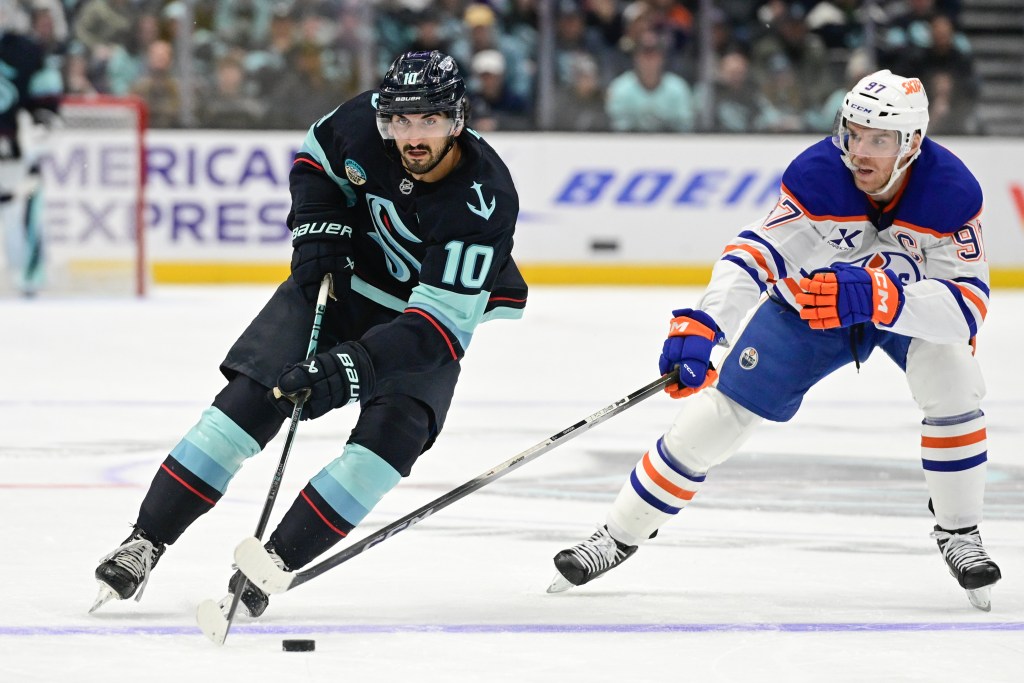
After the Kraken defeated the Vegas Golden Knights 2-1 in overtime at home on Oct. 11, Golden Knights coach Bruce Cassidy said something about Seattle that piqued my interest:
“They had a game plan, and they weren’t going to lose D up the ice. Even though I think they did a pretty good job of getting involved in the offense, it didn’t allow us a lot of odd-man rushes to get through the neutral zone clean. So I think it took us a while to figure that part out.”
The high-flying, downright lethal offensive talent of the Vegas Golden Knights couldn’t generate odd-man rushes against Seattle? How is that possible? What has head coach Lane Lambert changed so successfully?
“I wouldn’t say there’s necessarily a ton of things different,” Matty Beniers said. “I think Lane is just big on details and making sure everyone knows where they need to be at all times, and we’re gonna be there. That just builds trust over time.”
Since that Vegas game, I’ve been watching closely for odd-man rushes against—and anecdotally, there just haven’t been many.
To make sure my eyes weren’t deceiving me, I checked in with best friend of the Sound Of Hockey Podcast, Alison Lukan, who confirmed that the Kraken are, in fact, No. 1 in the NHL at limiting odd-man rushes against.
How about that?
Good tracking, staying above their defensemen
A few goals against have come off the rush—one that jumps to mind is the Alex Newhook goal in Seattle’s 5-4 overtime loss in Montreal—but even in those cases, the Kraken have generally had numbers back.
On that Newhook goal, for instance, Seattle had three players in defensive posture, with Mason Marchment back and helping Adam Larsson and Vince Dunn. The Kraken defenders were technically outnumbered, since Habs defenseman Alexandre Carrier jumped up to support Ivan Demidov, Newhook, and Oliver Kapanen, but Demidov still had to make an elite cut to get around Dunn and thread a perfect seam pass to Newhook.
Alex Newhook scores off a rush and a great pass by Ivan Demidov, and the #SeaKraken are chasing for the first time this season.
1-0 #GoHabsGo pic.twitter.com/YJ2fYH6x77
— Sound Of Hockey (@sound_hockey) October 14, 2025
“I think [we’re doing] pretty good [in limiting odd-man rushes],” Lambert said Monday. “I think that we’ve talked about it as a group here. I think there’s some things that we can do better when we come into the zone with some of our reads, so that will again enhance our ability to not give up any chances or things like that off the rush, so it’s a work in progress.”
I also spoke with Beniers on Monday about Seattle’s improved defensive structure and mentioned the Demidov–Newhook connection as one of only a handful of times I could recall an opponent scoring off a rush.
“The Demidov play was brought up today,” Beniers said with a smile. Funny timing.
It makes sense that this play would be discussed with the Canadiens visiting Climate Pledge Arena on Tuesday. But it also shows just how intent Lambert and his staff are on not allowing the same mistakes to happen twice.
Beniers said Lambert has emphasized “tracking”—another term for backchecking—and how players should react when they find themselves behind the play and chasing to rejoin Seattle’s defensive unit.
“That’s definitely a focus for us,” Beniers said. “On every play that could potentially happen, Lane’s trying to make sure that we have a plan for each time. If it’s a speed kick, if it’s a standing still guy on the wall, if there’s guys coming back, and you’re the fourth guy, or you’re the third guy, or you’re the fifth guy, he paints it pretty clear, so we know what we’re doing.”
Another factor Beniers pointed to in explaining Seattle’s success at limiting dangerous chances is “having a good F3.”
For context, F1, F2, and F3 refer to forechecking responsibilities, with F1 and F2 being the first two forwards into the offensive zone, usually pressuring the opponent’s puck carrier or working down low. The third forward (F3) stays high, available for a shot and ready to support the defense when the puck transitions the other way. When that happens, Beniers says the F3 must stay above any defensemen joining the rush.
“It’s getting back and staying above their D, especially against teams like Vegas with [Jack] Eichel that have active D or last game with Edmonton,” Beniers said. “They obviously have [Connor] McDavid flying around, and their D are pretty active too. It’s definitely a focus going into the game, just making sure we’re staying above them. And if you stay above a guy, you don’t give them a lot of time and space to create those rush chances.”
“It’s believing that we’re a good hockey team”
We’ve heard several players in the last week utter some variation of the phrase, “We believe we’re a good hockey team.” In discussing Seattle’s early-season defensive success with netminder Joey Daccord, he echoed that sentiment.
“I think it’s mindset,” Daccord said of what’s different about this version of the Kraken. “We’ve added some pieces, but we’re obviously down a lot of bodies right now and still finding ways to win. I think it’s a mindset from our group. I think it’s self-belief, I think it’s believing that we’re a good hockey team.”
Daccord added that having a strong game plan to keep opponents to the outside and limit rush chances is critical, but sustained success depends on total buy-in.
“I just think there’s a commitment to defensive structure and everyone being in the right spots,” Daccord said. “You look at the block that [Vince Dunn] made with a second left in the game [against Edmonton], those are game-winning plays. And that’s the mentality we have to have for 82 games.”
Injury updates
Seattle’s ongoing injury woes make its 5-2-2 start even more impressive. Even with Brandon Montour back from his leave of absence, the Kraken remain without four regulars—Kaapo Kakko, Ryker Evans, Freddy Gaudreau, and Jared McCann—all on injured reserve.
There’s some good news and some bad news on that front.
First, the good: Kaapo Kakko appears ahead of schedule in his recovery and could return sooner than the original six-week timeline suggested. The team gave that estimate on Sept. 28, which would have put the Finnish winger’s return around Nov. 9. But Kakko was a full participant in Monday’s practice, even joining line rushes and taking light contact.
Kaapo is also participating in drills… https://t.co/EpDuLpMzcd pic.twitter.com/Ieb91BVhZW
— Sound Of Hockey (@sound_hockey) October 27, 2025
He’s unlikely to play Tuesday against Montreal, but Saturday’s game against the New York Rangers looks like a realistic target.
On the other hand, McCann has now missed four games and doesn’t appear close to returning. I asked Lambert if McCann is progressing or still in a holding pattern.
“He’s in a little bit of a holding pattern,” Lambert said. “So, we’ll see where we go with him. We should know more here, day to day, as we go forward.”
The Kraken haven’t changed McCann’s official status, but based on Lambert’s comments and McCann’s continued absence from practice, I wouldn’t expect to see him in a game any time soon. Hopefully, whatever the Kraken do learn about their best goal scorer in the coming days doesn’t bring worse news than that.