
You get an extension, and you get an extension, and you get an extension!
They’re going out like Halloween candy these days as NHL front offices grapple with the changing salary landscape that’s hit the league like a tornado.
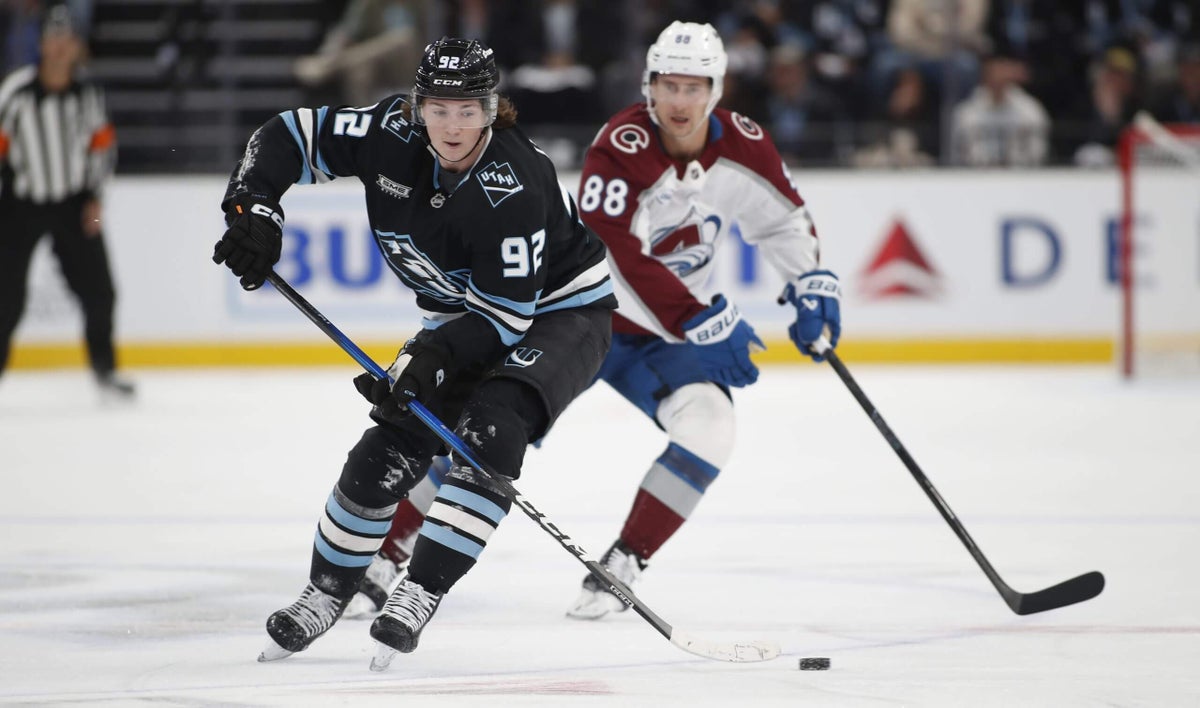
And as soon as Logan Cooley, the No. 3 pick in the 2022 draft, signed his eight-year extension Wednesday, the natural next thought was where things would fall extension-wise for the top three picks from 2023.
Connor Bedard, Leo Carlsson and Adam Fantilli are all up after this season. Believe me when I say that Cooley’s extension, which will pay him $10 million per season, was duly noted by everyone involved on both sides of those three situations.
As one might imagine, the Chicago Blackhawks approached Bedard’s camp, led by Greg Landry of Newport Sports, over the summer and started that discussion. They spoke conceptually, which normally means there would have been some numbers thrown around. But it doesn’t sound like it got too far. The result was the 2023 No. 1 pick wanting to shelve things for the moment while he focused on getting ready for this season, which he hoped would be better for himself and his team.
So far, so good on that front.
My understanding is neither side has pinpointed exactly how far down the road they’ve kicked the ball. It’s a fluid delay. Perhaps they pick it back up in the new year. Perhaps it waits until after the season. Either way, nothing is imminent on that front.
The bottom line is there’s no rush from the player’s perspective, and why would there be? If Bedard pops this season, that puts him in a better situation to negotiate the huge contract that awaits him. And it allows every extension that gets signed around the league to become data points that provide more guidance.
How do I think it eventually plays out? I’m totally guessing here, but I think Chicago will do all it can to go the max eight years while it wouldn’t surprise me if Newport Sports pushes for five. For five years, I could see something in the $10 million average-annual-value range, or just above. For seven or eight years, you’re looking more at the $12 million-plus range. Bedard has all the leverage, no matter where it goes.
For the Anaheim Ducks, meanwhile — on the heels of extending young core pieces in Lukas Dostal, Jackson LaCombe and Mason McTavish over the past few months — it’s natural to wonder where this leaves Carlsson, the No. 2 pick in 2023. Youngsters Cutter Gauthier, Pavel Mintyukov and Olen Zellweger are also on expiring entry-level deals. The up-and-coming Ducks are a busy team these days.
My understanding on the Ducks-Carlsson front is that there have been next to no discussions on an extension yet. Some of that is probably because the Ducks had a busy summer with more pressing matters, such as McTavish. But I think most of it is because it makes sense for Carlsson and his agent, Matt Keator, to wait this out. The young Swedish star hasn’t put up eye-popping numbers just yet, but his all-around game and talent are obvious. If he has a big season, it will help fill out the conversation when it comes to extension talks.
I don’t believe the Ducks and Keator have firmly established how long they’ll wait, but like Bedard, I would imagine it’s January at the earliest or possibly the offseason. The Ducks, for sure, will want to go the max eight years.
And finally, Fantilli, the third pick in 2023, whose 31 goals were more than either Bedard or Carlsson last season. His agent, Pat Brisson of CAA Sports, and Columbus Blue Jackets GM Don Waddell confirmed this week that they decided to wait until after the Olympic break to pick back up on extension talks. I kind of wonder if the Fantilli camp is best served to wait on Bedard and Carlsson signing to further see that market firmed up with fresh data.
What the Cooley deal means
Talks between Utah and Cooley’s camp, led by brothers Brian and Scott Bartlett, went off the rails a bit in early October when colleague Frank Seravalli reported that the player had turned down an eight-year deal at a $9.6 million AAV.
As one source involved in the negotiation told me this week, that had a bit of a cooling (sorry) effect in talks. Neither side was particularly happy the news got out, and it felt at the time like talks might be shelved until after the season.
But eventually, everyone calmed down, and the Mammoth in particular really wanted to get back at it. They were aggressive in working to get the extension done. Dropping $80 million on the table certainly helps in that regard. It’s the third-highest contract signed out of entry-level in NHL history, so nice job there by the Bartlett family — although the reaction I got from rival team execs and other player agents was that they all felt Cooley would still end up outplaying the deal.
Either way, there was real urgency for Utah to get it done.
And I think what we’re seeing, in the same week Thomas Harley also extended in Dallas, is that clubs are pretty nervous about next summer and the ever-changing landscape with salaries in the rising-salary-cap environment. Every time another young core player signs somewhere around the league, it’s a fresh, new contract comparison thrown on the board.
“Get it done yesterday” is clearly the mantra around the league right now. If the player is willing, that is.
What about Robertson?
Now that the Dallas Stars have extended Harley, the focus shifts to their next big name, Jason Robertson. I wouldn’t expect anything soon on that front, though.
You may remember Robertson’s name was out there a bit last offseason — not because the Stars were truly shopping him (they weren’t) but because they were willing to see what teams had in mind when they phoned. It’s always a worthy exercise to fully understand what the market thinks of your players before you decide whether you want to go ahead with extension talks.
Nothing caught the Stars’ fancy trade-wise, and the focus shifted instead to extending the 26-year-old winger, who is a restricted free agent next July 1 and one year removed from unrestricted status. There were numbers thrown in front of the player’s camp in the summer, but it was decided they would wait.
Maybe talks will pick up again in a meaningful way in January. They could wait until after the season. Robertson is focused on having a strong season and hopefully cracking Team USA for Milan, which could give him a stronger position for extension talks.
Robertson probably rushed back too quickly from offseason foot surgery last season, and it contributed to a slow start that cost him a spot on Team USA for the 4 Nations Face-Off. He still ended up with 35 goals in a so-called “down year” after a strong second half.
It will be interesting to see where this goes. The Stars genuinely want to keep him, but the escalating salaries in the new salary cap landscape make you wonder what that looks like if there’s a 40-goal season coming.
Back to Harley, meanwhile, it’s always eye-popping when a player crosses the double-digit AAV threshold, but by the end of this season, I still think the $10.5875 million AAV on his new eight-year deal will look pretty darn reasonable. If Harley wanted to play hardball, he would have instructed his agent, Andy Scott of Octagon, to wait a few months as he padded his resume. But Harley wants to win and wanted it done with.
What’s interesting, in the end, is that the two-year bridge deal the Stars signed Harley to in September 2024 at $4 million per season certainly proved quickly to be a bargain as he continued his rapid ascent as a top NHL defenseman. My sense is if Dallas had tried to sign him to an eight-year deal right out of his entry-level, it would have come in at somewhere around eight years and an $8.25 million AAV. So it cost the Stars a bit to wait via the bridge. But on the flip side, they got him cheaper for two years. And I mean, now they’ve got him signed through his age 32 season.
They’re getting all his peak years in this new deal. Well worth it.

Thomas Harley is staying in Dallas long-term. Will Jason Robertson, too? (Sam Hodde / Getty Images)
Necas’ extension and Makar’s next deal
The Colorado Avalanche can extend Cale Makar next summer, a year out from the expiry of his current deal that pays him $9 million, and what the AAV could look like for the world’s best defenseman is fascinating. That’s a story for another day.
As it relates to Thursday’s news of Colorado re-signing pending UFA Martin Necas, my understanding is that Makar’s future did have some impact on talks between the Avs and Necas. Things felt stuck for a bit, with Colorado feeling it had to be careful how far it could go with Necas. I believe the Avs were at $10.5 million for a while. It wasn’t until the team moved to $11.5 million that things finally got done, and Necas signed an eight-year extension Thursday.
Coincidence it was just a day after Cooley? Um, no. That definitely helped move the needle.
There was also some pressure on the Avs, to be sure, not to lose Necas — the central piece in the Mikko Rantanen trade.
Given all the big names who have re-signed over the past month, Necas gave up a chance to cash in in a greater way next July 1 on the open market. But he loves it in Denver, where his fast-paced style meshes so nicely with Nathan MacKinnon. More money doesn’t always mean more happiness in the NHL. Necas didn’t want to go anywhere else.
Rangers not rushing on Panarin
The New York Rangers have a ton of respect and appreciation for what Artemi Panarin has done for them, and that’s not to say it won’t continue past this season. But for the moment, my sense of the situation is that it’s very early in the season under new head coach Mike Sullivan, the Rangers want to see how things go and therefore are not in a hurry to get going more seriously on talks to extend the pending UFA winger.
If and when those talks get going again in a meaningful way, term may be the issue. Panarin turned 34 on Thursday. I don’t think he’ll be open to a short-term deal, which would probably be the Rangers’ preference. Panarin is repped by Paul Theofanous, the same agent who squeezed another million a year from the Minnesota Wild after turning down a whopping $16 million per season for Kirill Kaprizov.
The two negotiations have different dynamics because of the age difference and, to be blunt, because the Rangers are not nearly as desperate to get a deal done as Minnesota was with Kaprizov.
But if I were a betting man, I would predict Theofanous wanting as much term as possible for Panarin. This will be the last big contract in his career.
Bruins view Zacha as a long-term fit
There was speculation last weekend from colleague Elliotte Friedman of Sportsnet that the Vancouver Canucks were interested in Boston Bruins forward Pavel Zacha, and league sources indeed confirm Vancouver reached out in the summer with interest. But my understanding is the Bruins don’t intend to move Zacha. They view him as an important part of the core as they continue to transition and re-tool their roster.
Zacha is the right age, 28, to remain part of the team’s future. I wouldn’t be surprised if Boston tries to extend him this summer, a year out from the expiry of his current deal.
Obviously, that won’t stop teams from expressing interest, especially if the Bruins have a rocky season.
Frozen Frenzy will likely be altered
Nothing is decided for sure yet, but talks are already underway to tweak the Frozen Frenzy for next season.
All 32 teams played on Tuesday, with each start time staggered by 15 minutes. It’s a neat day on the NHL calendar. But it certainly hasn’t pleased everyone. A few team executives complained to me about it this week, noting the later start times aren’t ideal for their market and fan bases.
My prediction is that the league will alter the Frozen Frenzy in two ways:
1. They will have it later in the season. It wasn’t great that it went head-to-head with Game 4 of the World Series, especially with most of Canada watching the Blue Jays, not hockey. Sure, that might be a one-off, but why go head-to-head with the World Series anyway?
2. It wouldn’t surprise me if the next Frozen Frenzy is held on a weekend, when the start times can more easily be staggered from the afternoon on.