
Introducing a new recurring feature here at Sound Of Hockey called 10 for 10. Every 10 games, we’ll take a step back and look at 10 different stats that tell the story of where the Seattle Kraken are trending.
Some numbers will be straightforward, things like goals, shot attempts, or save percentage, while others might be a little more offbeat or meant to challenge assumptions about the team. Each stat will include a visual and a short breakdown to help make sense (or nonsense) of what’s happening with the Kraken over the last 10 games.
Data Point 1: Pace
It’s been well reported, and often mentioned on broadcasts, that the Kraken are off to their best start in franchise history. Here’s how that path looks compared to other seasons:
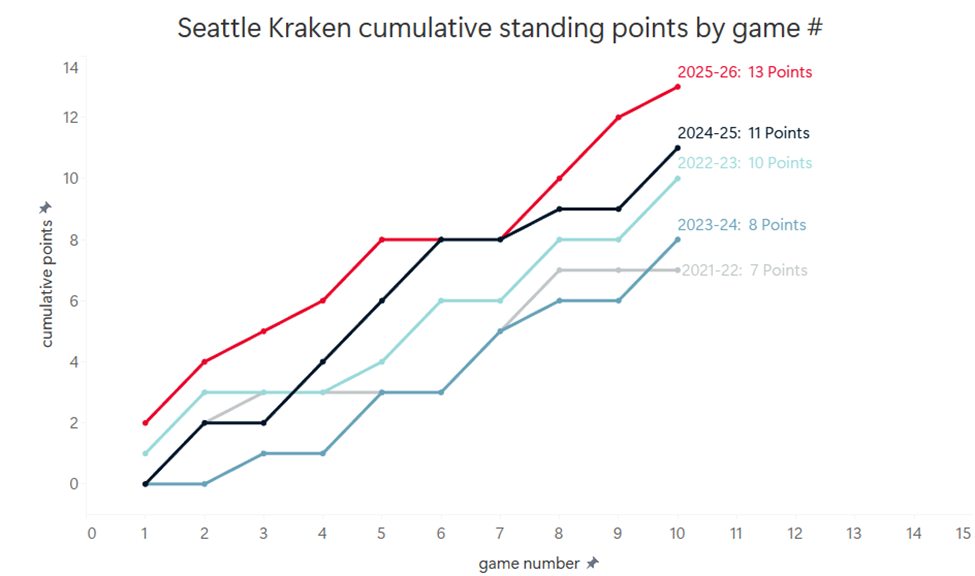
As Blaiz pointed out earlier this week, November shapes up as a much softer stretch from a strength-of-schedule perspective, but the 2022–23 team earned 17 out of a possible 20 points in games 11–20. Keeping pace with that group could still be a challenge.
Data Point 2: Rebound goals
I first started thinking about “rebound goals” when I read an article about the Kraken head coach’s vision for the team. It got me thinking more about those gritty, inside-area chances Seattle has been trying to create. For this analysis, I defined a rebound goal as a goal scored within three seconds of another shot on goal.
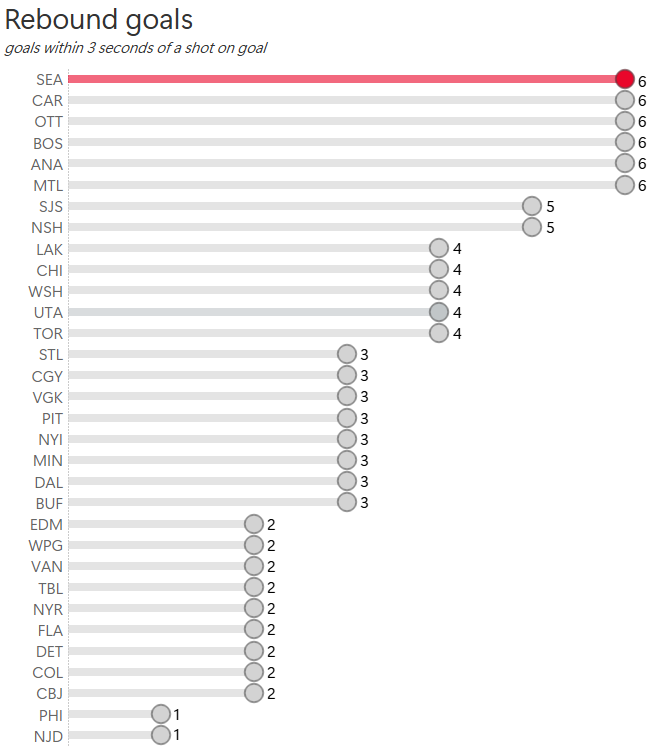
The chart above shows all situations; two of the Kraken’s rebound goals came on the power play. Worth noting, Seattle has only allowed two rebound goals against, which is tied for the third fewest in the league.
Data Point 3: Shot attempts against off the faceoff
We’ve established that the faceoff stats tracked and published by the league aren’t all that useful, but one thing we can tease out is the number of shot attempts for and against following a draw. That gives us a decent proxy for possession after a faceoff.
I started to worry about this when the Kraken allowed three goals immediately after faceoffs during their road trip. If you want to see the goals, here are some examples:
Those turned out to be the only faceoff goals allowed by the Kraken this season, but could it be a symptom of a bigger issue? Let’s look at the data.
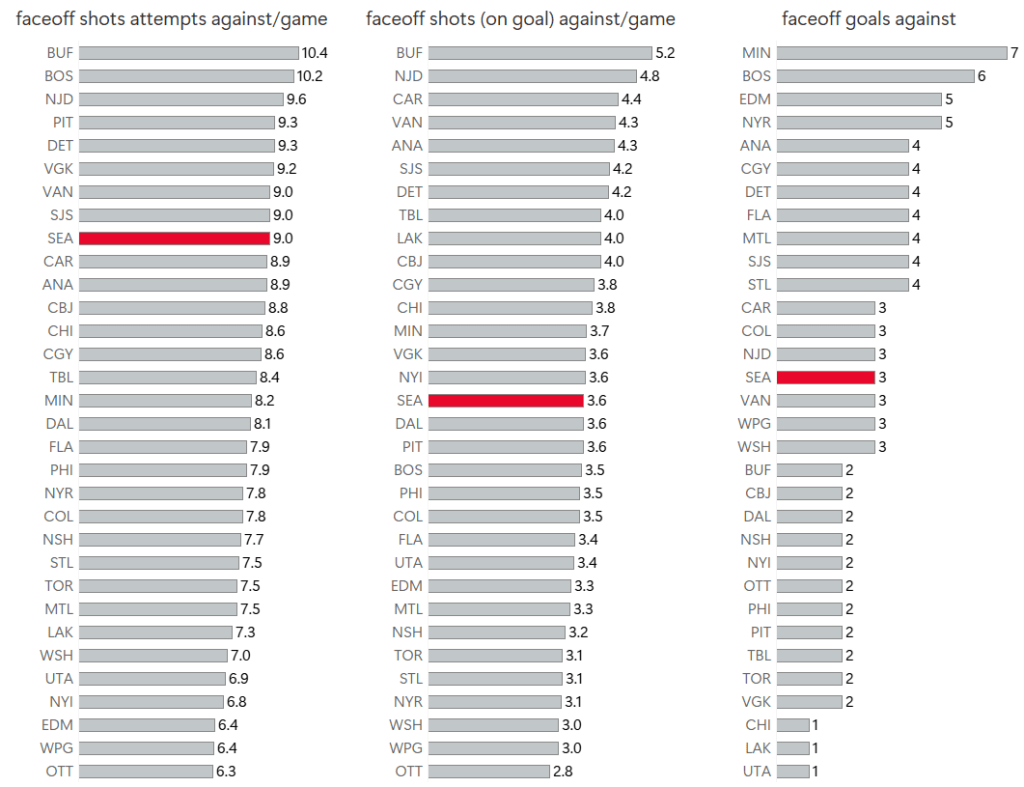
It doesn’t seem to be as big of an issue as I might have thought. The Kraken are definitely allowing more shot attempts after a faceoff than most other teams in the league but not as many shots are getting through to the goalie. And like I mentioned above, only a few made it in the net.
Data Point 4: Penalty kill success rate and volume
One area that’s gotten plenty of attention is Seattle’s penalty kill. From a percentage standpoint, the Kraken rank 29th in the NHL with a 64 percent success rate. The positive spin? They haven’t been shorthanded often, allowing nine power-play goals—tied for 18th in the league.
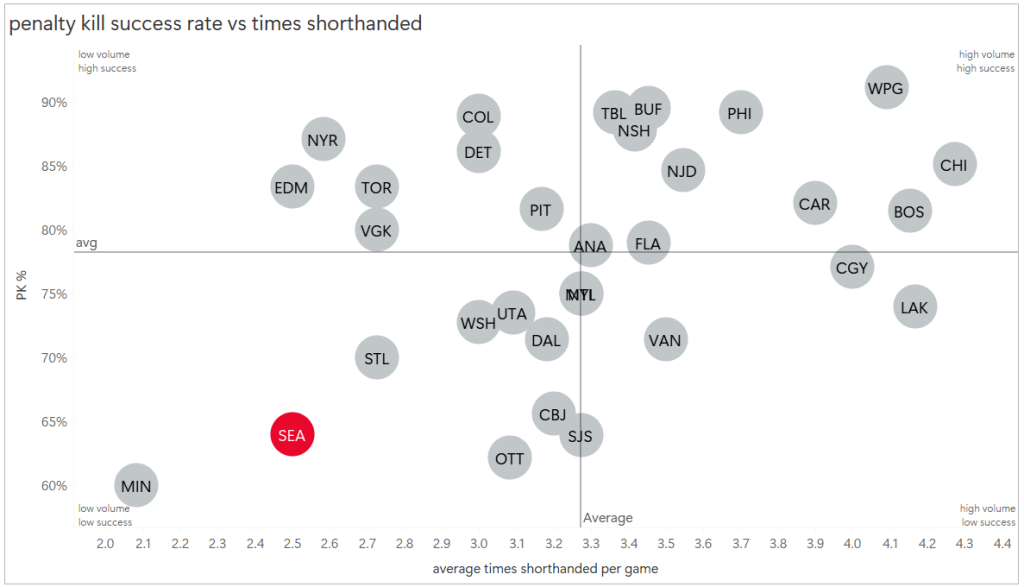
Regardless of how you frame it, though, 64 percent is brutally low. If the Kraken continue to play tight games, even a modest improvement toward league average could be the difference in picking up a few extra points in the standings.
It’s also interesting that the PK is among the best in the NHL at limiting high-danger opportunities during the PK, despite the team’s struggles at preventing goals. Lambert spoke about this on Saturday morning.
Data Point 5: Scoring first
Seattle has earned points in all but one game when not scoring first (Philadelphia). Seattle has scored first in seven of its first 10 games, winning five of those. On a league-wide basis, 90 percent of the time, teams that score first get at least a point and 66 percent of the time they win. For further context, last season’s team scored first in just 42.7 percent of its games (35 total).

On the other hand, Seattle has earned at least a point in every game when giving up the first goal (Philadelphia).
Data Point 6: Average goals against
This has been the story of Seattle’s early-season success. The Kraken have tightened up defensively, which gives them a chance to win every night. Last season, they allowed 3.2 goals per game compared to just 2.8 through the first 10 games this year.
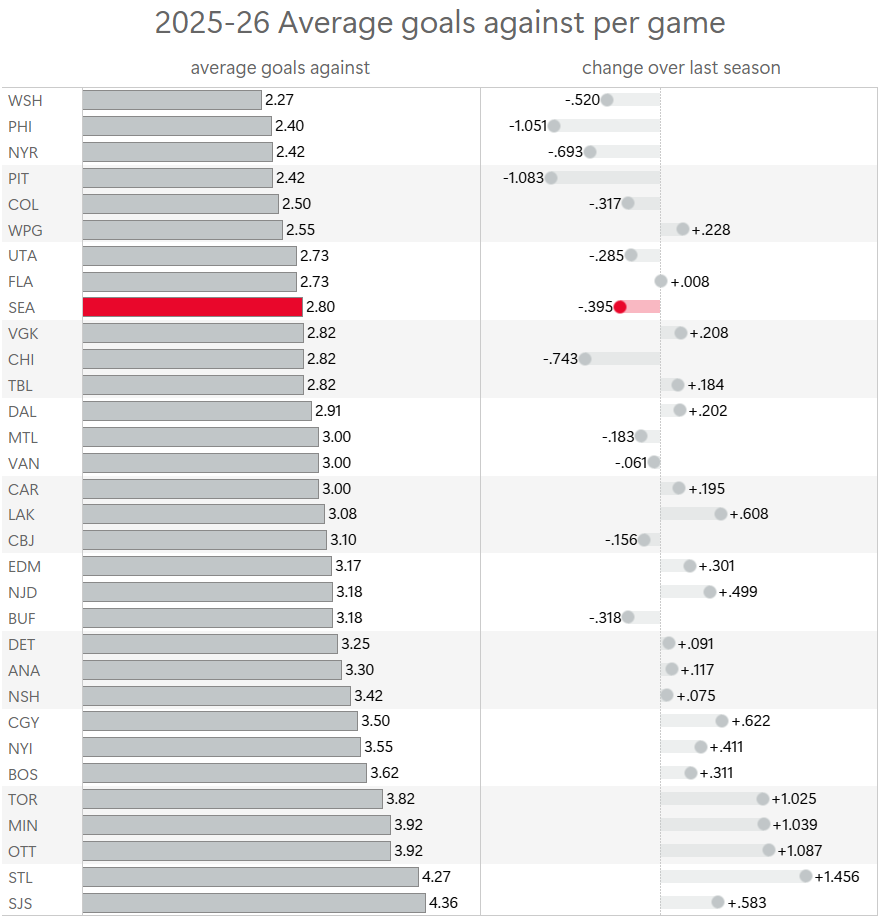
On the flip side, Kraken goal scoring is down a bit, but getting Kaapo Kakko and (hopefully) Jared McCann back should help boost that.
Data Point 7: Goal differential (excluding empty-net goals)
One data point I probably over-index to when evaluating teams is their goal differential excluding empty-net goals. My target for the Kraken to remain competitive and in the playoff hunt is around even to plus-five.
Right now, they sit at minus-one, which isn’t great on paper but isn’t alarming either. With the exception of the season opener against Anaheim, all of Seattle’s wins have come by a single non-empty-net goal, which explains why their differential trails their solid 5-2-3 record.
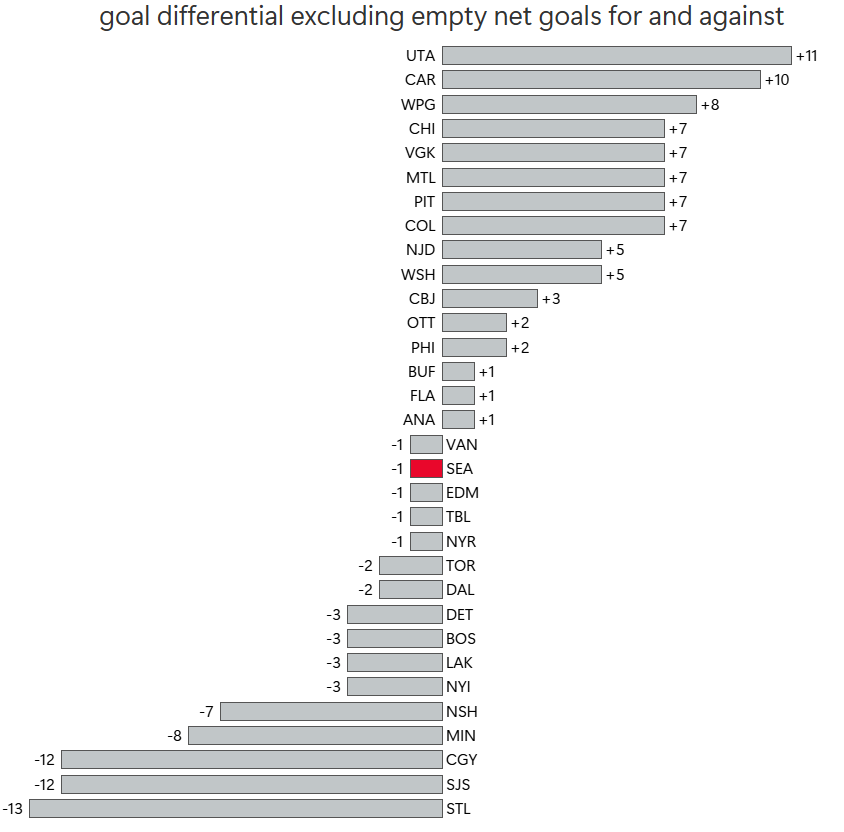
Last season’s Kraken were plus-five after 10 games (5-4-1). Considering this year’s injury issues, I’ll take that minus-one in stride.
Data Point 8: Games lost to injury or absence
It would be irresponsible to talk about the first 10 games without mentioning the injury bug that’s bitten this team since preseason. It started when Kaapo Kakko broke his hand on a slash in an exhibition game, and it’s snowballed from there.
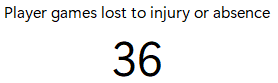
The good news: Ryker Evans and Kakko both appear close to returning, and Freddy Gaudreau is back skating.
Data Point 9: Berkly Catton’s ice time
One silver lining of all those injuries has been the opportunity for Berkly Catton to get NHL reps. His first two games coincided with Seattle’s roughest stretch of the season, but that also meant more ice time for him in situations where the Kraken were chasing offense rather than protecting leads.
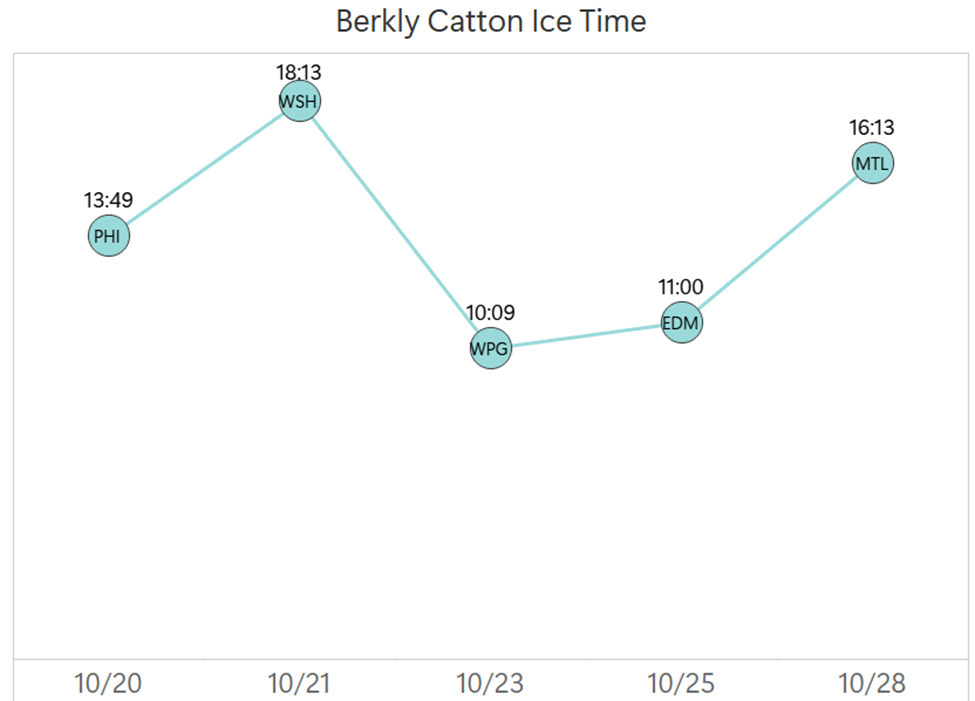
Catton is just four games away from burning the first year of his entry-level contract, so it’ll be interesting to see how the team handles him over the next few weeks. He’s clearly shown flashes of NHL skill, but he still makes the occasional high-risk mistake. With margins of victory this thin, every decision on his usage matters.
Data Point 10: Goalie starts
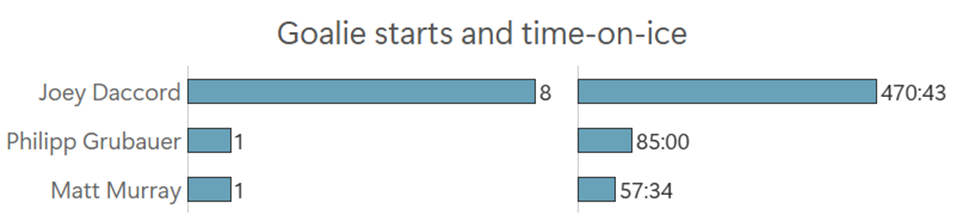
I was hoping these 10 games would clarify how the Kraken plan to manage their three-goalie situation, but honestly, it’s still hard to tell. For now, it looks like they’re just riding Joey Daccord except in back-to-back situations.
Wrapping it up
This series is a bit of an experiment, so I’d love to hear your feedback. Which metrics helped you understand the Kraken better, and which ones left you wanting more? I’ll adjust and evolve 10 for 10 as we go, so tell me what should make the cut for Games 11–20.