
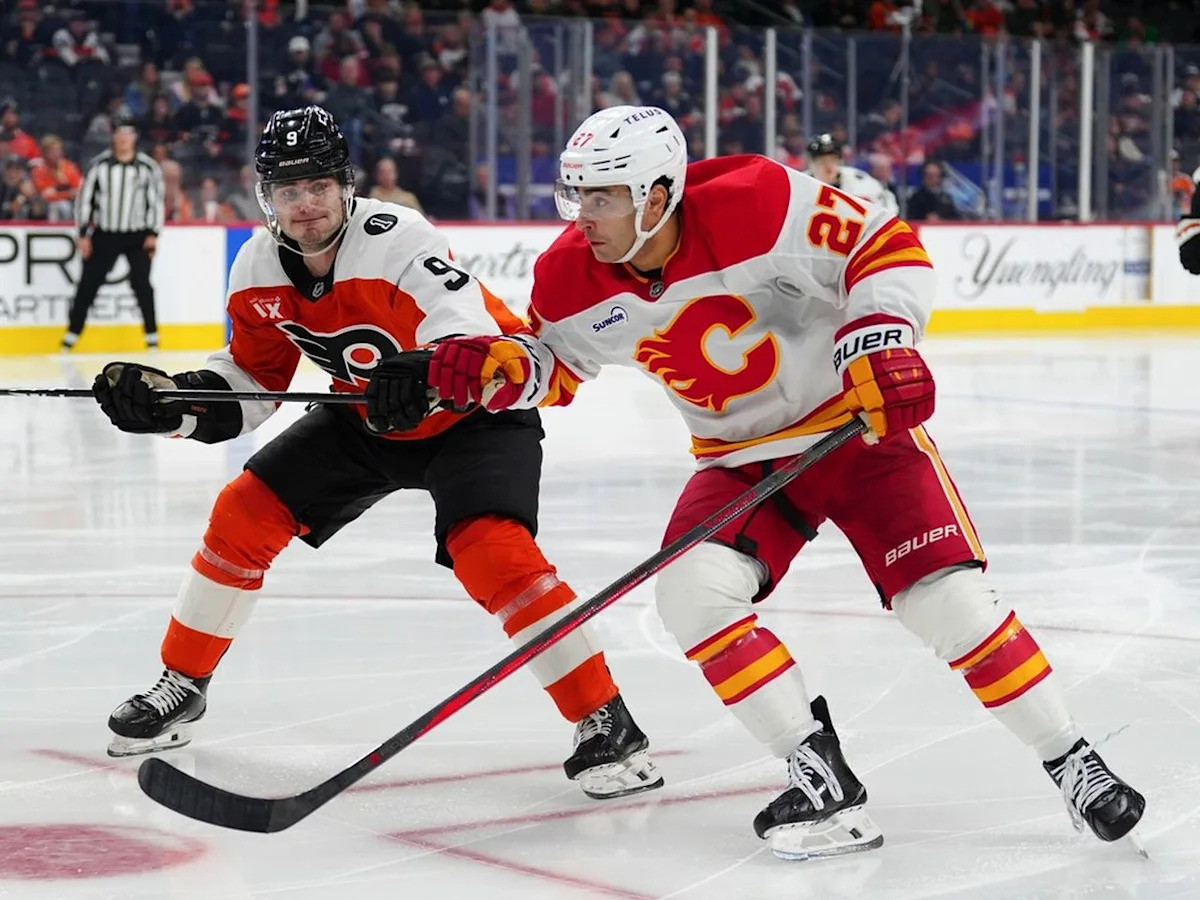
When a team starts the year with the worst record in the NHL, it’s easy to think things have gone off the rails because of the standings.
But in Calgary’s case, that misses the point. The problem isn’t that the Flames managed just six points through their first 12 games. It’s that almost none of their key young players are showing any signs of progress.
This was never supposed to be a season about contention.
Even before the puck dropped, the Flames weren’t considered anything more than a long-shot playoff hopeful. They were, at best, a modest bet to sneak into the postseason and a distant one to do any damage if they got there.
In truth, a poor record was always within the probable range of outcomes. If the team ends up near the bottom of the league, they will enjoy the silver lining of a high draft pick and a chance at a much-needed blue-chip forward.
But that only matters if the organization is actually moving forward in other ways. The true priority this year should be development. Meaning, the team needs to find out which of its younger players can eventually lead them out of mediocrity.
So far, the answer has been discouraging.
Matt Coronato was expected to take the next step after scoring 24 goals as a rookie and earning a $6.5 million per year extension. Instead, he’s looked lost. Four points in 11 games. Deeply negative shot and scoring chance ratios. Periodic scratches and line shuffling. The Flames paid him like a future pillar, but right now, he looks like a player still searching for a role.
Connor Zary, another (potential) piece of the club’s young core, hasn’t fared even worse. He’s had flashes of skill in his brief NHL career, but injuries and inconsistency continue to hold him back.
The big question for him and the organization this year was finding a role that would allow him to blossom. But through the first month if play, he managed just two points and spent time both on the fourth line and in the press box. Another big step back from someone the team needs to take major steps forward.
On the back end, Zayne Parekh entered the season as one of the most exciting prospects in hockey. The kind of dynamic offensive defenseman modern teams build around.
Instead, he produced a single assist through 9 games in October and averaged just over fifteen minutes of ice time per game. The coaching staff has been cautious with him, which is fine in theory, but he hasn’t yet found a rhythm or a consistent partner. The longer that continues, the more you wonder if this season will end up being a developmental step or a wasted one.
Sam Honzek has been a modest bright spot. The 20-year-old, Calgary’s 2023 first-round pick, made the team thanks to early injuries and has looked reasonably comfortable on a line with Mikael Backlund and Blake Coleman. But even he’s been quiet statistically, with just two points in eleven games. And while it’s encouraging that he looks NHL-ready, there’s a difference between fitting in and standing out, particularly when playing alongside two of the team’s most dependable veterans.
Players tend to excel next to the Backlund and Coleman duo, owing to their mature, straightforward play and two-way prowess, so it remains to be seen how Honzek would fare anywhere else in the lineup.
Matvei Gridin, another promising youngster who impressed in camp, was sent down to the AHL after just a handful of games once the roster got healthy. He’s performing well in the minors, but that only reinforces how few players under 25 are moving the needle in Calgary right now. The Wrangler’s lead scorer so far this year and through all of last year, Rory Kerins, didn’t even make the cut.
All of this would be less concerning if the Flames had a lineup already full of young, rapidly developing cornerstone talent. But they don’t.
The team’s best scorer is 35 years old. Their most reliable two-way forwards are 34 and 37. Their top two defensemen are 29 and 31. Most of the players driving the bus today aren’t the ones who will still be here when the Flames are ready to compete again.
That’s a problem.
Right now, the kids aren’t being asked to lead. They’re merely surviving, if they are in the NHL at all. Veterans still dominate the Flames’ roster, deployment, and ice time at the top of the rotation. And for a franchise that’s been spinning its tires since its last playoff appearance in 2022, it’s a dynamic that threatens to strand the club in neutral.
The truth is, Calgary’s record doesn’t really matter this season. If they finish near the bottom of the league, so be it. They were never going to seriously compete for the Stanley Cup. What matters is whether players like Coronato, Zary, and Parekh end the season as better, more confident, more capable players than they started.
If they don’t, then this year will have been worse than just another lost one in the standings. It will have been a failure of purpose.
Because if you’re not actively developing the next generation of core talent, you’re not rebuilding. You’re just waiting for the next reset. And that’s what makes the Flames’ early struggles more troubling than their record: not that they’re losing, but that they don’t seem to be growing the internal assets required to take the next, pivotal step forward.