
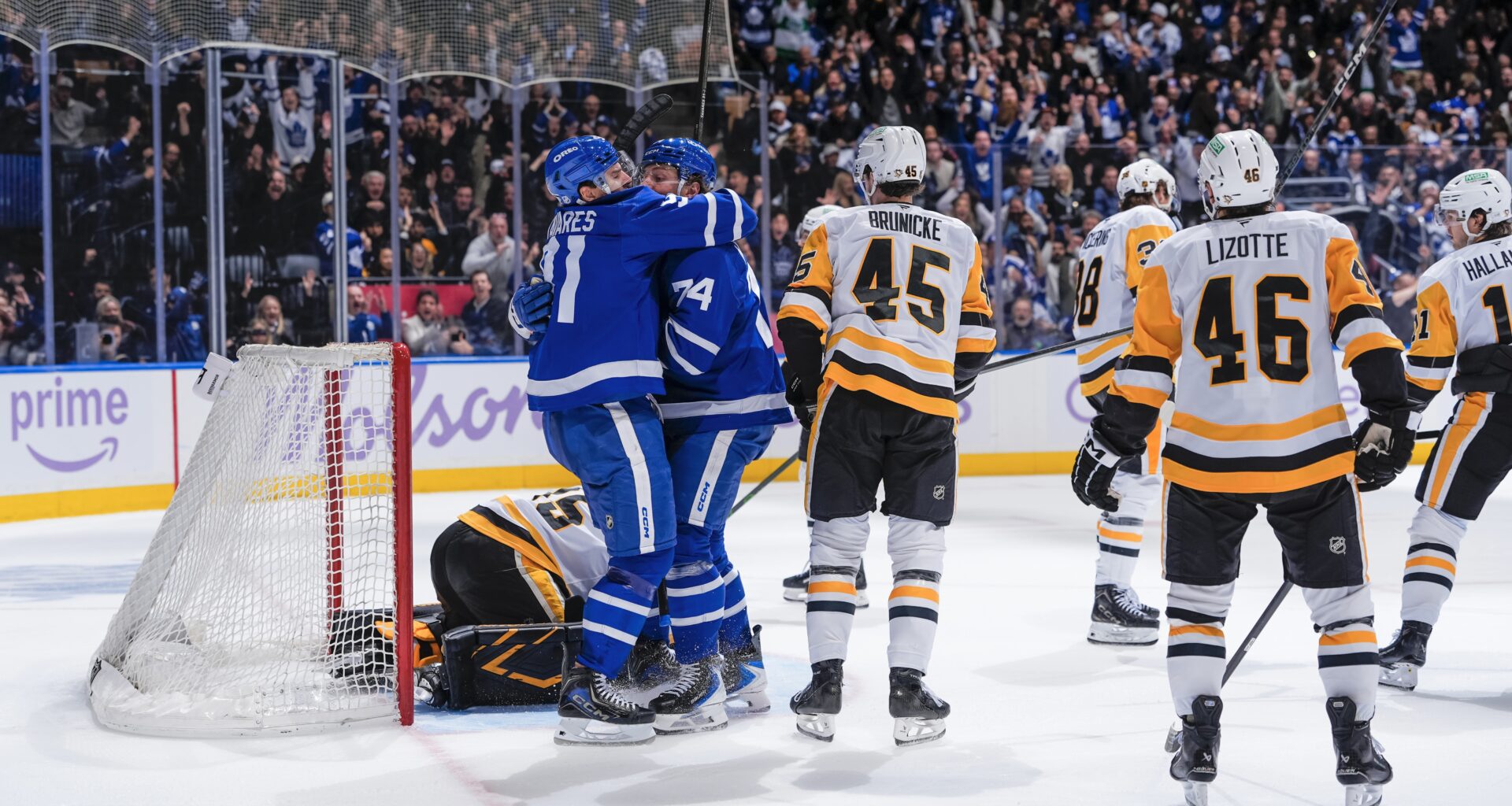
The Penguins appeared to be on track for maybe their most dominant win of the season Monday night, but an epic third-period collapse had them leaving Scotiabank Arena without anything to show for it, ending their road trip with a 4-3 loss to the Maple Leafs.
Through two periods, it wasn’t even close. Erik Karlsson’s first goal of the year and Ben Kindel’s first-ever two-goal game gave the Penguins a 3-0 lead, but that didn’t properly represent how dominant they were. They were outshooting the Maple Leafs, 25-8, including 17-3 in the second period alone. Shot attempts were similarly lopsided, 55-20, in the Penguins’ favor. They had a 10-4 edge in high-danger attempts, not conceding a single one in the second period.
It wasn’t even that the Maple Leafs dominated the third period. Really, it was fairly even. Shots on goal were exactly even, at 12 apiece. But in terms of quality of chances and possession, it was a back-and-forth period. But one of those swings in Toronto’s favor changed the entire game, with three goals coming in a span of 3:24 to tie the game.
The tight, connected effort defensively evaporated. The first goal wasn’t egregious, sure. Sidney Crosby lost the faceoff to Auston Matthews, and the puck to his winger William Nylander, who sent it back to defenseman Jake McCabe. By then, Matthews is nearing the far blue line and McCabe springs him on a breakaway. Crosby nearly caught up with Matthews in time, and Tristan Jarry had dropped a split-second sooner it’d be a pad save, but Matthews snaps the shot under his pads and gets Toronto on the board. It wasn’t a total breakdown, It wasn’t an awful goal from Jarry, but it sparked the shift.
Nylander made it a one-goal game 1:16 later. Just a total disjointed mess ended in Nylander backhanding a shot off the post and in:
It was at that point that Dan Muse called his timeout. I asked him afterward what his message was in that moment, and he explained that the decision wasn’t about sending a message at all.
“It was just to settle things down,” he said. “It was just to take a minute. You know, I think when that happens quick, we were hoping to settle in, maybe keep things a little bit quieter, just take a second, regroup. It didn’t work.”
It didn’t work because just over two minutes later the game was tied, with Nylander ripping a shot from the point. The freedom with which the Maple Leafs were able to move the puck around in the Penguins’ end leading up to the goal made it look like a Toronto power play:
The Maple Leafs completed the comeback with a fourth unanswered goal later in the period, with Bobby McMann going to the net and banging in a rebound. After allowing just one rebound attempt in the first two periods combined, the Penguins allowed a pair in the third period, and that’s what turned out to be the most costly.
Coming into the Leafs’ own barn, at the end of a long road trip, and losing by a goal to a star-studded team whose leading scorer was back from injury in and of itself wouldn’t have been a disaster by any means. But the feeling in the locker room afterward was of course that the Penguins had this game and gave it away.
“We just got too comfortable,” Harrison Brunicke told me, after he was on the ice for the second and last goals allowed. “This one stinks, for sure. I mean, it should have been us all the way, but I guess we just got a little bit too safe.”
Muse cited “a number of different factors” that led to the game turning the way it did.
“When they took momentum there, we weren’t able to at least pause the momentum,” Muse said. “It just kept coming, and then we’re back on our heels, and we can’t play the game that way. I mean, I think the things that were working there in the first two periods, I think they’re things that can be sustainable, but we got away from them and it can’t happen.”
Those good things that should have been sustainable were the way the Penguins were moving pucks and supporting pucks, and really limiting odd-man rushes against. Maybe limiting a team to three shots on goal isn’t always going to be sustainable, but the way the Penguins were at least limiting quality, dangerous chances could have been sustainable, to a degree.
“We got away from it,” Muse said.
A bad loss, sure. But the Penguins are 8-4-2, a point out of first in the entire league. Expecting them to keep racking up wins and points at this rate over the course of the season probably isn’t sustainable or realistic, but through this early stretch of the season they’ve showed that they can absolutely be competitive, and it’s not unreasonable to think that they might put themselves in a spot to return to the postseason this year.
And that, too, is what makes a loss like this one sting. Those were two points they squandered that could prove immensely impactful in April.
“It’s tough,” said Erik Karlsson. “I think losses like this are tough. This was a winnable game for us and might be points that we could have needed down the road. We’ve just got to hope that we can be on the other side a couple of times and take this one back.”