
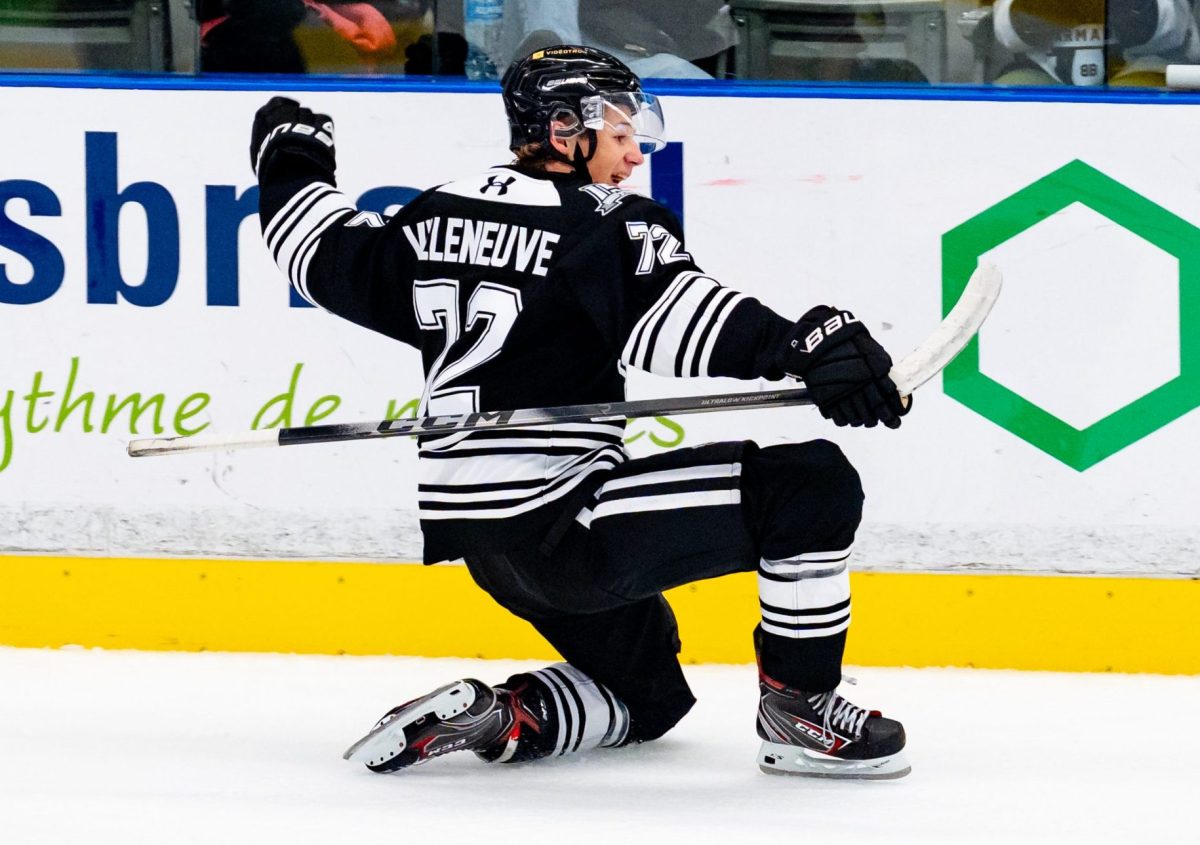
 Xavier Villeneuve (photo by Laurent Corbeil)
Time for another series at McKeen’s from our scouting staff. The 2026 NHL Draft season is well under way, and our scouts have been busy soaking in the action around the globe. Analyzing early season play can be difficult, perhaps even a bit of a ruse. Hot starts aren’t always sustainable, and cold starts are not always indicative. However, players can still catch our attention in positive ways and that’s what this series intends to highlight.
This is EASTERN CANADA PART ONE
Joey Fortin Boulay
Olivers Murnieks
Center – Saint John Sea Dogs
6-foot-1, 190 pounds
Murnieks has long stood out for Team Latvia, debuting on the U18 national team at 15 and joining the U20 squad a year later, where he quickly became one of its top players. After a full 2024–25 season with the Sioux City Musketeers in the USHL, where he recorded 35 points in 52 games as a DY-1 player, he was drafted sixth overall in the CHL Import Draft by the Saint John Sea Dogs and joined them for the 2025–26 season.
An intelligent, composed two-way center, Murnieks influences play through elite anticipation, impressive vision, and positional awareness. His processing speed allows him to see passing lanes before they open, regularly creating high-danger chances with deceptive, creative feeds. He’s not flashy but I find him remarkably efficient, displaying the habits and maturity of a veteran. On the power play or during breakouts, he maintains structure and poise, keeping lanes open and facilitating puck movement. He makes calm, calculated decisions under pressure, favoring smart redirections or recoverable plays over risky passes.
He impressed me by being defensively reliable and disciplined, showcasing excellent spatial awareness and stick positioning. His forechecking intelligence, particularly his sense of timing and pressure angles, makes him incredibly disruptive. He’s effective on the penalty kill, cleverly reading opposing power plays and forcing turnovers.
His work ethic and stamina are also notable strengths, enabling him to log heavy minutes and remain impactful late in shifts. With a strong, compact frame, he excels in board battles and net-front scrums, consistently winning positioning and getting above pucks. His soft hands in tight spaces, proficiency on faceoffs and ability to contribute on both special teams further enhance his value as a complete center.
Skating remains his primary area for improvement though. While strong and balanced, his stride can appear heavy and rigid, limiting his agility and acceleration. He can also struggle with puck control when handling difficult passes and occasionally defaults to safe plays when options close quickly. His shot also seems to lack confidence, often directed into the goaltender’s chest rather than the back of the net.
All in all, his hockey sense, maturity and consistency give him a high floor and make him a strong candidate to transition smoothly to the pro level. His playing style and reliability usually leads to winning hockey. In a draft class short on elite centers, he stands out as one of the most well-rounded pivots for the 2026 NHL Draft.
Bring on the Videos!
Now that’s turning elite defense into offense. Murnieks (#14) reads the play, intercepts the entry pass, and sets up his breakaway teammate, creating a 2-on-0 that results in a goal.
Murnieks shows his playmaking prowess here, receiving the puck while driving through the middle and delivering a neat crisscross drop pass to his teammate for the goal.
A great example of Murnieks’ assertiveness at the bumper spot. On the powerplay, his sole presence drags two defenders and as he receives the pass, then he sends a nifty backhand no-look feed to his flank teammate for a beautiful tic-tac-toe score at the backdoor.
Rian Chudzinski
Right Wing – Moncton Wildcats
6-foot-1, 190 pounds
A standout for Dexter Southfield School last season, where he posted 27 goals and 52 points in 28 games, Chudzinski is one of the few Americans who signed with the Moncton Wildcats for 2025–26, thanks to the new NCAA eligibility rule change. He’s also committed to play college hockey at Boston University, though he will join after completing his junior career.
He’s been a pleasant surprise so far this season, emerging as one of Moncton’s best scorers. His strengths lie in his remarkable hockey sense, scoring ability and hard-nosed style. He consistently reads and anticipates plays well, finding soft areas to free himself from coverage and supporting teammates effectively. He maintains composure when facing heavy forecheck and plays with high intensity, consistently playing within his strengths and his role.
Chudzinski demonstrates a powerful snapshot from the slot and uses deception to create scoring chances. His puck protection is nearly impenetrable, as he uses his body, shoulders, and back to shield the puck—absorbing contact, maintaining inside positioning, sustaining possession in high-traffic areas and even delivering the occasional reverse hit. He’s contributing as a net-front presence on the power play, proving to be a handful for opposing defensemen.
I was pleasantly surprised by his vision in transition, as he quickly identifies and attacks openings on counterattacks, delivering precise feeds on the rush. He possesses a powerful, balanced skating stride that allows him to generate momentum through turns and maintain control. He’s at his best in the middle of the ice, generating one-timers off the rush and finding weak-side trailers on odd-man opportunities. Defensively, he’s positionally sound, covers open men effectively and disrupts plays with active stickwork. His forechecking is relentless and his situational awareness allows him to recover quickly and sustain pressure.
However, he lacks some pace with the puck, which can cause plays to stagnate a bit. While he executes dump-in entries effectively, developing a more explosive stride could enhance his ability to beat second waves. Additionally, his physical but occasionally undisciplined playing style leads to a relatively high penalty rate, which needs better calibration to avoid hurting his team. I’m eager to see how he develops this season under the guidance of Gardiner MacDougall and as part of a talented Moncton team.
Bring on the Videos!
Here, Chudzinski (#22) gives a glimpse of his scoring ability off the rush, freezing the goaltender in overtime with a beautiful top-shelf finish.
Watch Chudzinski lead the forecheck here. He’s in first, pinning the 6-foot-4” Will Murphy behind the net. As the scrum builds and the opposing team swarms, Chudzinski stays strong on the puck and supports his teammate, helping them win the battle and come out with possession.
A great example of Chudzinski’s underrated vision in transition here. After the recovery, his team breaks out, and Chudzinski (#36) jumps in as the trailer. He takes the drop pass, surveys the ice, and threads a gorgeous backdoor feed to his teammate cutting in on the weak side.
Michel Myloserdnyy
Defense – Gatineau Olympiques
6-foot-6, 214 pounds
Myloserdnyy joins the list of prospects whose raw skill set, and towering frame make him an intriguing player for scouts. He began his junior career last season with the Gatineau Olympiques after joining midseason from Stanstead College, appearing in 29 regular-season games and 5 playoff contests. Though his statistics were modest, he demonstrated a strong defensive game and physical presence as a 17-year-old adjusting to major junior hockey.
He stands out as a lofty, physically dominant defenseman who combines reach and aggression to impose himself defensively. At 6-foot-6, he’s exceptionally difficult to beat one-on-one, using his length to steer puck carriers wide and deny zone entries. His defensive-zone coverage is both smart and assertive, marked by active stick positioning and well-timed engagements. He consistently boxes out net-front threats and clears rebounds decisively.
Myloserdnyy plays with a mean, intimidating edge that sets the tone for his team. He’s fearless and relentless, engaging with authority in board battles and making opponents pay the price. His style projects well for playoff hockey, where his blend of reach, bite and suffocating defense becomes even more valuable. He usually remains poised under pressure, executing clean, well-timed breakouts through short, accurate passes or controlled use of the boards. His pre-retrieval scanning shows pro-level awareness, identifying outlets before gaining possession.
While defensively sound, his offensive involvement remains limited. He tends to play conservatively at the blue line, keeping pucks deep and rarely attacking the middle. When given space, however, he’ll attempt subtle fakes or lateral movements to open shooting lanes or advance play toward the slot. Despite his large frame, he’s a reasonably fluid skater, even when backpedaling, though his first-step acceleration and pivots from a standstill still need improvement. Those deficiencies can occasionally affect his recovery when he’s caught flat-footed.
Discipline is another area for refinement. While his physical edge generally benefits his team, he can sometimes cross the line and take unnecessary penalties when emotions run high. I’ll be keeping a close eye on his development this season, as his combination of size, reach and punishing defensive play could intrigue NHL teams, particularly those seeking a physically dominant, playoff-style defender.
Bring on the Videos!
In this sequence, Myloserdnyy (#5) showcased his strong rush defense, reach and physicality, denying zone entries, helping his team regain possession and successfully exit their zone.
Here’s another example of Myloserdnyy’s rush defense and disruptive physicality. He steers the play to the perimeter with his reach, deceives the opponent into thinking he’s playing the puck, then engages the body and delivers a blistering open-ice hit.
As the opponent dumps the puck into Gatineau’s zone, Myloserdnyy shows great hand-eye coordination by knocking the puck out of the air, recovering it and finding his breakaway teammate with a crisp stretch pass.
Here’s a bonus clip: Myloserdnyy is always ready to stand up for his teammates — cross the line with them, and you’ll have to answer to him.
Jamison Derksen – North American Video Scout
Xavier Villeneuve
Defense – Blainville-Boisbriand Armada
5-foot-11, 162 pounds
Xavier Villeneuve looks like an early candidate to get selected in the first round of the 2026 NHL Draft despite the fact that he checks in at 5-foot-11 and not a single sub-six-foot defenceman was drafted last year. The diminutive blueliner is an offensive force in the QMJHL, as he was over a point per game last year in the QMJHL and is already at 20 points this season, good for second in league scoring. He also leads the Blainville-Boisbriand Armada in ice time as he plays in all situations for the club.
Villeneuve is a handful to contain in the offensive zone, his elite skating and top notch puckhandling are reminiscent of other young, smaller offensive dynamos such as Lane Hutson and Zayne Parekh. He moves effortlessly and seems to create offense every time he touches the puck. When defending, he relies on excellent skating and nifty stickwork to force turnovers. His shot could be harder, and he definitely needs to get stronger, but his elite attributes should carry him to the next level even as a small defenceman.
Bring on the Videos!
It’s a beautiful goal, but the puckhandling and skating on full display are pretty routine for Villeneuve, this is how he piles up points the way he does.
Picks up puck, dekes past opponent, immediately becomes a scoring threat, feeds his teammate for an open shot.
There will never be a debate that Villeneuve’s size is not a factor that he needs to overcome in order to defend effectively, but his skating is so elite and his stickwork is strong enough that he is able to steal pucks and kill plays on the rush.
Felix Sicard – North American Video Scout
Benjamin Cossette-Ayotte
Defense – Val D’Or Foreurs
6-foot-1, 185 pounds
Cossette-Ayotte has all the tools to be a long-time pro. As a 6-foot-1 right-shot defenseman, he checks boxes that teams covet. However, it’s his skating that really draws the intrigue. His four-way mobility has stood out this season, where you’ll often see him seamlessly transitioning from a forward stride to a backward stride, or a change of direction.
The Foreurs defenseman uses that mobility effectively. He hounds opposing puck carriers, both in open ice and along the boards, then deploying his longer reach to disrupt stickhandling sequences.
Once he has the puck, he flashes some advanced breakout sequences, looking off forecheckers before slipping a puck over to a teammate. Of course, that creativity can cut both ways at times, as he’s still finding the balance between making the simple play, and the advanced one. However, the fact that he’s already manipulating opponents on the breakout is promising.
Cossette-Ayotte is also a willing offensive player, looking for seams at the offensive blueline, jumping up into the play, and firing off calculated point shots. There’s still a lot of work to be done both physically and in his risk-reward calculation, but he possesses what it takes to potentially be an impact player at the next level.
Here, Cossette-Ayotte takes a good angle to the oncoming forward, then closing off time and space by laying the body. He then seamlessly gathers the puck and makes a bump pass along the end boards. This shows both his play killing ability, as well as his breakout fundamentals.
Here, Cossette-Ayotte smartly tracks the backdoor option, before sprawling out to block a chance on net. This shows how he’s able to use his length and defensive smarts to negate opposing chances.
Here, Cossette-Ayotte quickly gathers a puck in the defensive-zone, before lobbing it all the way down the ice to spring a breakaway. This shows that he’s able to quickly read the ice and make a creative play, knowing what to do before he even has the puck.