
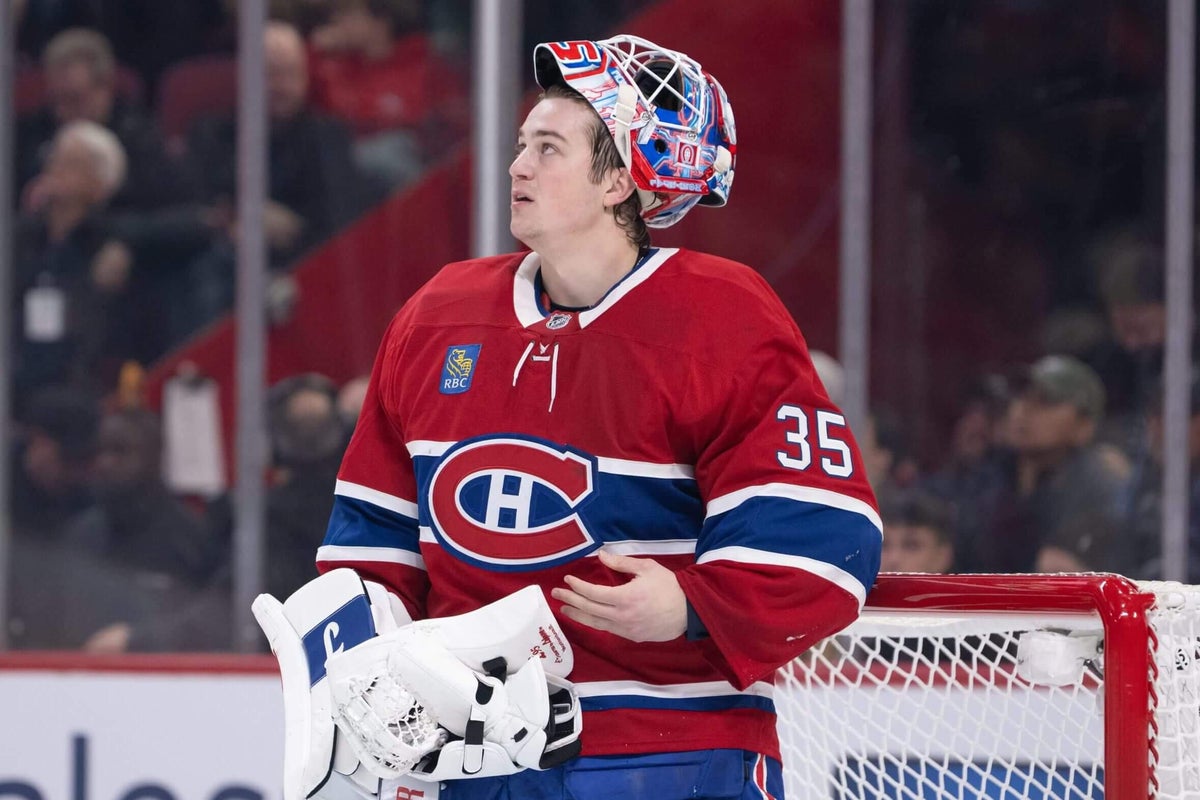
MONTREAL — The Montreal Canadiens had a game like this in them, one where nothing seemed to work, passes were not connecting and players were not connected.
They’ve earned a pass, because Tuesday night’s 5-1 loss to the Los Angeles Kings on home ice dropped their record to 10-4-2. The sky is not falling. Everyone has a bad day at work from time to time.
But at the same time, the Canadiens should also take a look at what happened against the Kings — a team they haven’t beaten since the pandemic — as a lesson.
The Canadiens are the youngest team in the league, the Kings are the oldest. At the first TV timeout, the Canadiens showed a video tribute to Joel Armia, one of four members of their 2021 team that reached the Stanley Cup Final to suit up for the Kings in this game, but the most recent one to leave.
Armia got a warm ovation from the Bell Centre crowd that seemed to catch him a bit by surprise.
Rebienvenue à Joel Armia!
Welcome back, Army! @LAKings pic.twitter.com/aWk1sUPL8c
— Canadiens Montréal (@CanadiensMTL) November 12, 2025
Armia wanted to stay in Montreal, but he was allowed to leave as a free agent because the Canadiens needed room for their young players, for an infusion of talent. They knew he would leave a hole behind, similar to the hole left behind by another free agent departure, Christian Dvorak, or the one left behind by the retirement of David Savard.
The result was the Canadiens would get more talented, but younger.
How many times this season have the Canadiens held a lead in the third period only to allow it to slip away, to fall victim to immature play or a lack of situational awareness?
Or, in other words, how many times did they fail to display the kind of maturity the Kings displayed as soon as they scored three goals in four minutes early in the second period to turn a 1-0 deficit into a 3-1 lead?
“I would say the difference is we fell asleep at the wheel for three minutes in the second and they’re a veteran team, they shut it down,” Canadiens coach Martin St. Louis said. “They tightened up and it wasn’t easy for us. Our execution wasn’t there to break that down.”
A part of St. Louis had to be watching the Kings shut it down for the final 35 minutes and feel a bit jealous. The Canadiens weren’t executing, that’s true, but the Kings were not allowing them to execute. East-west passes in the neutral and offensive zones became turnovers, and when they reached their targets they were bouncing off sticks. Shots were hitting Kings shin pads almost as often they were hitting the Kings net.
The Kings improved to 6-0-0 this season when leading after two periods, and they are now 41-1-2 under those circumstances since the start of last season. This season alone, the Canadiens have lost as many games when leading after two periods as the Kings have since the start of last season, and their 4-1-2 record in those situations masks the two times this season the Canadiens entered the third period with a lead and needed overtime to win.
“We were able to generate, but once they took the lead, we didn’t have the execution to go create some plays,” St. Louis said. “It takes execution when you’re playing a team that tightens things up. There wasn’t a lot of space to make little passes.
“That’s a veteran team, they’re a tough team to play against when they lead by two or three goals in the third.”
The Canadiens had ample opportunity to make it so the Kings did not lead by two or three goals. Ivan Demidov was all alone in front of Darcy Kuemper less than five minutes into the game and his quick shot was stopped. They had a five-on-three power play for more than a minute in the first period that resulted in one shot on goal.
They did still manage to enter the first intermission with a 1-0 lead, but once Joel Edmundson cranked a 97 mph slap shot past Sam Montembeault off a clean Kings faceoff win in the Canadiens zone, and once the Canadiens allowed their league-worst fourth goal of the season while defending at five-on-six because of a delayed penalty call exactly three minutes later, it was essentially game over.
The Kings deserve credit for that. And the Canadiens can most definitely learn a lesson from that.
But St. Louis also likes to talk about a player’s ability to have their B-game and still contribute to the team, still find a way to have an impact. But a young team also needs to learn how to manage situations where they collectively have their B-game, where connectivity is lost, whether that’s because you’re not sharp or because your opponent is simply not allowing you to be connected.
“We obviously talk about it, there’s nights we’re not going to be at our best,” defenceman Noah Dobson said. “You’ve got to find a way to grind through, simplify, just try to get pucks in and get on the forecheck. I don’t think we did a good enough job of that with the turnovers through the neutral zone. It’s something we can be better at for sure.”
And sometimes, having your B-game and being a bit stifled calls for something different, something more tangible than simplicity. It calls for anger.
“Yeah, if you’re not feeling it that night, try to find another way you can contribute,” said Josh Anderson, the Canadiens’ lone goal scorer. “Obviously, being a little bit more physical. I think I’ve got to do a better job in that department tonight and lead in that way, but I think everybody else can help out. If they’re not feeling it, a lot of those guys are on every game, so when they’re not, can they have a little (anger) to their game?”
Anderson didn’t specify who he meant by “they” but it’s not hard to figure out. He means every other forward line on the team, the three offensive lines who “are on” every game.
He didn’t specifically say so, but can the added talent on this team show some anger, some pushback, when things aren’t going their way? The Canadiens haven’t really had a game like this, so it’s hard to know. But the fact Anderson is asking that question is somewhat indicative of another lesson to be learned.
Still, that is the less important lesson of the night.
The Canadiens, again, have earned the ability to move past this one game. It is, by and large, a one-off, and St. Louis continuously says he does not worry about one-offs.
But the important lesson to be learned is the example the league’s oldest team gave on how to behave with a lead, and it is one the league’s youngest team needs to absorb.